
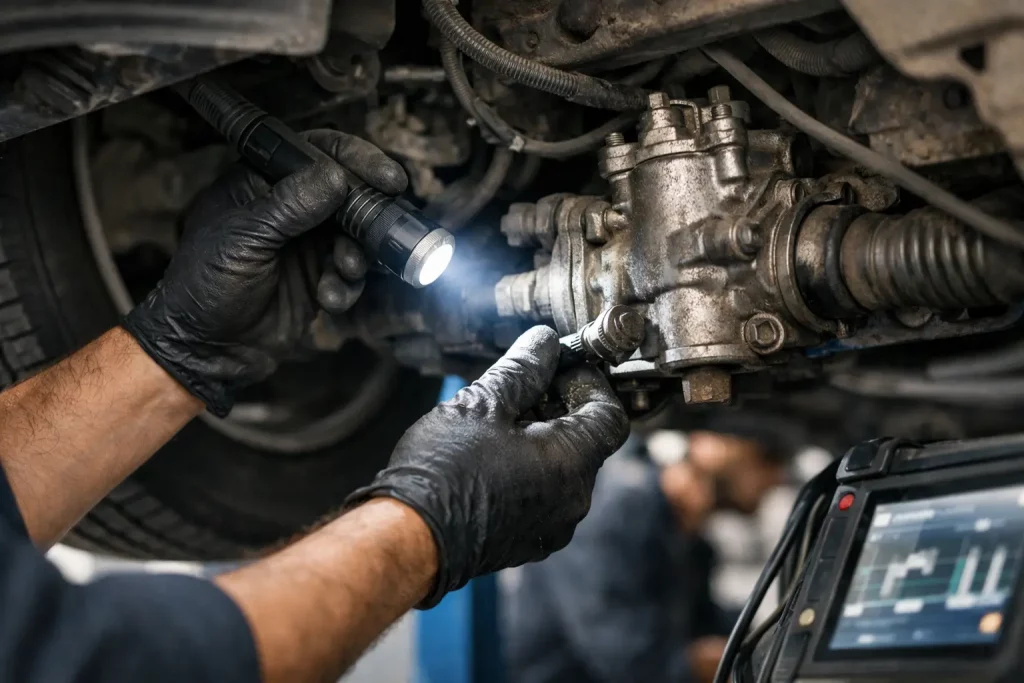
A steering box can wear gradually enough that a driver adapts to it without noticing. The car may need small corrections on a straight road, feel vague as it comes out of a bend, or develop a knock that appears only over uneven surfaces. Knowing how to diagnose steering box faults properly helps separate a genuine box problem from wear elsewhere in the steering and suspension system.
Steering boxes remain common on many classic vehicles, older 4x4s, commercial vehicles and certain specialist applications. Unlike a steering rack, a box converts steering-wheel movement through an internal gear mechanism and a drop arm. The system can provide durable, predictable steering, but its diagnosis needs to account for the box itself, its mountings, linkage and, where fitted, power-assistance components.
Start with the character of the steering fault
The most useful diagnosis begins with a precise description of what the vehicle does, rather than an assumption about the failed part. Excessive free play at the steering wheel is a common concern, but it does not automatically mean the steering box is worn. Play can also come from the column couplings, universal joints, drop arm, track rod ends, drag link, idler arm or suspension joints.
A steering box fault is more likely where the steering wheel turns noticeably before the drop arm responds, particularly if the movement can be seen while the vehicle is stationary. This needs checking carefully and safely: one person moves the steering wheel through the free-play range while a competent technician observes each connection in sequence. The point at which movement is lost is often more revealing than the amount of movement felt at the wheel.
The nature of the symptom matters. A consistently vague straight-ahead position suggests internal wear or incorrect adjustment, while a tight spot, roughness or resistance at a particular part of the steering sweep can point to internal gear or bearing damage. Steering that is heavy in both directions may have a different cause altogether, depending on whether the vehicle uses manual or hydraulic assistance.
How to diagnose steering box play accurately
A specialist inspection should establish whether the apparent play is internal to the box or being introduced before or after it. The steering wheel and column should be checked first, followed by the input shaft at the box. If the input shaft moves promptly but the drop arm hesitates, the box requires closer attention.
On a worn steering box, internal clearance can develop between the worm, sector shaft and associated bearings. The vehicle may wander, require repeated corrections, or feel less settled on cambers. Some boxes are designed with an adjustment mechanism, but this is not a universal cure for looseness.
Adjusting a steering box simply to remove free play can create a more serious issue if the internal components are worn. Many designs have their tightest operating point around the straight-ahead position. An over-tightened adjustment may make the steering bind or fail to self-centre correctly away from centre. That is why adjustment should follow the manufacturer’s procedure and only after the rest of the steering linkage has been assessed.
A useful professional check is to measure steering-wheel free play against the manufacturer’s specification where available, while confirming the road wheels are in the true straight-ahead position. A box can feel acceptable on a ramp yet still show poor on-road control if wear, alignment or tyre condition is contributing to the complaint.
Check the drop arm and box mountings
The output side of the box deserves as much attention as the internal mechanism. A loose or worn drop-arm spline, securing nut, idler arm or drag-link joint can closely imitate a worn steering box. On vehicles with chassis-mounted boxes, damaged or fatigued mounting points may allow the box to shift under steering load. This can produce a delayed response, creaking, knocking or an unsettling change in direction when manoeuvring.
Mounting movement is particularly relevant on older vehicles and hard-worked 4x4s, vans and commercial applications. The box may be mechanically sound, while the chassis bracket, fasteners or surrounding structure require repair. Reconditioning the box alone would not correct that fault.
Look for leaks, contamination and physical damage
On hydraulic steering boxes, fluid leakage is an important diagnostic clue but not proof that the complete unit has failed. Fluid around the input seal, sector-shaft seal or end cover can indicate aged seals, shaft wear or internal pressure issues. A clean inspection is needed because fluid can travel across the casing from another component and make the box appear to be the source.
The condition of the fluid can also help build the picture. Dark, burnt-smelling or contaminated fluid may indicate system deterioration, while metallic debris can raise concern about internal damage. However, the wider system must be considered before deciding on repair. A reconditioned steering box fitted to a contaminated system is at risk of repeat failure.
Physical damage to the casing, impact marks near the drop arm, damaged hydraulic ports or corrosion around seals should be documented. On classic and specialist vehicles, previous repairs, non-standard linkages or incorrect components can complicate diagnosis. Identifying the exact steering-box specification is essential before sourcing parts or planning refurbishment, especially for Right Hand Drive applications where a superficially similar unit may not be correct.
Distinguish steering-box faults from alignment and tyre issues
Poor directional stability is not always caused by steering-box wear. Wheel alignment, tyre pressures, tyre construction, uneven tread wear and worn suspension bushes can all make a vehicle pull, tramline or feel imprecise. A steering box with moderate but serviceable wear may feel much worse when combined with incorrect toe settings or deteriorated suspension components.
Conversely, wheel alignment should not be used to disguise a steering fault. Alignment readings are only meaningful when steering and suspension joints are secure and the steering box is correctly centred. If the box has excessive internal play or a central tight spot, setting the steering wheel straight during alignment may not deliver a safe, consistent result on the road.
A road test by an experienced technician remains valuable. They can assess self-centring, straight-line stability, steering effort, kickback and whether symptoms change under braking or over road imperfections. These details often distinguish a steering-box concern from a suspension, tyre or brake-related issue.
When reconditioning is appropriate
A steering box is often a suitable candidate for component-level reconditioning where the casing and core components remain viable. The unit can be stripped, inspected and rebuilt with appropriate OE or OE-quality parts where applicable, then tested before it leaves the workshop. This can be a practical alternative to replacing an entire unit, particularly where a new steering box is expensive, unavailable or unsuitable for a specialist vehicle.
There are limits. Severe casing damage, unavailable hard parts, extensive corrosion or previous incorrect modifications may make refurbishment uneconomical or impossible. Some vehicles also require additional work once the box is refitted, such as wheel alignment, steering-wheel centring or checks to associated linkages. The right repair path depends on the exact fault and vehicle specification, not simply the age of the unit.
For garages and owners, supplying clear information speeds up the assessment: vehicle registration or chassis details, steering-box part numbers, whether the vehicle is Right Hand Drive, the symptoms experienced and photographs of the unit where possible. If the box has been removed, protecting the ports and input shaft during transport helps preserve the evidence needed for inspection.
Choose diagnosis before replacement
Steering is a safety-critical system, and replacing parts by guesswork can leave the original fault unresolved. A methodical diagnosis should identify where movement, resistance or leakage begins, assess the condition of connected components, and confirm whether reconditioning, replacement or related chassis work is required.
Pro Power Steering can assess suitable steering boxes at component level, support fitting garages with technical advice and provide tested reconditioned units where a repair is viable. The aim is not to force every steering issue into a box replacement, but to return the vehicle to smooth, precise and dependable steering with the work that its condition genuinely requires.
If the steering feels vague, heavy, inconsistent or noisy, avoid treating it as a minor inconvenience. An accurate inspection now can protect tyre life, improve vehicle control and prevent a developing fault from becoming a more involved repair.
