
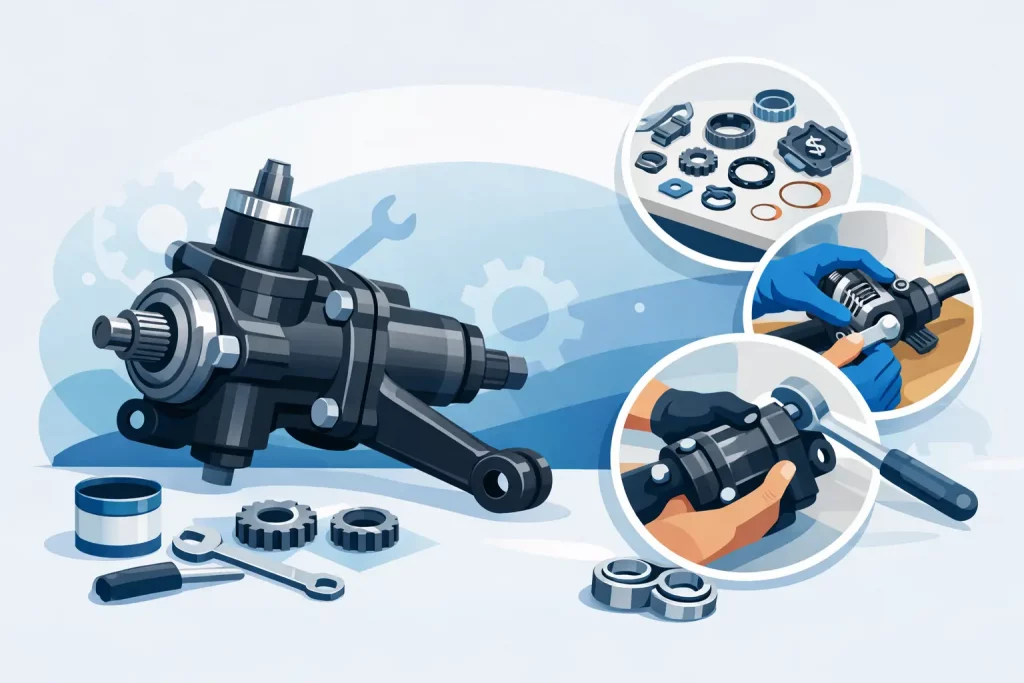
A steering wheel that needs constant correction, feels vague around the straight-ahead position or develops a noticeable tight spot can make an otherwise sound vehicle tiring and uncertain to drive. Manual steering box refurbishment addresses those faults at their source, restoring the internal control and adjustment that allow the steering to feel direct, predictable and safe.
Manual steering boxes are most commonly found on classic cars, older commercial vehicles, 4x4s and certain performance or specialist applications. They are durable assemblies, but they are not maintenance-free for life. Decades of load, road contamination, ageing lubricant and imperfect adjustment can wear the components that control the relationship between steering-wheel movement and road-wheel response.
What a manual steering box does
Unlike a steering rack, which moves laterally to turn the wheels, a steering box converts rotation from the steering column into movement through a drop arm and steering linkage. Depending on its design, it may use a worm and sector shaft, recirculating balls, or a cam-and-roller arrangement. Each system is designed to multiply driver input while retaining a controlled amount of internal clearance.
That clearance matters. A box set too loose creates excessive free play and delayed response. Set too tight, it can bind, wear rapidly and fail to self-centre correctly after a corner. The correct setting is therefore not simply a matter of tightening an adjuster until the steering feels firmer. It must be established around the box’s centre position and to the manufacturer’s specification.
On a classic vehicle, slight steering movement before the wheels react may be normal. The question is whether the movement is consistent, whether the vehicle holds its line, and whether the steering remains smooth through the full range of travel. A specialist diagnosis separates normal characteristics of an older design from wear that requires attention.
Signs a steering box needs refurbishment
Free play at the wheel is the symptom most owners notice first. You may turn the steering wheel several centimetres before the vehicle begins to respond, particularly when travelling straight ahead. That can make a car wander on uneven roads or demand repeated small corrections at motorway speed.
Other signs include a knock transmitted through the steering wheel, stiffness in one part of the lock, poor self-centring, a loose or notchy feel, and visible lubricant leakage from seals or shaft areas. In severe cases, the steering may feel different when loaded in a bend compared with when the vehicle is stationary.
These symptoms do not automatically condemn the steering box. Wear in track rod ends, drag links, idler arms, suspension bushes, steering-column joints and wheel bearings can produce very similar complaints. Incorrect wheel alignment and tyre condition can also disguise themselves as a steering fault. Replacing or refurbishing a box before checking the whole steering linkage risks unnecessary cost and leaves the original problem unresolved.
A proper inspection starts with the vehicle safely raised and the steering system checked methodically. The technician assesses play at the steering wheel, input shaft, drop arm and associated joints, while also checking for casing damage, loose mountings and evidence of previous incorrect adjustment. This establishes whether the box is the source of the problem and whether any related components need attention before the vehicle returns to the road.
Manual steering box refurbishment is more than a reseal
A leaking steering box is sometimes treated as a simple seal replacement. That can be appropriate where inspection confirms that shafts, bearings and internal gears remain within tolerance. However, seals often fail because wear has allowed movement where there should be controlled support. Fitting new seals without correcting the underlying wear can provide only a short-term result.
A full manual steering box refurbishment begins with careful dismantling and cleaning. The condition of the worm, sector shaft, roller, ball guides, bearings, races, bushes and shaft surfaces is assessed. Components are measured for scoring, pitting, wear patterns and loss of hardening where applicable. The casing and mounting points are also examined, particularly on older vehicles where corrosion or damage may affect alignment.
Worn or damaged serviceable parts are replaced with suitable quality components. Where specialist machining, bushing work or shaft restoration is required, it must preserve the original geometry rather than merely remove visible damage. The objective is to restore controlled movement throughout the assembly, not to make it artificially tight.
Reassembly is followed by accurate preload and mesh adjustment. This is a critical stage, especially on worm-and-sector designs. The box should have the correct centred resistance, smooth travel towards full lock and no excessive tightness. It is then filled with the correct lubricant and tested for smooth, repeatable operation before fitting.
Why adjustment alone is rarely the answer
Many manual boxes have an external adjustment screw, which can tempt owners or workshops into making a quick correction for steering play. Used correctly, that adjuster compensates for limited, specified wear. Used as a cure-all, it can make a worn steering box worse.
The sector shaft and worm generally experience their greatest wear near the straight-ahead position, because that is where the steering spends most of its time. Tightening the adjustment to remove play at centre can make the box excessively tight once turned away from centre, where the gears may be less worn. The result can be a heavy steering action, reluctance to self-centre and accelerated internal damage.
If the steering was previously free but has become heavy after adjustment, the setting should be checked without delay. A steering system must not be tuned by feel alone. Correct refurbishment uses inspection, measurement and controlled adjustment to achieve a safe balance between response and freedom of movement.
Refurbishment or replacement?
The right answer depends on the vehicle, the condition of the original unit and the availability of correct replacement parts. For many classics and specialist vehicles, refurbishment is often the better route because the original steering box is built for the vehicle’s mounting arrangement, steering geometry and right-hand-drive configuration. A modern substitute may require modifications that compromise fitment or originality.
A reconditioned exchange unit can be practical where a suitable unit is available and the vehicle needs to return to service quickly. It can also offer a predictable repair route for trade customers. However, the reconditioned box must be correct for the exact application. Similar-looking steering boxes can differ in input spline, drop-arm position, ratio, mounting pattern and handedness.
A new unit can be the sensible choice where it is genuinely available from a reputable source and offers the correct specification. Yet new old stock may have ageing seals, while lower-cost pattern parts can vary in material quality and machining accuracy. Price alone is not a reliable guide to suitability in a safety-critical steering component.
For vehicles where originality, fitment and steering feel matter, a specialist assessment of the existing unit is usually the most informed first step. It identifies whether refurbishment is viable before an owner commits to a replacement that may not deliver the same result.
Installation and checks after repair
Even a correctly refurbished steering box will not perform properly if it is installed out of centre, connected to worn linkage parts or followed by inaccurate alignment. Before fitting, the steering wheel, box and road wheels must be positioned correctly. The box should be centred at its designed high point before the steering linkage is adjusted.
Once installed, all fixings should be tightened to the vehicle manufacturer’s specification and the steering checked from lock to lock with the wheels unloaded and loaded. There should be no binding, interference or abnormal movement at the column, mounts or linkage. Wheel alignment should then be checked, because toe settings have a direct effect on straight-line stability and steering response.
A road test confirms the final result. The steering should move smoothly, return naturally after normal turns and hold a consistent line without excessive correction. On older vehicles, the aim is not to make the steering behave like a modern electrically assisted system. It is to restore the precise, dependable character the original design was intended to provide.
For owners, restorers and workshops, the value of specialist steering work lies in getting the diagnosis right before parts are changed. Pro Power Steering approaches steering boxes as safety-critical mechanical assemblies, with refurbishment based on component condition, correct set-up and final testing. A properly restored manual steering box gives the driver something more useful than a lighter wheel or a tidier appearance: clear feedback, accurate control and the confidence to use the vehicle as it was meant to be driven.
