
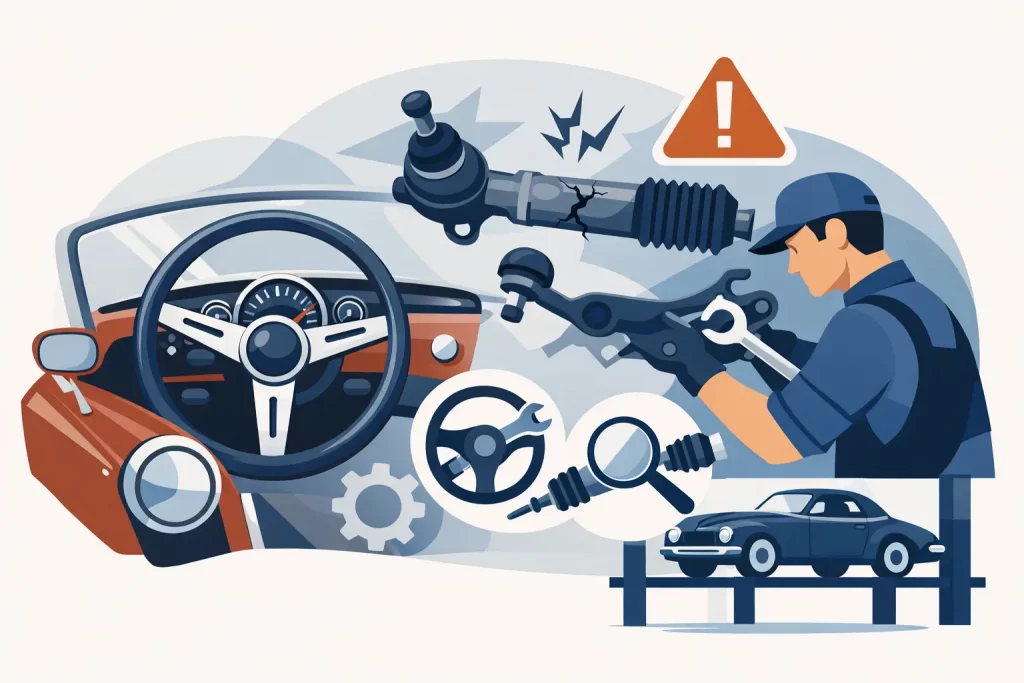
A classic car can look superb, start cleanly and still feel disappointing on the road if its steering is worn or incorrectly set. Classic car steering is not simply about turning the front wheels. It determines straight-line stability, cornering confidence, steering weight and the feedback that makes an older vehicle enjoyable to drive.
Unlike many modern systems, classic steering often gives the driver a direct mechanical connection to the road. That makes faults easier to feel, but not always easier to diagnose. A vague wheel, wandering under braking or a heavy spot through a bend can originate in the steering box or rack, column joints, mountings, suspension components or wheel alignment. Accurate diagnosis is the difference between restoring the car properly and replacing parts without resolving the cause.
Why Classic Car Steering Feels Different
Many classic vehicles use a manual steering rack, a recirculating-ball steering box or an early hydraulic assistance arrangement. Their design, geometry and tyres were developed for a different era of motoring. Some steering weight at parking speeds may therefore be normal, particularly on a car with narrow steering-wheel leverage, wider modern tyres or no assistance.
What should not be accepted as normal is excessive free play, inconsistency, knocking, binding or a need for continual correction on a level road. Older cars can mask deterioration because wear develops gradually. An owner adapts to the change over years of use, then notices the difference only after driving a well-sorted example.
The aim is not to make every classic feel like a new car. A properly restored manual system should retain its intended weight and character while responding accurately and predictably. An assisted system should feel smooth, progressive and controlled rather than over-light or disconnected.
Common Classic Car Steering Symptoms
A steering wheel that moves noticeably before the road wheels respond is one of the most familiar complaints. Small amounts of movement may be within the vehicle manufacturer’s original tolerance, especially on older steering-box designs. Significant free play, however, deserves investigation. It can be caused by internal wear, worn column couplings, loose mountings or wear elsewhere in the steering linkage.
Wandering is another frequent issue. The car may seem to follow cambers, need repeated small corrections or feel unsettled after hitting a bump. Wheel alignment is a common contributor, but it should not be adjusted until the steering and suspension are inspected for wear. Aligning a vehicle with movement in its joints or rack mountings can create a misleading result that will not last.
Heavy steering can have several explanations. Tyre specification and pressure matter, as do seized joints, incorrect geometry and internal stiffness in the rack or box. A steering system that is light in one direction but stiff in the other points towards a more specific fault and should be assessed by a steering specialist.
Knocking through the wheel, a clonk during parking manoeuvres or vibration at certain speeds also requires a structured inspection. Not every noise comes from the rack or box, yet ignoring it can allow a safety-critical fault to worsen. The same applies to visible fluid loss from an assisted steering system. Leakage may be repairable, but the source and the condition of the surrounding components need to be established first.
Steering Boxes Need Careful Assessment
Steering boxes are fitted to many British and European classics, as well as older 4x4s, sports cars and commercial vehicles. Their adjustment is often misunderstood. Tightening an adjuster may appear to reduce free play, but it cannot reverse worn internal components. If adjusted beyond specification, the box can bind around the straight-ahead position, where steering precision matters most.
A correct assessment considers input movement at the steering wheel, output movement at the drop arm, centralisation, load through the system and the condition of external linkages. The box must be checked through its full travel, not judged solely when the wheels are pointing straight ahead.
Specialist steering box reconditioning can retain the original component and vehicle character while addressing internal wear. The exact scope depends on the unit and parts availability. Some boxes respond well to refurbishment; others may have damage or corrosion that makes a replacement unit the more sensible option. The important point is to make that decision after inspection, not assumption.
Steering Rack Wear Is Often More Than Free Play
A classic steering rack can develop wear in several areas. Internal components may lose their original fit, gaiters can deteriorate and allow contamination to enter, and rack mountings can soften or split. The driver may describe the result as vague handling, a rattle over rough roads or a steering wheel that fails to settle naturally after a turn.
Reconditioning is particularly valuable where a correct original rack is difficult to source or where replacement alternatives are of uncertain quality. A properly reconditioned unit should be built and tested with attention to the rack’s operation across its travel, rather than treated as a generic exchange part.
Before fitting any reconditioned rack, the rest of the vehicle should be considered. Worn track rod ends, damaged column joints, tired bushes and incorrect alignment can all compromise the final result. A sound rack cannot compensate for movement elsewhere in the front end.
The Column and Couplings Matter Too
The steering column is sometimes overlooked because it is partly hidden behind the dashboard, but it is central to both safety and steering feel. Wear in universal joints, flexible couplings, bushes or mounting points can create delay between steering-wheel movement and road-wheel response.
On restoration projects, modifications around the dashboard, bulkhead or engine bay can also affect column alignment. A column that is under strain or incorrectly supported may feel notchy and can accelerate wear in connected components. This is why steering work should account for the system from wheel to road wheels, rather than focusing on the most obvious part alone.
Wheel Alignment Must Suit the Vehicle
Classic car wheel alignment is not simply a matter of setting the front wheels parallel or using generic modern figures. Toe, camber and castor affect steering weight, self-centring, tyre wear and stability. The right specification depends on the model, its ride height, tyre size, wheel offset and intended use.
A car prepared for occasional touring may need a different compromise from one used for fast road driving or historic competition. Altered suspension, lowered ride height and non-standard wheels can all change geometry. That does not mean a classic must remain difficult to drive because it has been modified. It means the alignment should be measured and set with an understanding of the vehicle rather than guessed at.
On right-hand-drive cars, road camber can make a slight directional tendency more noticeable. Before attributing this to alignment alone, check tyre condition and pressures, brake drag, suspension movement and steering component wear.
Preserving Originality Without Compromising Safety
Owners often face a reasonable dilemma: retain the original steering system or fit a later conversion. Originality can support the car’s value, preserve its driving character and simplify compliance with historic specifications. A well-reconditioned original rack or box is frequently the best answer.
There are cases where an upgrade is appropriate. A regularly used classic with significantly wider tyres, a heavy front end or a driver with limited upper-body strength may benefit from carefully selected assistance. Any conversion should be engineered properly, mounted securely and set up so that it does not introduce unwanted play, poor self-centring or clearance issues.
Safety must come first. Excessive steering movement, binding, fractured mountings, severe corrosion around mounting points or fluid leaks affecting steering operation are not restoration details to postpone until winter. The vehicle should be inspected before regular road use.
A Better Repair Process for Classic Steering
The strongest repair route begins with symptom-led steering diagnostics. The vehicle should be assessed on the road where appropriate, then examined with the front end unloaded and loaded. This helps separate internal steering faults from issues in suspension, tyres and alignment.
Once the fault is identified, a specialist can advise whether adjustment, repair, reconditioning or replacement is the most economical and reliable route. For owners and restoration workshops, component-level reconditioning can avoid the cost of unnecessary dealer-style replacement while preserving correct original parts.
After repairs, fitting quality matters just as much as the component itself. Mounting hardware should be secure, the steering wheel correctly centred and wheel alignment carried out only after all relevant wear has been addressed. A final road test confirms that the car tracks straight, turns smoothly and communicates honestly through the wheel.
A well-sorted classic should never need to be wrestled down the road or constantly corrected through every bend. If the steering has lost its accuracy, a proper inspection can restore the calm, precise response that lets the rest of the car shine.
