
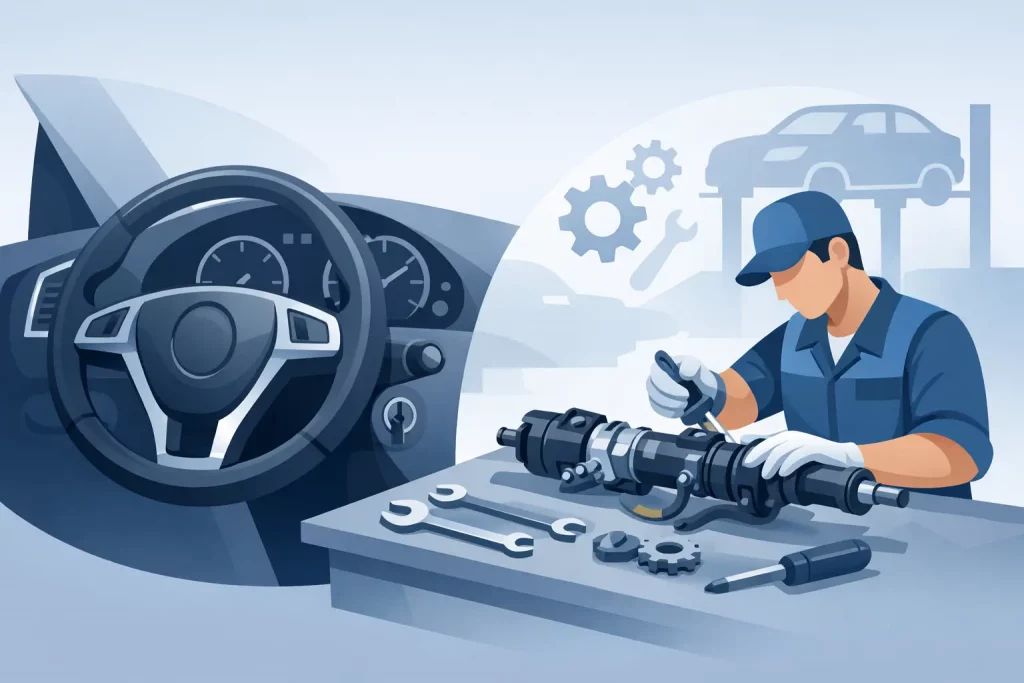
A steering column repair service is not simply about curing an annoying rattle behind the steering wheel. The column is the mechanical and, on many modern vehicles, electronic link between the driver’s input and the steering system. Wear, damage or an electrical fault in this area can affect steering precision, trigger warning lights and, in serious cases, compromise safe vehicle control.
For that reason, the right repair begins with accurate steering diagnostics. A heavy steering complaint, excess free play or an EPS warning does not automatically mean the column itself has failed. The fault may lie elsewhere in the steering system, so replacing parts before testing can be expensive and ineffective.
What the steering column does
The steering column transfers movement from the steering wheel through one or more shafts and universal joints to the steering rack or steering box. On conventional systems, its role is principally mechanical. On electric power steering systems, however, the column may also incorporate a torque sensor, position sensor, electric motor, control module or associated wiring.
It is also a safety-critical assembly. Modern columns are designed to collapse in a controlled way during a collision, while maintaining the correct driving position and secure mounting under normal use. The column commonly carries components including the ignition housing, steering lock, stalk controls, clock spring and airbag-related connections. That makes careful, vehicle-specific work essential.
A fault can be obvious, such as movement felt at the steering wheel, or intermittent, such as a warning light that appears only after the vehicle has warmed up. The symptoms matter, but they are only the starting point for diagnosis.
Signs you may need a steering column repair service
A noticeable knock or clunk when turning the wheel, especially at low speed or over uneven ground, can point to wear in a shaft joint, column mounting or internal mechanism. Excessive movement before the wheels respond is another concern. Some small amount of movement can originate elsewhere, but free play should never be ignored when it affects the accuracy of the steering.
A steering wheel that feels stiff, notchy or reluctant to self-centre also requires investigation. On an EPS-equipped vehicle, this may be accompanied by an electric power steering warning light or assistance that cuts in and out. A torque sensor or electronic control fault can cause steering assistance to behave inconsistently, while a mechanical restriction within the column or intermediate shaft can produce a similar driving sensation.
Other signs include a steering wheel that will not adjust correctly, a steering lock issue, clicking from behind the wheel, or a change in steering-wheel position after previous repair work. If the vehicle has suffered kerb impact, collision damage, water ingress or attempted theft, the column and its connected components deserve particularly close inspection.
Do not continue driving with significant steering play, an intermittent loss of assistance or a suspected steering lock fault. These are not comfort issues. They need prompt professional assessment.
Diagnosis before replacement
A specialist approach separates a column fault from faults in the rack, steering linkage, suspension mounting points and electronic system. This prevents a common and costly outcome: fitting a replacement column when the original unit was not the cause.
The process normally starts with a road-test assessment where safe to do so, followed by checks for movement, binding and noise through the full steering range. The technician will inspect column mountings, lower shafts, universal joints and couplings for wear or corrosion. The steering wheel position, operation of adjustment mechanisms and condition of associated electrical connections are also checked.
For electric power steering, diagnostic equipment is used to read stored fault codes and live data. This can help identify implausible torque readings, communication faults, voltage-related issues or sensor errors. However, fault codes should be interpreted alongside physical testing. A code identifies where the system has detected a problem; it does not always prove which component needs replacing.
On some vehicles, calibration is required after repairs to the steering angle sensor or EPS system. If the steering wheel is not centred correctly or the vehicle’s geometry is out, the system can continue to report faults or deliver inconsistent assistance. A complete repair should account for these requirements rather than treating the warning light as a standalone problem.
Repair, reconditioning or replacement?
The best route depends on the vehicle, the fault and the condition of the original unit. A worn intermediate shaft or universal joint may be repairable or replaceable without changing the complete column. A column with an electronic internal fault may require specialist repair or reconditioning where parts, test capability and vehicle application allow. Damage to a collapsible section or safety structure, on the other hand, may make replacement the appropriate option.
Reconditioning can offer a cost-effective alternative to main-dealer replacement, particularly for premium, classic and performance vehicles where new assemblies are expensive or no longer readily available. The value lies in restoring the relevant components properly, not merely making a symptom disappear temporarily.
A quality reconditioning process will involve strip-down where applicable, inspection of wear points, replacement of defective serviceable components, reassembly and testing. Electronic columns need suitable bench testing and, where required, vehicle-level verification after installation. The exact scope varies by make and model, which is why a specialist should confirm what is repairable before committing to a solution.
Used components can appear attractive on price, but they bring uncertainty. Their internal wear, previous accident history, coding requirements and compatibility may be unknown. This is particularly relevant to EPS columns and steering lock assemblies. A reconditioned or professionally repaired unit with a clear warranty often provides a more dependable long-term answer.
Why vehicle-specific knowledge matters
The steering arrangement on a classic car is very different from that of a modern Audi, BMW, Mercedes or Land Rover. Earlier vehicles may use straightforward mechanical columns and steering boxes, where wear can develop gradually over decades. Newer vehicles can combine the column with electronic assistance, security systems and calibration procedures that require correct diagnostic equipment.
Commercial vehicles also present different demands. High mileage, frequent manoeuvring and load-related use can accelerate wear in shafts and joints. For fleet operators, an accurate diagnosis helps avoid unnecessary downtime and repeat repairs. For restoration specialists, preserving the correct feel and original configuration may be as important as resolving obvious wear.
This is where a dedicated steering specialist differs from a general parts-fitting approach. The aim is to understand how the system is meant to operate on that specific vehicle, identify the actual defect and return the steering to smooth, precise and predictable operation.
What to expect from a professional repair
Before authorising work, ask whether the fault has been confirmed through both mechanical inspection and electronic diagnostics where relevant. You should also know whether the proposed solution is a repair, reconditioned exchange unit or new replacement, and whether coding or calibration is included.
It is sensible to ask about warranty cover, turnaround time and any related work required after fitting. If steering components have been removed or disturbed, wheel alignment may need checking to ensure the steering wheel sits correctly and the vehicle tracks accurately. A repair that removes a warning light but leaves the vehicle pulling or off-centre is not a finished job.
Pro Power Steering provides specialist steering diagnostics, column and shaft work, reconditioning and supply-and-fit support for a broad range of vehicles. Completed work is backed by a 12-month guarantee, giving owners and trade customers added confidence in a repair that is carried out for the right reason.
Act on steering changes early
Steering faults rarely improve with use. A slight knock can become pronounced free play, a stiff spot can develop into a persistent restriction, and an occasional EPS warning can become a complete loss of assistance. Early inspection gives more opportunity to repair the affected component before wear spreads or a minor concern becomes a safety issue.
If your steering no longer feels direct, quiet and consistent, arrange a specialist assessment. The goal is simple: every turn of the wheel should produce a controlled, accurate response you can trust.
