
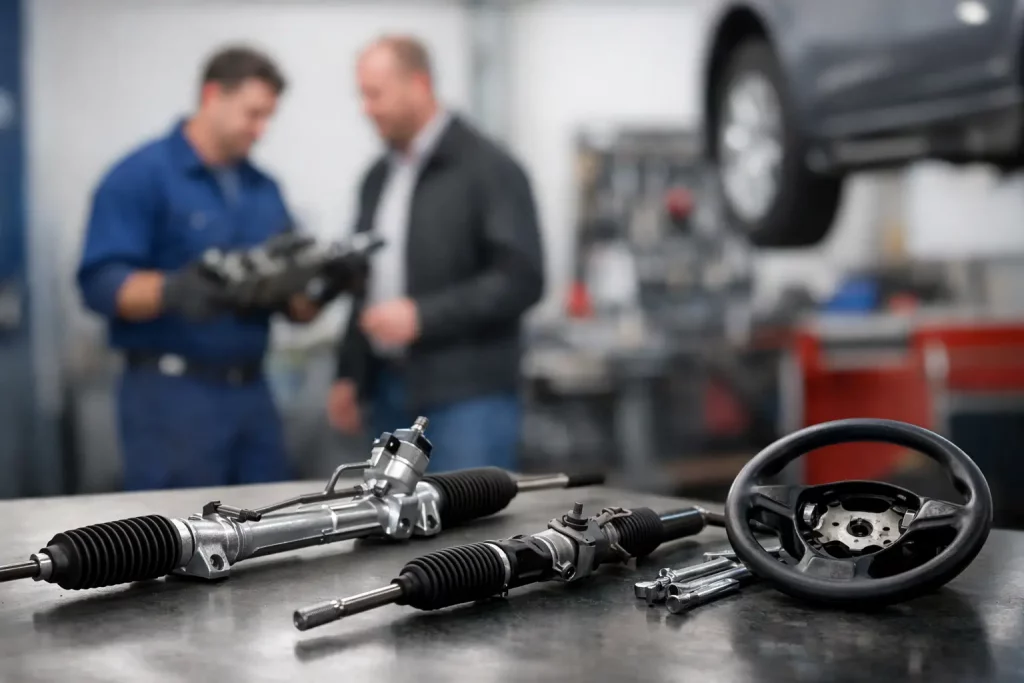
A warning light, fluid leak or suddenly heavy steering can lead quickly to one recommendation: a complete new steering rack from the dealer. That may be the correct route in some cases, but dealer steering replacement alternatives deserve proper consideration first. A steering system is a safety-critical assembly, yet many faults arise in serviceable internal components, sensors, motors or associated parts rather than from total failure of the rack itself.
The right decision starts with diagnosis, not with the catalogue price of a replacement unit. For owners, garages and fleet operators, that can mean a dependable repair path with less unnecessary replacement, provided the component is suitable and the work is carried out by steering specialists.
Why a dealer replacement is not the only answer
A main dealer will commonly follow the manufacturer’s replacement procedure. This is understandable: it gives the workshop a defined route, access to factory parts and, on newer vehicles, a clear process for programming and calibration. A brand-new OE rack can be the best answer where the original component is beyond repair, where software support is restricted, or where the vehicle remains under a warranty that requires dealer-fit parts.
However, complete replacement is not always technically necessary. Hydraulic racks can suffer from worn seals, corrosion in the working area, damaged inner components or leaks that are repairable after full strip-down and inspection. Electric power steering, or EPS, racks may develop faults in the motor, torque sensor, control electronics, gears or wiring connections. A fault code is evidence to investigate, not automatically proof that every part of the rack has failed.
Older, classic and specialist vehicles create another issue: a new replacement may no longer exist, may be available only in left-hand-drive form, or may not match the vehicle’s original specification. Reconditioning the correct Right Hand Drive unit can preserve fitment, steering geometry and the character of the vehicle.
The main dealer steering replacement alternatives
There is no single alternative suitable for every fault. The practical options depend on the steering design, the condition of the unit, parts availability and the vehicle’s electronic requirements.
Specialist assessment and component-level reconditioning
For a suitable rack, steering box or column-related component, reconditioning is often the strongest alternative to buying a complete new unit. The assembly is assessed, dismantled where appropriate, cleaned and measured. Worn or damaged serviceable parts can then be renewed using suitable OE or OE-quality components, before the rebuilt unit is tested.
This is not the same as fitting seals to an unknown rack and hoping for the best. The condition of the rack bar, housing, gears, bearings, valves, electrical elements and mounting points matters. Corrosion, accident damage, severe internal wear or unavailable electronics can make reconditioning unsuitable. An honest specialist should identify those limitations before promising a repair.
The benefit is precision. Rather than replacing an entire steering assembly because of one fault area, the work can address the cause while retaining a vehicle-correct housing and configuration. This can be particularly valuable on premium, performance, commercial and older vehicles, where a generic replacement may be difficult to source or wrong for the application.
A professionally remanufactured exchange unit
An exchange rack is often useful where the vehicle cannot remain off the road while its original unit is rebuilt. The old component is removed, an equivalent reconditioned unit is supplied, and the original is usually returned as a surcharge core.
The key word is equivalent. Steering racks vary by engine, drivetrain, wheelbase, active steering specification, sensor type and software generation. Even apparently identical units may have different part numbers or calibrations. The vehicle registration alone is sometimes insufficient, so physical numbers and diagnostic information may be needed before supply.
A professionally remanufactured exchange unit should have been rebuilt and function-tested to a defined process. It is a very different proposition from an unverified used part, especially when dealing with electronic steering systems.
New OE, OEM or quality replacement units
New replacement remains appropriate when a rack is structurally damaged, electrically unrepairable or unsuitable for reconditioning. It can also be sensible where a manufacturer-supported new assembly is readily available and the vehicle needs a particular current software level.
There is a difference between OE, OEM and aftermarket terminology. OE normally refers to the manufacturer-branded part. OEM may be produced by the original equipment manufacturer but supplied outside the vehicle-maker’s packaging. Quality aftermarket units vary considerably, so correct application, provenance and warranty terms matter more than a low headline price.
For some vehicles, a new unit is the most straightforward choice. The question is not whether new is good or bad, but whether it is necessary for the specific fault.
Repairing the wider steering fault
A rack can be blamed for symptoms caused elsewhere. Free play, pulling, inconsistent assistance or an off-centre wheel may involve steering columns, intermediate shafts, track rods, suspension joints, tyres, wheel alignment or electrical supply faults. On EPS systems, low battery voltage, poor earth connections and communication errors can trigger steering warnings or alter assistance.
Replacing the rack without confirming these factors can leave the original symptom unresolved. A proper steering diagnosis considers fault codes, live data where available, mechanical checks and the vehicle’s reported behaviour on the road. This approach is especially relevant where a dealer quotation has identified a rack after a warning light but the underlying cause has not been fully established.
EPS coding, calibration and alignment are part of the job
Modern electric steering systems are not always fit-and-forget components. After fitting or repairing an EPS rack, the vehicle may require coding, commissioning, steering-angle sensor calibration or an end-stop learning procedure. Some systems must be flashed or virginised before they can accept the vehicle-specific configuration.
These requirements vary by manufacturer and model. On certain vehicles, dealer-level software access may still be needed. On others, an independent specialist or suitably equipped fitting garage can complete the required steps. Assuming that a replacement rack will work immediately after installation is a common and costly mistake.
Wheel alignment is equally important. Removing and refitting a rack or disturbing track-rod settings can affect toe and steering-wheel centre. The car may drive poorly, wear tyres prematurely or show stability-control warnings if alignment and steering-angle calibration are not completed correctly. The finished repair should deliver smooth assistance, accurate response and a centred steering wheel, not simply an extinguished warning lamp.
Why used steering parts require caution
A second-hand rack can look like the cheapest alternative, particularly for an older vehicle. It can occasionally be a practical choice where the part is rare and the buyer accepts the risk, but it is seldom the best default for a safety-critical component.
Its internal condition is unknown, storage may have caused corrosion, and the unit may have come from a vehicle with an undeclared steering fault or collision damage. EPS racks also bring uncertainty over software compatibility, sensor condition and coding status. Labour, alignment and calibration costs remain much the same if the used unit fails shortly after fitting.
For this reason, a tested reconditioned unit or an assessed repair generally offers a more controlled route when available.
Choosing the right route for your vehicle
The best option balances technical suitability, downtime and budget. A newer vehicle with restricted software access may favour a dealer-supplied new rack. A leaking or worn hydraulic unit with a sound housing may be an excellent candidate for reconditioning. A garage needing a quick turnaround may prefer a tested exchange unit, while a restoration project may need the original steering box or rack preserved and rebuilt.
Before authorising work, ask what evidence supports the diagnosis, whether the original component has been assessed for repair, what testing has been completed, and whether coding, calibration and alignment are included in the plan. Also confirm the warranty terms and whether the vehicle’s specific part number has been checked.
Pro Power Steering provides specialist diagnostics, reconditioning, tested steering components and supply-and-fit support across a broad range of hydraulic, manual and electric steering systems. For suitable units, UK-wide collection and delivery can make specialist assessment practical even when the vehicle is being repaired elsewhere.
A dealer quote is valuable information, but it should be the start of an informed steering repair decision rather than the end of it. When the fault is diagnosed at component level, the chosen solution can be safer, more proportionate and better matched to the vehicle in front of you.
