
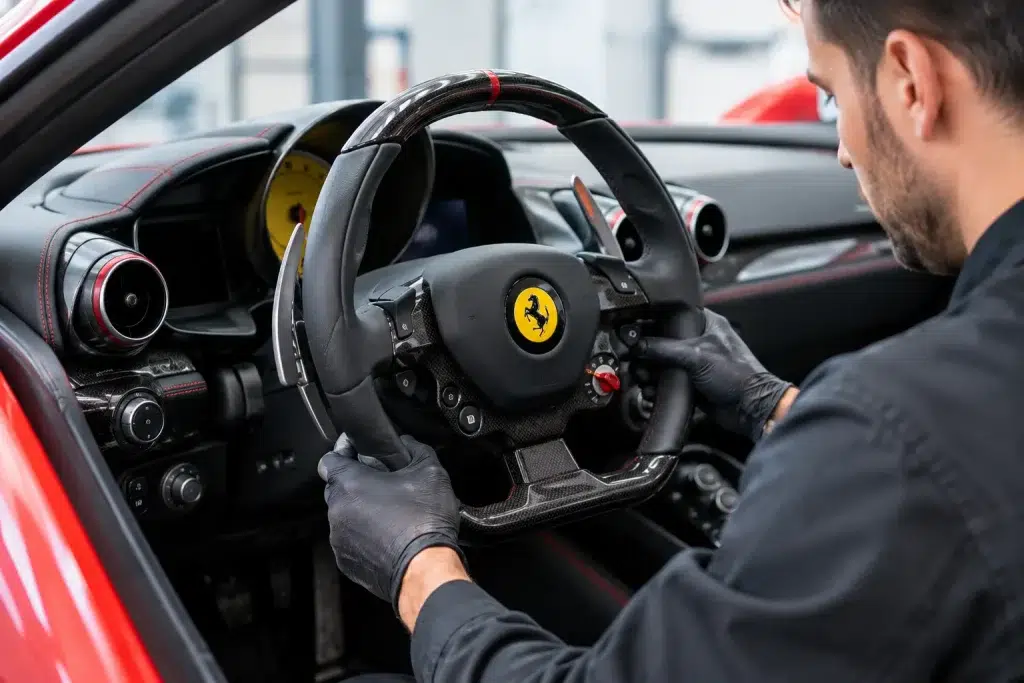
A Ferrari that no longer tracks cleanly, feels unusually heavy through the wheel or develops an intermittent steering warning needs more than a routine inspection. Ferrari steering repair starts with identifying the exact source of the fault: the rack, column, electronic assistance, hydraulic circuit, suspension geometry or a related electrical issue. Replacing parts before that diagnosis can be expensive and may not restore the precise, confidence-inspiring response the car should deliver.
Why Ferrari steering faults need a specialist approach
Ferrari steering systems are designed around sharp response, controlled weighting and clear feedback. A small amount of free play, uneven assistance or a steering wheel that does not self-centre correctly can change the way the vehicle feels, particularly at motorway speed or during more spirited driving.
The repair route depends on the model, year and steering system fitted. Earlier and classic Ferrari models may use manual or hydraulic arrangements, while newer vehicles can incorporate electronically controlled steering assistance, steering angle sensors and vehicle-specific calibration requirements. The same symptom can therefore have very different causes.
For example, a heavy steering complaint could arise from internal wear in a hydraulic rack, restricted fluid flow, a steering column joint, damaged wiring, a control-unit fault or incorrect wheel alignment. A warning message may point towards an electronic issue, but the underlying problem could still be a poor connection, sensor signal or mechanical resistance within the system.
This is why accurate diagnosis matters before a rack is condemned. It helps prevent unnecessary complete replacement and establishes whether a component-level repair, reconditioning, coding procedure or replacement unit is the appropriate route.
Common signs that Ferrari steering repair may be required
A change in steering feel is often the first warning. Drivers may notice stiffness at parking speeds, assistance that comes and goes, excessive effort in one direction, vibration through the wheel or a steering wheel that is off-centre after normal driving.
Fluid loss or visible contamination can indicate a problem on hydraulic systems, while clunks, knocks or a vague response may suggest wear within the rack, inner joints, steering column, mounting points or associated suspension components. These symptoms should not automatically be attributed to the rack. A thorough inspection needs to distinguish between steering-system wear and faults elsewhere at the front of the vehicle.
On applicable electronic systems, dashboard warnings, reduced steering assistance or faults stored in control modules require proper diagnostic equipment and interpretation. Clearing a fault code without finding its cause is not a repair. The fault may return as soon as the system sees the same implausible sensor reading or electrical condition.
A vehicle that pulls, wanders or has an off-centre wheel may simply require alignment, but alignment alone cannot correct internal rack wear, bent components or an electronic steering system that has not been calibrated after repair. The condition of tyres and suspension also needs consideration, as both have a direct effect on steering behaviour.
Symptoms that should not be delayed
Sudden loss of assistance, pronounced free play, binding, fluid leaking onto hot components, or an active steering-system warning should be assessed promptly. Steering is a safety-critical system. Continuing to drive with a significant fault can make the vehicle harder to control and may cause further damage to an otherwise repairable component.
What a proper diagnosis should establish
A useful Ferrari steering diagnosis is not limited to reading fault codes. It should combine the driver’s report with a physical and electronic assessment of the system. The objective is to identify what has failed, why it failed and what work is needed to return the steering to safe, consistent operation.
Technicians will consider steering effort from lock to lock, free play, noises, leaks, rack mount condition, column and shaft movement, electrical supply and communication, and the condition of related suspension and alignment components. Where electronic assistance is fitted, live data may be needed to assess steering angle, torque-sensor signals, motor operation and module communication.
Vehicle history can be valuable too. Kerb strikes, pothole impacts, accident repairs, flood exposure, low battery voltage and previous steering work can all affect the diagnostic path. On a high-performance car, small deviations matter. A repair should account for the car’s specified geometry and any model-specific set-up requirements rather than treating it as a generic steering fault.
Ferrari steering rack repair or replacement?
A complete new steering rack is sometimes the correct option, especially where a unit is unavailable for safe reconditioning, has suffered major impact damage, or manufacturer procedures require replacement. On certain newer electronic applications, access to manufacturer systems or dealer-level configuration may also form part of the process.
However, replacement is not the only answer. Where suitable, component-level Ferrari steering rack repair or reconditioning can address the actual failed areas within the unit. This may include seals, bearings, bushes, internal mechanical components or relevant electronic elements, depending on the rack design and condition.
The benefit is not simply cost. A specialist assessment can preserve an original unit where practical, which may be particularly relevant for older, rare or right-hand-drive vehicles where supply is limited. It also avoids assuming that every fault requires a complete assembly.
There are limits. Corrosion, severe housing damage, accident distortion, unavailable parts or irreparable electronic damage can make reconditioning unsuitable. An honest inspection should make that clear before work proceeds. The right solution is the one that can be tested, fitted and supported reliably, not merely the cheapest option at the outset.
Testing, coding and calibration after repair
A repaired steering component should be tested before it is returned for fitting. Workshop testing helps confirm smooth operation, correct movement and freedom from obvious leaks or irregularities. It is an essential part of a reconditioning process, but it does not remove the need for correct installation and final vehicle checks.
After a rack, steering column or related component has been removed and refitted, wheel alignment is often required. This ensures the steering wheel is centred and the vehicle geometry is set correctly. On systems with electronic steering functions, steering-angle calibration and fault-code checks may also be necessary.
Some electronic power steering racks can be flashed or virginised where applicable, allowing them to be prepared for vehicle-specific coding. Whether this is possible depends on the particular Ferrari system and the condition of the unit. The fitting garage may still need to complete coding, configuration or calibration on the vehicle using suitable equipment.
This division of work is important for trade customers. A steering specialist can diagnose and recondition the component, while the installing workshop completes the vehicle-level procedures that require access to the car. Clear technical communication between both parties reduces delays and helps avoid a repaired unit being incorrectly judged because a required calibration step was missed.
Choosing the right repair route for a specialist vehicle
Before authorising work, provide the vehicle registration, VIN where available, model, year, steering symptoms and any diagnostic codes already recorded. Details of previous accident damage, battery problems or recent suspension work can also help establish the likely cause.
For supplied units, correct part identification is essential. Ferrari systems can vary across model years and markets, and right-hand-drive specification must never be assumed from appearance alone. Matching a rack accurately protects both fitment and steering performance.
Pro Power Steering assesses suitable units at component level, using appropriate OE or OE-quality parts where applicable and testing completed work before it leaves the workshop. Direct technical support can also help owners and fitting garages understand when alignment, coding or further vehicle diagnosis is needed. Completed repair work is supported by a 12-month warranty under the applicable terms.
The most useful next step is to treat a change in steering feel as diagnostic information rather than an inconvenience to drive around. A clear assessment of the rack, electronics and vehicle geometry gives your Ferrari the best chance of returning to the smooth, precise steering it was engineered to have.
