
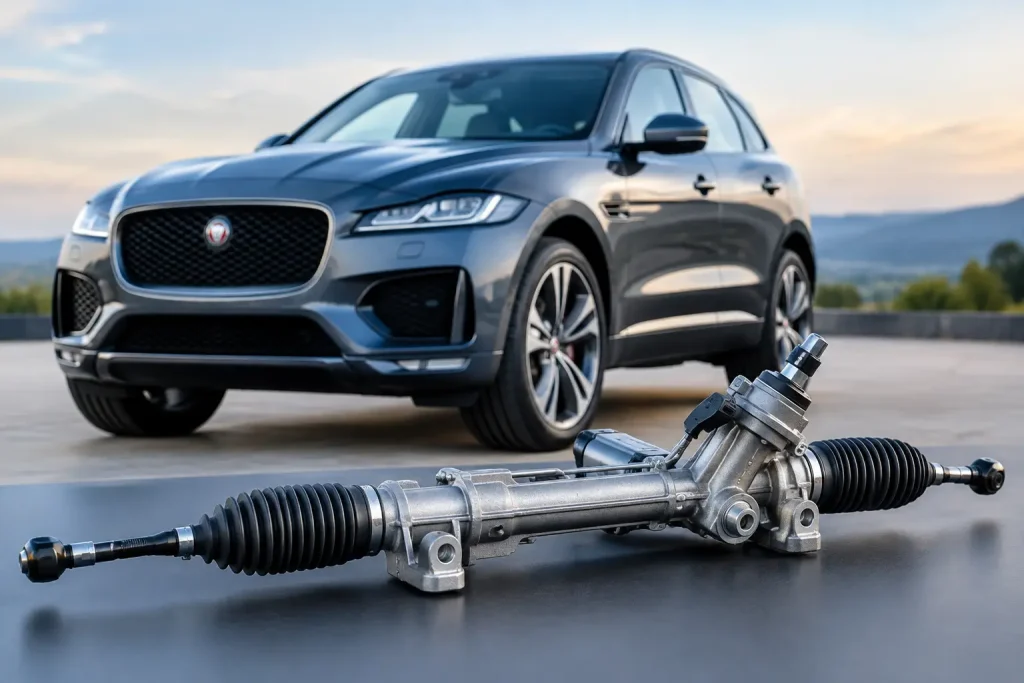
A Jaguar F-Pace that suddenly feels heavy, inconsistent or reluctant to self-centre needs more than a quick fault-code clear. Jaguar F-Pace electric steering rack issues can affect the way the vehicle responds at low speed, on the motorway and during precise manoeuvres, so the cause needs to be identified before any parts are ordered.
The F-Pace uses electric power steering, commonly called EPS. Assistance is controlled electronically and delivered through the rack assembly, rather than by a conventional hydraulic system. This gives the vehicle adaptable steering weight and allows safety systems to interact with steering assistance, but it also means a fault can involve mechanical wear, power supply, wiring, software or calibration.
Common Jaguar F-Pace electric steering rack issues
The most obvious symptom is an electric power steering warning on the instrument display. In some cases, assistance is reduced or removed, leaving the steering noticeably heavier, particularly when parking. The steering will generally remain mechanically connected, but the effort required can be substantial and the vehicle should not be treated as normal to drive.
Other faults are less dramatic. A driver may notice a notch, tight spot or uneven assistance when turning through the centre position. The wheel may fail to return smoothly after a corner, feel vague around the straight-ahead position, or require small repeated corrections. A knocking noise over rough surfaces can also be associated with free play in the rack or connected steering components, although this must not automatically be blamed on the rack itself.
Intermittent warnings are particularly common reasons for misdiagnosis. If assistance returns after an ignition cycle, that does not prove the fault has gone away. It may point to a voltage-related event, a network communication issue, excessive motor current, a sensor plausibility fault or an internal rack control problem stored in the vehicle’s modules.
Heavy steering is not always a failed rack
A complete rack replacement is not the correct answer for every F-Pace with heavy steering. A weak battery, charging-system concern, poor earth, damaged wiring or connector corrosion can reduce EPS performance or create warning messages. Wheel alignment, tyre condition and seized suspension joints can also make a vehicle feel heavier or less accurate, even when the electric rack is operating correctly.
Equally, a diagnostic scan alone is not enough. Stored codes provide direction, but an experienced technician must consider live data, supply voltage, steering angle information, CAN communication and the physical feel of the steering. This avoids replacing an expensive assembly when the true cause sits elsewhere in the system.
Why accurate EPS diagnosis matters
The electric rack is part of a wider vehicle-control system. It exchanges information with modules responsible for stability control, braking and driver-assistance functions. Depending on the specification, steering-angle data and rack status may influence systems such as lane support or parking assistance.
For that reason, a sound diagnostic process starts with confirming the customer’s concern and checking the condition of the vehicle around the rack. The rack should be inspected for impact damage, movement at its mountings, damaged gaiters and signs of water ingress. Technicians should then assess the steering column, intermediate shaft, track-rod joints and suspension components before condemning the EPS unit.
Electronic testing should establish whether the rack has a clean power and earth supply, whether relevant modules communicate correctly and whether faults are current, historic or repeatedly returning. Where appropriate, live data can reveal implausible torque-sensor readings, steering-angle discrepancies or faults that occur only when the rack is loaded.
This approach matters because a rack may be perfectly serviceable but inhibited by an external issue. Conversely, a rack with an internal electronic or mechanical fault can sometimes pass a basic road test until the right temperature, steering load or voltage condition exposes the problem.
Mechanical, electrical and software-related faults
Electric steering rack faults tend to fall into three overlapping groups. Mechanical problems may include internal wear, free play, binding or damage following a kerb strike. Electrical concerns can involve the motor, position or torque sensing, internal circuit board, connectors or the wiring that supplies the unit. Software and configuration problems may appear after low-voltage events, module replacement, accident repairs or unsuccessful programming.
The distinction is useful, but not always absolute. For example, an internal sensor fault may produce inconsistent assistance that feels mechanical from the driver’s seat. A damaged rack housing or water ingress can create both physical corrosion and electrical failures. The right repair route depends on what testing finds, the rack version fitted and whether the underlying vehicle fault has been resolved.
A warning message immediately after a battery has gone flat deserves particular care. Clearing faults without checking battery condition, charging voltage and retained codes can allow the issue to return. On a modern Jaguar, stable system voltage is fundamental to dependable module operation.
Does a replacement rack need coding?
Often, yes. A replacement or reconditioned EPS rack may require vehicle-specific coding, configuration and calibration before it will operate correctly. The exact process depends on model year, rack part number and vehicle equipment. Steering-angle calibration and wheel alignment may also be required once the mechanical work is complete.
Skipping these steps can leave warning lights active, steering assistance restricted or driver-assistance systems unavailable. Fitting a unit with the wrong specification can create further complications, even if it appears physically identical. Part-number verification and correct handling of the vehicle’s electronic configuration are therefore as important as the physical installation.
Some suitable EPS units can be flashed or virginised in preparation for coding to the receiving vehicle. That is not a universal solution, and it should only be considered after confirming compatibility and the nature of the original fault. There are occasions when a new OE unit, dealer programming support or further vehicle-level diagnosis remains the appropriate route.
Repair, reconditioning or replacement?
A failed Jaguar F-Pace rack does not automatically mean that a complete new unit is the only option. Where a rack is suitable for repair, component-level reconditioning may address identifiable internal faults while retaining the correct housing and vehicle-specific unit type. The finished assembly should be tested before it leaves the workshop, rather than relying solely on a visual inspection.
This can be a practical option for owners and garages facing long lead times or the cost of a full replacement. However, repairability depends on the condition of the unit. Severe accident damage, extensive corrosion, unavailable internal parts, unsuitable electronic damage or a unit that cannot be reliably tested may rule out reconditioning.
A properly assessed exchange or replacement option can be preferable when time is critical or the original rack is beyond economical repair. The key point is to choose on evidence, not assumptions. A cheaper unit without correct testing, compatibility checks or coding support can cost more in repeat labour and unresolved faults.
Pro Power Steering assesses suitable steering units at component level, using appropriate OE or OE-quality parts where applicable, and supports fitting garages with practical technical advice on coding, calibration and installation requirements. Completed work is covered by a 12-month warranty under the applicable terms.
What to do when the warning appears
If the F-Pace displays an EPS warning or the steering becomes unexpectedly heavy, avoid treating it as a minor inconvenience. Do not continue driving simply because the warning disappears after restarting the engine. Make a note of when it occurred, whether it followed a flat battery or impact, and whether the steering felt heavy, notchy or inconsistent.
A garage or steering specialist can then scan the relevant modules and carry out the mechanical and electrical checks needed to distinguish a rack fault from an external cause. If the vehicle has suffered a kerb strike or collision, the steering and suspension geometry should be checked before a repaired or replacement rack is calibrated.
The best outcome is not simply a warning light switched off. It is a Jaguar F-Pace returned to smooth, precise and predictable steering, with the rack, vehicle electronics and wheel alignment all working together as intended.
