
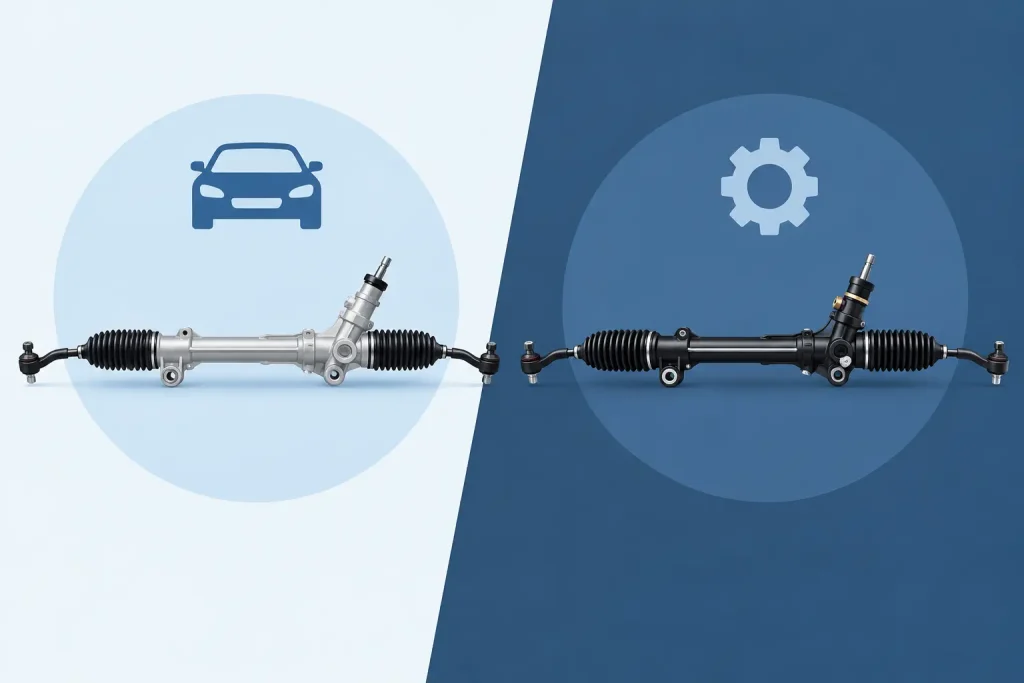
A steering rack is not a component to choose purely by the lowest purchase price. It determines how accurately the vehicle responds, how much effort is needed at the wheel and, on many modern cars, whether electronic safety and driver-assistance systems operate as intended. The choice between OEM versus aftermarket steering racks therefore deserves more than a quick parts-catalogue comparison.
For some vehicles, a brand-new manufacturer-supplied rack is the sensible route. For others, a professionally reconditioned original unit offers a reliable, cost-effective answer while retaining the correct vehicle-specific housing, mounting points and connections. The right decision depends on the fault, the vehicle, the rack type and what has been confirmed during diagnosis.
What OEM and aftermarket really mean
OEM is often used to describe a part supplied through the vehicle manufacturer’s parts network. It is built to the original specification for that model, although the component itself may have been manufactured by a specialist supplier rather than by the vehicle brand.
The term aftermarket is broader. It can mean a newly manufactured pattern rack, an exchange reconditioned unit, or a component supplied by the original equipment manufacturer outside the dealer network. Those options are not equivalent. A well-reconditioned genuine core and a low-cost newly produced pattern rack may both be described as aftermarket, but their design, testing and suitability can be very different.
This distinction matters particularly with steering. Rack ratios, input shaft splines, hydraulic port positions, track-rod arrangements, motor specifications and electronic control units can vary between apparently similar models. Right Hand Drive applications may also use different parts from their left-hand-drive counterparts. Matching a rack by appearance alone is not enough.
OEM versus aftermarket steering racks: the practical differences
A new OEM rack offers the reassurance of a part supplied to the vehicle manufacturer’s specification. It is often the straightforward choice where a vehicle is under manufacturer warranty, where the rack includes model-specific electronics that cannot be economically recovered, or where the manufacturer requires a new replacement as part of a particular repair process.
Availability and cost can be limiting factors. Some OEM racks have long supply lead times, particularly for older, specialist or low-volume vehicles. On certain models, the dealer route may only offer complete replacement when the actual defect is confined to serviceable internal or electronic elements.
A quality aftermarket option can reduce delay and expense, but it needs careful assessment. A newly manufactured replacement may fit correctly and perform well when sourced from a reputable supplier for the exact application. However, specification differences between brands can affect refinement, durability, steering feel and the ease of installation. The fact that a rack is listed for a vehicle registration does not automatically confirm it is the correct version.
Reconditioning occupies a separate and often valuable position. A suitable original rack can be stripped, inspected and rebuilt at component level using appropriate OE or OE-quality parts where applicable. Worn internal components, seals, bearings and related items can be addressed, then the completed unit can be tested before it leaves the workshop. This approach retains an original housing and geometry designed for the vehicle, rather than substituting an unknown pattern equivalent.
That does not mean every original rack should be rebuilt. Corrosion damage, broken castings, unavailable hard parts, severe internal wear or an unrecoverable electronic fault can make replacement the more responsible option. A steering specialist should assess the unit rather than assume that reconditioning is always possible.
Fitment is about more than mounting bolts
The most expensive mistake is fitting a rack that is almost right. It may bolt into place but still create problems with steering-centre position, column engagement, pipe routing, motor clearance or track-rod length. In some cases, the steering wheel may sit off-centre or the vehicle may not achieve the required alignment settings.
On conventional hydraulic and manual systems, checking the part number, vehicle identification details and physical specification is essential. On electric power steering systems, the process is more involved. The rack may contain a control module, torque sensing equipment and a motor that communicate with other vehicle systems. A replacement can require programming, coding, flashing or calibration before it will operate correctly.
Some EPS racks can be flashed or virginised in preparation for vehicle-specific coding and calibration. Others may need a new unit, dealer-level procedures or a specific diagnostic path. Fitting a rack without considering these requirements can leave warning lights, reduced assistance, fault codes or unsafe steering behaviour even if the mechanical installation is sound.
Alignment and calibration remain part of the repair
Any rack replacement or removal should be followed by proper wheel alignment. The track rods must be set accurately, and the steering wheel should be centred before final calibration where the vehicle requires it. Modern systems may also need steering-angle sensor learning, end-stop procedures or advanced driver-assistance system checks.
These are not optional finishing tasks. A correctly rebuilt or supplied rack can still feel poor, pull to one side or generate faults if alignment and electronic set-up are overlooked. Garages fitting a supplied rack should establish the coding and calibration requirements before the vehicle is dismantled, especially on premium and late-model applications.
How quality should be judged
Price is easy to compare; provenance is more useful. Ask whether the rack is new, remanufactured or simply described as exchange. Confirm the exact application, whether it is suitable for Right Hand Drive, what is included and whether the unit has been bench tested. For electric racks, establish the condition of the electronic module and what programming work remains after fitting.
Warranty terms also need to be understood in context. A warranty provides useful protection, but it does not correct an underlying vehicle fault. Worn suspension joints, damaged steering columns, accident damage, contaminated fluid on hydraulic systems, poor earth connections or low vehicle voltage can all affect steering operation and may damage a replacement component. Accurate diagnosis before ordering prevents the new rack becoming part of a longer, more expensive fault-finding exercise.
For trade customers, this is where a steering specialist can save workshop time. Clear part identification, honest assessment of repairability and direct technical support help avoid repeated fitting work. For owners, the benefit is a repair path based on the condition of the vehicle rather than a blanket instruction to replace the most expensive assembly.
When reconditioning is the stronger option
A reconditioned original rack is often especially suitable for older vehicles, classics, performance models and specialist applications where new stock is scarce or the original design is known to fit correctly. It can also be a sensible option for a modern vehicle where diagnosis identifies a repairable mechanical fault and the electronic elements are serviceable.
The value is not simply in replacing seals. Proper reconditioning is an engineering process: the unit is examined for the cause and extent of failure, recoverable components are restored or replaced as needed, and the finished assembly is tested. The aim is smooth, precise steering with dependable operation, not a cosmetic clean-up.
Pro Power Steering assesses suitable steering units at component level and supports repairs with a 12-month warranty under the applicable terms. For customers across the UK, collection and delivery can also make specialist assessment practical where the vehicle or removed component is suitable for the service.
When a new OEM rack is worth the extra cost
There are cases where choosing new OEM is entirely justified. A very new vehicle, an application with limited electronic repair options, a rack affected by a manufacturer technical requirement or a unit with major structural damage may all point towards replacement. Fleet operators may also prioritise a known new-part route where vehicle downtime, supplier policy and warranty administration matter more than the initial outlay.
The key is to make that decision with full information. A new part is not automatically superior to a correctly reconditioned original unit, just as an aftermarket part is not automatically a compromise. Specification, condition, testing, installation quality and electronic set-up determine the outcome.
Before authorising a steering repair, ask for the diagnosis behind the recommendation and whether the original unit has been assessed for repair. That conversation usually leads to the right balance of safety, reliability, availability and cost for the vehicle in front of you.
