
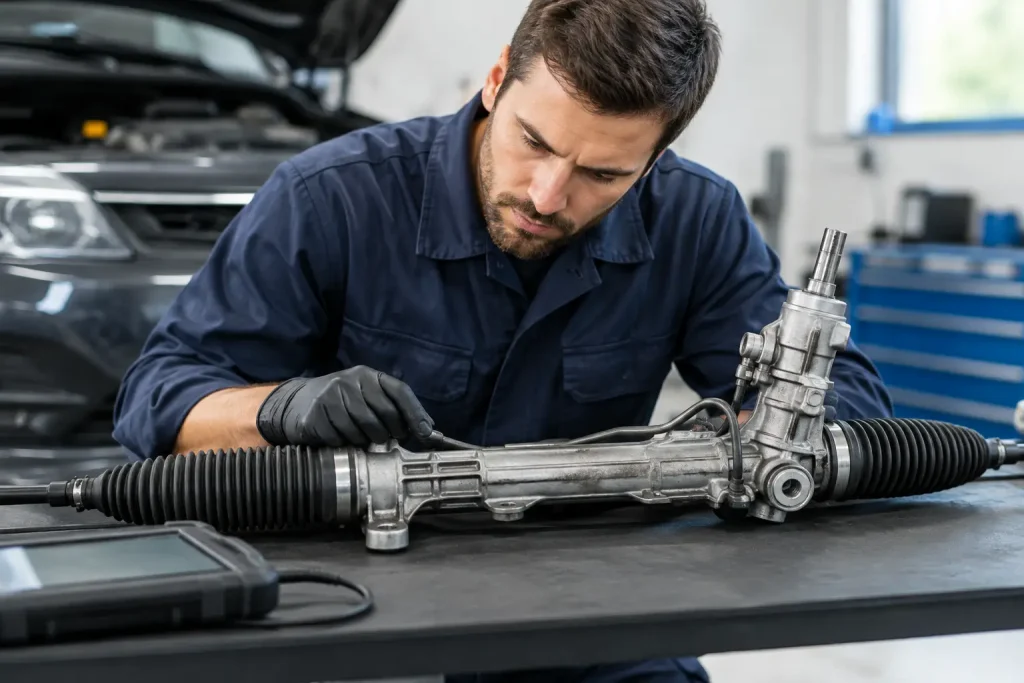
A steering complaint can sound straightforward – heavy steering, a warning light, a knock or fluid loss – but the failed part is not always obvious. Understanding how garages diagnose steering faults helps prevent a costly steering rack being replaced when the cause lies elsewhere, while ensuring a worn or electronically failed rack is not overlooked.
For a specialist, diagnosis is about building evidence. The vehicle’s symptoms, steering feel, fault-code data, physical condition and measured readings must point to the same conclusion before a steering rack repair, reconditioning or replacement is recommended.
The first stage: confirm the customer’s complaint
A good diagnosis begins before the vehicle reaches a ramp. The technician will establish when the fault occurs: whether steering is heavy only when parking, whether assistance disappears intermittently, whether a noise occurs on full lock, or whether the vehicle wanders at speed. A warning message, recent battery failure, accident repair or previous steering work can all be relevant.
The distinction matters. A hydraulic rack that is consistently heavy may have an internal rack fault, but it could also have a supply issue elsewhere in the hydraulic system. A rack-mounted EPS system that loses assistance after several minutes may be suffering from an electric motor, ECU, wiring, heat-related or calibration fault. A knock through the steering wheel may originate in the rack, but a thorough inspection must rule out connected suspension and steering components first.
The vehicle is then road tested where it is safe to do so. The technician assesses steering weight, self-centring, straight-ahead stability, free play, vibration and any change in behaviour between left and right lock. These details often indicate whether the problem is mechanical, hydraulic or electronic.
How garages diagnose steering faults on the ramp
With the vehicle raised correctly, the inspection moves from symptoms to the steering rack assembly itself. Technicians check for obvious signs such as damaged rack gaiters, corrosion on exposed rack bar sections, fluid contamination, loose mountings and evidence of a previous impact. A torn gaiter is not merely a cosmetic issue. It can admit water and grit that damage the rack bar, seals and internal components.
The front wheels are checked for excessive movement while the steering is held and turned. This helps identify play at the inner track rod joints and assesses whether movement is being created within the rack. A rack with internal wear can produce a dull knock, delayed response around the straight-ahead position or inconsistent steering accuracy. However, similar symptoms can be caused by outer joints, suspension joints or mounting issues, which is why a rack should not be condemned from noise alone.
Technicians also inspect the rack housing and its fixing points. On some vehicles, particularly heavier premium SUVs and performance models, rack mount condition and subframe position can affect steering feel. The goal is to separate a fault inside the steering rack from a fault that is merely being transmitted through it.
Checking hydraulic steering racks
For hydraulic steering racks, fluid loss is a major diagnostic clue. A specialist will look for leaks at rack seals, pipe connections and the rack gaiters. Fluid found inside a gaiter can indicate that an internal rack seal has failed, allowing fluid past the rack bar rather than retaining it within the hydraulic chambers.
The condition of the fluid also matters. Dark, burnt or contaminated fluid can point to a wider system problem and may affect the long-term outcome of any repair. The rack is assessed for stiffness, uneven assistance and leakage under operating conditions where appropriate. Internal corrosion, scored rack bars and worn seals can make reconditioning impractical in some cases, while many serviceable hydraulic racks can be stripped, repaired and tested to restore smooth operation.
A hydraulic rack diagnosis should never assume that every leak means a complete replacement. Equally, fitting seals to a badly pitted rack bar is not a durable repair. The condition of the core components determines whether refurbishment is viable.
Checking rack-mounted EPS systems
Modern rack-mounted electric power steering systems require a different approach. The rack may contain an electric motor, control unit, torque sensing components and position sensing technology, all working alongside the mechanical rack assembly. A fault can therefore be mechanical, electrical, electronic or a combination of all three.
The garage will use suitable diagnostic equipment to read manufacturer-specific fault codes and live data. Codes can identify communication errors, motor circuit concerns, torque sensor plausibility faults, internal ECU failures, voltage problems or steering-angle-related errors. Yet a stored code is a starting point, not a final diagnosis. Low battery voltage, poor connections or a network fault can trigger EPS warnings without proving that the rack itself has failed.
Live readings are particularly useful. A technician may compare commanded and actual motor assistance, steering torque values, supply voltage and steering position signals. If the data is implausible, intermittent or absent, further electrical testing may be required before deciding whether the rack needs repair. On certain BMW, Jaguar, Land Rover, Range Rover, Porsche, Mercedes-Benz, Audi and Volvo applications, replacement or repaired EPS racks can also require vehicle-specific coding, programming or calibration.
Why fault codes are only part of the answer
Electronic diagnosis can be misleading if it is treated as a quick verdict. An EPS code may identify a circuit or a signal, but it does not always identify why that circuit or signal has failed. Water ingress into a connector, damaged wiring after collision work, a weak battery or an internal rack ECU fault can create similar warnings.
A specialist therefore checks the basics before authorising a rack-level repair. Power and earth supplies, connector condition, communication integrity and relevant calibration status need to be considered. Where the evidence supports an internal EPS rack fault, the unit may be suitable for component-level repair or reconditioning. This can involve investigation of the motor, ECU and internal electronic components, followed by testing and any required programming process.
Not every electronic rack is economically or technically repairable. Severe crash damage, extensive corrosion, unavailable parts or a non-serviceable design may mean replacement is the correct route. The important point is that the decision should follow diagnosis, rather than assumption.
Identifying mechanical faults within a steering rack
Manual racks and the mechanical elements of powered racks are diagnosed through feel, movement and internal condition. Heavy or notchy steering can arise from corrosion, damaged teeth, worn bearings, incorrect preload or a bent rack bar. Excessive free play may indicate wear in the pinion area, rack guide or inner joints.
Classic and specialist vehicles often need a more measured assessment. Parts availability can be limited, and a replacement rack may not exist in the correct Right Hand Drive specification. In those cases, careful inspection and reconditioning of the original manual rack can be the most appropriate solution, provided its fundamental structure remains sound.
When a rack is removed for specialist assessment, the diagnosis becomes more detailed. The unit can be stripped, cleaned and examined for corrosion, wear patterns, seal damage, bearing condition and damage to the rack bar or pinion. A proper reconditioned rack is not simply cleaned and painted. Wear items and defective components are addressed, then the completed unit is tested before it returns to service.
Repair, reconditioning or replacement: making the right call
The final recommendation depends on the rack type, fault, vehicle application and condition of the unit. A hydraulic rack with localised seal failure and a sound rack bar may be a good candidate for reconditioning. An EPS rack with a confirmed internal electronic defect may be repairable, subject to its design and parts availability. A rack that has suffered major accident damage or severe corrosion may require replacement.
The installation process also affects the result. Once fitted, the steering system must be checked for correct operation and any relevant wheel alignment work completed. For many rack-mounted EPS vehicles, calibration, coding or commissioning is essential. Without this stage, a sound replacement or repaired rack can still produce warning lights, poor steering feel or system faults.
For independent garages and vehicle owners, clear diagnostic findings are as valuable as the repair itself. They provide a defensible reason for the work, reduce the risk of repeat visits and ensure the chosen solution suits the vehicle rather than merely clearing a symptom.
Steering faults deserve a methodical approach because the rack sits at the centre of steering precision and safety. When the evidence points to the rack, a specialist such as Pro Power Steering can assess whether expert repair, reconditioning or a correctly specified replacement is the sensible next step – with the necessary testing and vehicle-specific requirements considered from the outset.
