
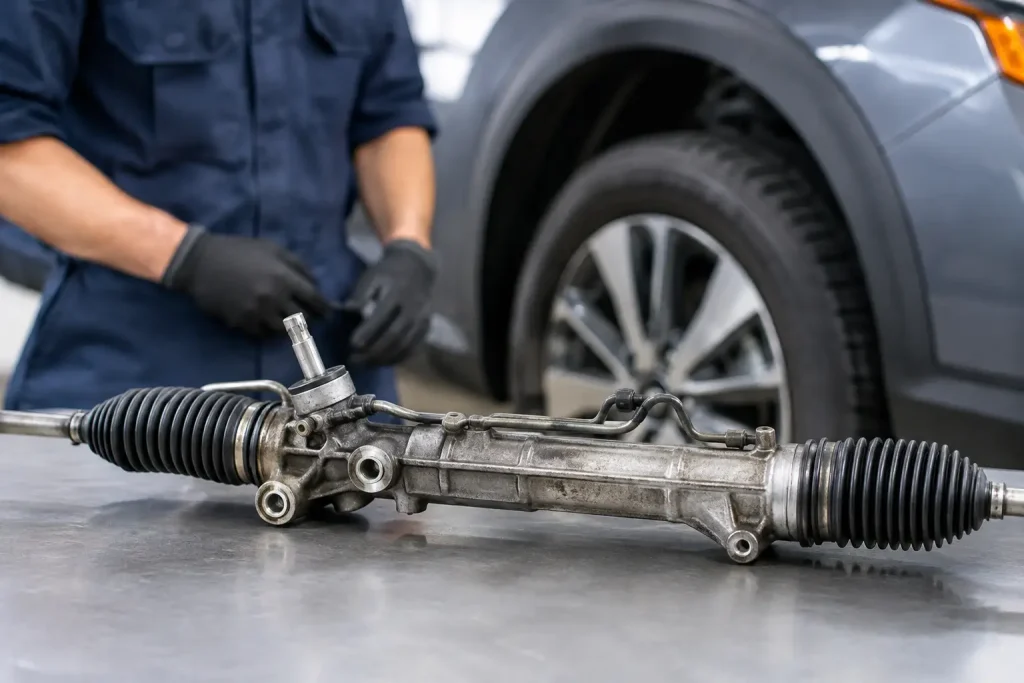
A steering complaint rarely begins with a clear instruction to replace a rack. A driver may notice a stiff spot when parking, a wandering feel at speed, an intermittent warning light or fluid on the drive. While several steering parts can contribute to these symptoms, the steering rack is often the component that requires the closest inspection – particularly on modern vehicles with rack-mounted electric power steering.
For owners and workshops, the key is not to treat every fault as the same. A hydraulic rack with an external leak, an EPS rack reporting an internal motor fault and a manual rack with excessive mechanical play need different diagnostic routes. Accurate identification protects vehicle safety, avoids unnecessary parts replacement and establishes whether repair, reconditioning or replacement is the sensible option.
Which Steering Parts Matter Most in Rack Diagnosis?
The steering rack converts the rotation of the steering wheel into the movement that turns the road wheels. Its pinion engages with a toothed rack bar, and track rods transfer that movement to the steering arms. On powered systems, hydraulic pressure or an electric motor reduces the effort required from the driver.
Although the rack is central, related steering parts affect the diagnosis. Inner track rod joints, outer track rod ends, rack mountings, gaiters and the connection between the steering column and rack can all create play, noise or poor steering response. Their condition must be checked before condemning the rack itself.
That said, a sound-looking outer component does not rule out an internal rack fault. Wear in the rack guide, pinion bearings or internal joints may only become evident when the rack is loaded. On an electric power steering rack, a fault may be mechanical, electronic or a combination of both. A warning lamp is useful evidence, but it is not a diagnosis on its own.
Rack-mounted EPS systems
Many premium and modern vehicles use an electric motor fitted directly to the steering rack. The motor, torque sensing, ECU and mechanical rack assembly work as a matched system. Problems can include intermittent or complete loss of assistance, uneven assistance from lock to lock, a heavy steering feel, fault codes, communication issues, water ingress or internal motor and ECU defects.
A rack-mounted EPS unit can also retain a mechanical issue despite no electrical fault code. For example, internal rack wear may cause knocking or a vague steering feel, while a seized or tight rack can make the steering heavy. Conversely, replacing mechanical steering parts will not resolve an ECU or motor failure within the rack assembly.
Repair work on EPS steering racks may involve component-level electronic investigation alongside mechanical reconditioning. Depending on the vehicle and unit, programming, coding, calibration or virginising may be required after repair or installation. These steps should be considered before a replacement rack is ordered, not after it has been fitted.
Hydraulic steering racks
Hydraulic racks remain common on older vehicles, performance cars and many specialist applications. Their most recognisable fault is a leak, often identified by fluid escaping beneath a gaiter or from a seal area. A leaking rack does not automatically mean the entire unit is beyond repair, but it does require prompt assessment.
Internal seals, the rack bar surface, pinion condition and housing integrity all influence whether hydraulic steering rack reconditioning is viable. If the rack bar is pitted or badly corroded in the seal travel area, fitting seals alone may not produce a durable result. A proper reconditioning process addresses the cause of the leak rather than merely masking its symptoms.
Heavy or inconsistent steering in a hydraulic system can also be caused by factors outside the rack. However, if the rack is internally tight, damaged or worn, attention elsewhere will not restore accurate steering operation. Testing and inspection are needed to separate a rack fault from issues in associated components.
Manual steering racks
Manual racks have no hydraulic or electric assistance, but their condition is just as relevant to safety and steering precision. They are frequently found on classic, specialist and discontinued vehicles, where new replacements may be unavailable or unsuitable.
Typical faults include tightness, free play around the straight-ahead position, roughness through the steering range and damaged mounting points. Restoration work may require careful mechanical assessment, replacement of worn internal components where available and controlled reassembly. The aim is not simply lighter steering, but predictable, accurate response appropriate to the vehicle.
Symptoms That Can Indicate a Steering Rack Fault
Some symptoms point more strongly towards the rack than others, but no single sign is conclusive. A vehicle that pulls or has an off-centre steering wheel may have an alignment issue, suspension wear or tyre-related cause. Alignment should not be used to hide mechanical play in the rack or track rods.
The following signs justify a specialist steering rack inspection:
- Knocking, clunking or a distinct rattle felt through the steering wheel, particularly over rough surfaces or during low-speed direction changes.
- Excessive free play, delayed response or a vague sensation around the straight-ahead position.
- Steering that is heavy, notchy or inconsistent from one side to the other.
- Fluid loss from a hydraulic rack, including fluid found inside or around a rack gaiter.
- EPS warning messages, reduced assistance, intermittent assistance or stored steering-related fault codes.
- Damage to rack mountings, gaiters or track rod connections that may have allowed contamination or movement at the rack.
A road test can help reproduce the complaint, but it should be supported by inspection and, where relevant, diagnostic equipment. For EPS racks, reading codes without checking live data, supply integrity and mechanical condition can lead to the wrong conclusion. For hydraulic racks, an external leak should be investigated for its origin rather than assumed to be a simple seal failure.
Repair, Reconditioning or Replacement?
The most cost-effective outcome is not always the cheapest-looking part. It is the option that returns the vehicle to safe, consistent steering operation with the correct specification and any required electronic setup completed.
Repair is appropriate where a specific defect can be identified and corrected without compromising the rest of the assembly. This may include an electronic issue within a suitable EPS rack or a contained mechanical fault in a unit that remains structurally sound. Reconditioning is broader: the rack is stripped, assessed, rebuilt using suitable components and tested before return to service.
A reconditioned steering rack is often particularly valuable for vehicles where new units are expensive, unavailable or only supplied through a main dealer. It can also be the practical choice for RHD applications, where the correct rack configuration may be harder to source than an equivalent left-hand-drive unit. However, suitability depends on the damage found, parts availability and the design of the rack.
Replacement may be necessary if the housing is damaged, the rack has suffered severe corrosion, critical internal parts cannot be restored or the electronic assembly is not economically repairable. In those circumstances, the replacement unit must match the vehicle’s exact application. Vehicle specification, steering ratio, connector arrangement, software requirements and RHD configuration all matter.
Why Coding and Calibration Cannot Be an Afterthought
Fitting an EPS rack is not always a purely mechanical task. Many modern vehicles require the replacement or repaired rack to be recognised by the vehicle, coded correctly and calibrated. Steering angle sensor procedures, end-stop learning and fault-code clearance may also be necessary before the system operates as intended.
Skipping these steps can leave warning lights active, reduce assistance or create steering behaviour that does not match the vehicle’s design. It can also lead to a serviceable rack being wrongly blamed for an installation or configuration problem. Garages should establish the required procedures before fitting the unit and ensure the necessary diagnostic capability is available.
The same principle applies after mechanical work. If track rods or a rack have been removed and refitted, wheel alignment should be checked once the steering system is confirmed mechanically sound. Alignment is a final setting process, not a repair for internal rack wear or looseness.
Choosing a Specialist Assessment
A useful steering rack assessment starts with the exact complaint: when it occurs, whether it is intermittent, whether a warning appears and what work has already been carried out. Vehicle registration details, VIN information where required, fault codes and photographs of the installed unit can all help identify the correct route.
For workshops, clear communication also avoids delays around exchange units and programming requirements. For private owners, it provides a more informed choice between repairing the original rack and fitting a replacement. Pro Power Steering assesses hydraulic, manual and rack-mounted EPS steering racks with the practical realities of vehicle application, component condition and post-installation requirements in mind.
If the steering feels different, leaks, knocks or reports an EPS fault, treat it as evidence to investigate rather than a reason to guess. The right attention to the rack and its related components can restore the smooth, precise steering the vehicle was designed to deliver.
