
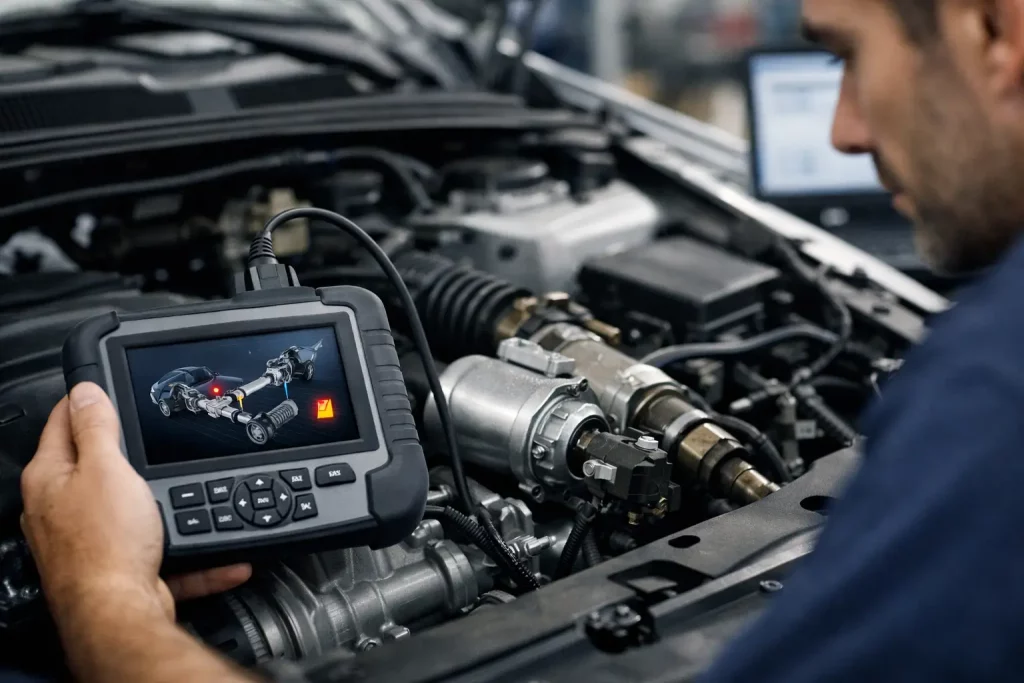
A warning light, intermittent heavy steering or a steering wheel that no longer feels centred can quickly lead to a search for EPS fault scanners. A scanner is a valuable starting point, particularly on modern vehicles where the electric power steering system communicates with several control modules. It is not, however, a verdict on which part to replace.
Electric power steering faults can arise in the rack, column, motor, torque sensor, wiring, battery supply, charging system, CAN network or vehicle configuration. Reading a stored code helps narrow the investigation. Accurate diagnosis comes from understanding why the code was logged, whether it is current or historic, and what the steering system is doing in live operation.
What EPS fault scanners actually do
EPS fault scanners communicate with the vehicle’s electronic control units through the diagnostic socket. Depending on the tool and vehicle, they can access the power steering control module, read diagnostic trouble codes, view live data, clear eligible fault memories and carry out guided routines such as steering-angle calibration.
On many vehicles, a basic code reader can only access engine-related faults. That may be enough to identify a general warning, but it will often miss manufacturer-specific steering codes and the detailed data behind them. A capable diagnostic platform with the correct vehicle coverage is normally needed to interrogate the EPS module properly.
The useful information is not limited to a code description. A specialist may be able to see battery voltage at the steering control unit, motor current demand, torque sensor signals, steering-angle readings, module status, communication errors and recorded environmental data from the moment the fault occurred. These readings help distinguish a genuine internal rack or column fault from a supply, wiring or configuration issue.
A fault code for a torque sensor, for example, does not automatically mean the sensor alone has failed. The system may have detected implausible signals caused by an internal sensor defect, damaged wiring, poor connector contact, low system voltage or a fault elsewhere in the steering assembly. Replacing parts on the wording of a code alone can be expensive and may leave the original fault unresolved.
The difference between a code read and a steering diagnosis
A proper steering diagnosis begins with the scan, but should not finish there. The first question is whether the vehicle has an active fault, an intermittent fault or a stored historic event. A low-voltage code recorded after a weak battery, for instance, may be relevant background information rather than evidence that the rack has failed.
Live data then gives the code context. On an EPS system, left and right torque signals should generally track each other in a plausible way, steering-angle values should respond smoothly, and voltage supply should remain within an acceptable range while the system is under load. A technician also considers the driver’s complaint. Heavy steering at parking speed, a brief loss of assistance over bumps and assistance that disappears after several minutes can point towards very different causes.
Physical inspection remains part of the process. Connector condition, harness routing, water ingress, impact damage and the mechanical condition of the steering and suspension all matter. A rack may be electronically healthy but feel poor because of seized joints, damaged suspension components or alignment issues. Equally, a communication fault can be traced to a damaged loom rather than the rack electronics.
This is why a scan report by itself should be treated as evidence, not a repair instruction. It provides a route into the diagnosis, particularly when paired with vehicle-specific technical knowledge.
Common EPS faults a scanner may help identify
Modern EPS systems are designed to protect the driver and the vehicle. When the control unit sees a signal it cannot trust, it may reduce or remove assistance and store a code. The vehicle can often still be steered manually, but the effort required can increase significantly, especially at low speed.
Scanner results may indicate faults relating to the steering motor, internal control electronics, torque sensor correlation, steering-angle sensor plausibility, supply voltage, CAN communication or overheating protection. Some systems also record faults for end-stop learning, coding status or configuration mismatch after a replacement component has been fitted.
The symptom and the stored code do not always align neatly. A vehicle with an internal rack issue may show an intermittent communication code because the electronics are losing contact internally. Conversely, a rack-related code can be logged when a poor external earth connection causes voltage to fall during high steering demand. This is where experience with the particular make, model and steering design becomes valuable.
Premium and performance vehicles often have more integrated steering systems. The EPS module may exchange data with the ABS, stability control, engine, body control and driver-assistance systems. A fault outside the steering assembly can therefore affect steering operation, while a steering fault may trigger additional warning messages. Reading all relevant modules, rather than the EPS unit in isolation, gives a clearer picture.
Why low voltage and coding matter
EPS motors can draw substantial current during manoeuvring. A tired battery, weak charging performance, corroded connections or poor earth paths can produce low-voltage events that confuse or disable a steering module. This does not mean every voltage-related code is external, but battery and charging checks should form part of a sensible assessment before condemning a costly assembly.
Coding and calibration are equally significant after certain repairs or replacements. Some racks, columns and steering control units need to be configured to the vehicle. They may require a steering-angle reset, end-stop learning, torque sensor zeroing or an online coding procedure. The exact requirement depends on the manufacturer, model year and component fitted.
Where applicable, suitable EPS racks can be flashed or virginised before vehicle-specific coding and calibration. That can make a remanufactured unit a practical repair route, but it does not remove the need for correct fitting, programming and final checks on the vehicle. In some cases, main-dealer-level access or manufacturer systems are still required.
For right-hand drive vehicles, correct part identification matters particularly. A visually similar left-hand drive assembly may not be suitable due to physical layout, wiring, steering geometry or software configuration. This is one reason a part number, VIN details and the original fault information should be checked before repair or supply decisions are made.
When a scanner cannot give the full answer
No diagnostic tool can inspect worn mechanical parts, confirm an internal motor fault with absolute certainty in every case or guarantee that a replacement unit will communicate correctly once installed. It also cannot compensate for incomplete vehicle history, poor-quality previous repairs or modifications that alter the electrical system.
Intermittent faults can be especially challenging. A code may only appear after the vehicle has been driven, when temperatures rise, or while turning at a particular point. In those cases, capturing live data during the conditions that reproduce the complaint is more useful than repeatedly clearing codes. Clearing fault memory too early can remove information that helps establish the cause.
There are also occasions where a complete replacement is the appropriate option. Severe accident damage, an unsuitable or unavailable core unit, irreparable electronics, extensive corrosion or lack of replacement parts can make reconditioning impractical. A reputable steering specialist should explain this clearly rather than promising that every EPS assembly can be repaired.
A practical route from fault code to repair
For vehicle owners and fitting garages, the most useful starting information is the exact vehicle registration or VIN, the steering complaint, all stored codes and whether warnings are permanent or intermittent. Details such as recent battery work, accident repairs, suspension work or a replacement rack can also change the diagnostic direction.
The assessment should establish whether the fault is external to the steering unit, related to configuration, or genuinely within the rack or column. If a suitable unit is removed for specialist examination, component-level testing and reconditioning may offer a cost-effective alternative to fitting a complete new assembly. The correct repair route depends on the fault, availability of parts and the condition of the original unit.
At Pro Power Steering, suitable steering units are assessed and reconditioned using appropriate OE or OE-quality parts where applicable, then tested before leaving the workshop. Direct technical support can also help fitting garages understand any likely coding, calibration or alignment requirements after installation. Completed work is supported by a 12-month warranty under the applicable terms.
The goal is not simply to erase a warning light. It is to establish why the EPS system stopped trusting its inputs, correct the underlying fault and return the vehicle to the smooth, precise and predictable steering it was designed to provide.
