
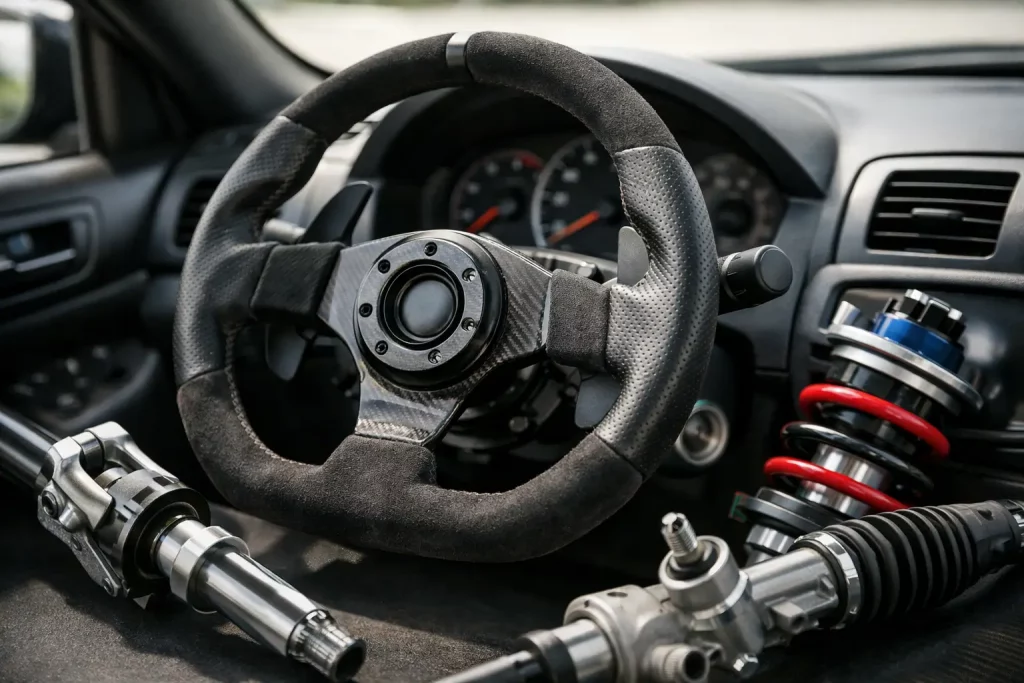
Steering upgrades are often considered when a vehicle feels heavy at parking speeds, vague on the road or simply less enjoyable to drive than it should. The right change can reduce effort, sharpen response and improve confidence, but steering is a safety-critical system. An upgrade that suits a lightweight classic may be entirely wrong for a modern vehicle with electronic driver assistance systems.
The starting point is not a catalogue of parts. It is an accurate understanding of the vehicle, how it is used and whether the existing steering system is fundamentally sound. Worn joints, incorrect geometry, tyre issues or an internal rack fault can all imitate the symptoms that owners hope an upgrade will solve.
What should steering upgrades achieve?
A worthwhile steering improvement should make the vehicle more predictable without removing the feedback needed to place it accurately on the road. For many drivers, that means lighter low-speed steering, a more positive on-centre feel and less wandering. For performance and enthusiast vehicles, the priority may instead be response, consistency and confidence during faster road use.
There is no universal definition of better steering. Very light assistance may be welcome in a town-driven classic, yet feel artificial in a sports car. A quicker rack can make a vehicle more responsive, but it can also make small inputs more pronounced and increase the effort required if the system has limited assistance. The best specification depends on the chassis, tyre size, suspension geometry, intended use and driver expectations.
It is also useful to separate an upgrade from a repair. Reconditioning an original rack, steering box or column may restore the precise steering the vehicle had when correctly set up. That can be the most appropriate outcome, particularly where originality, established vehicle behaviour or parts compatibility matter.
Diagnose the baseline before changing components
Before approving any steering work, establish what the car is doing and when. Heavy steering only when parking can point to a different cause from a steering wheel that fails to self-centre after a bend. A knock through the wheel, uneven assistance, fluid loss, warning lights and a vague straight-ahead position each require a different diagnostic route.
On hydraulic systems, the rack, pump, drive arrangement and fluid condition all need consideration, but the steering and suspension joints must not be overlooked. On electric power steering systems, faults can arise in the rack motor, torque sensor, control electronics, wiring, battery voltage or communications network. Replacing a major component without identifying the underlying fault can leave the same warning message or poor steering feel in place.
Vehicle geometry is equally important. Toe settings, camber, caster, tyre pressures and worn bushes affect steering weight, return-to-centre and straight-line stability. A new or reconditioned rack should be followed by appropriate wheel alignment. If the steering wheel is not centred, or the vehicle pulls after the work, calibration or geometry may still be required rather than further parts replacement.
For garages, a clear fault report is particularly useful before a component is removed. It should record the vehicle registration or VIN, steering system type, dashboard messages, diagnostic codes, symptoms and any previous repair work. This helps a steering specialist identify whether repair, reconditioning, coding support or replacement is the realistic route.
Electric power steering conversions for classics
For suitable classic and specialist vehicles, electric power steering is one of the most significant steering upgrades available. A properly engineered conversion can reduce the physical effort of manoeuvring while retaining a conventional appearance and avoiding the need to add an engine-driven hydraulic system.
Column-assist electric power steering is commonly selected where packaging, originality and installation practicality are key. The assistance can often be adjusted to match the vehicle, so the wheel is not excessively light once speed rises. Done properly, the conversion must preserve secure column mounting, correct shaft alignment, suitable joints and a safe relationship between the steering wheel and rack or box.
The conversion is not automatically suitable for every classic. Space behind the dashboard, the condition of the original column, the steering layout and the vehicle’s use all matter. A vehicle with a worn steering box or poor front-end geometry will not become precise merely because assistance has been added. The underlying system should be assessed and rectified first.
Electrical installation also deserves proper attention. The motor requires an appropriate power supply, fusing, earths and secure wiring. Poorly planned installations can introduce intermittent assistance, warning issues or unwanted loads. Owners should also discuss insurance disclosure and any inspection requirements relevant to the modification. Documentation of the work and components fitted is sensible for future servicing and resale.
Rack ratio, steering boxes and mechanical changes
A quicker steering rack or altered steering arm arrangement can reduce the number of turns from lock to lock. This may improve response in some road, rally or track-oriented applications, provided the rest of the vehicle is designed to support it. Suspension movement, wheel clearance and bump-steer characteristics must be checked rather than assumed.
A faster ratio can be a poor choice if it creates excessive kickback, makes parking uncomfortable or leaves the vehicle nervous on uneven roads. Wider tyres and altered wheel offsets may also raise steering effort. These changes need to be considered together, not as isolated modifications.
On older vehicles with steering boxes, refurbishment can often offer a more authentic improvement than substituting an unsuitable modern component. Correct adjustment, internal condition and the associated linkages are central to steering accuracy. Over-tightening a worn box to disguise free play is not a repair and can cause stiffness or premature wear.
Steering columns and intermediate shafts also deserve attention, especially on classic restorations and modified vehicles. Worn universal joints, seized sliding sections or poorly matched components can create stiffness and inconsistent steering. Any alteration in this area must maintain safe engagement, alignment and collapse characteristics where applicable.
Modern EPS upgrades and replacement decisions
Modern electric steering racks are integrated systems rather than simple mechanical assemblies. The rack may contain an electric motor, control unit, torque sensing and vehicle-specific software, while its operation can be linked to stability control, lane functions and driver-assistance features.
That complexity makes part matching essential. A visually similar rack may not be electronically compatible, and a replacement may require coding, parameterisation, end-stop learning, steering-angle calibration or alignment before the vehicle operates correctly. Some suitable EPS units can be repaired at component level, tested and, where applicable, flashed or virginised for vehicle-specific coding. Other units may be too damaged, unavailable in repairable form or unsuitable for that process.
This is where a specialist assessment can avoid an unnecessary complete replacement, while still being honest when replacement is the safer or only viable option. Pro Power Steering assesses suitable racks and steering components for reconditioning, uses appropriate OE or OE-quality parts where applicable, and tests completed units before they leave the workshop. Fitting garages can also benefit from direct technical support where coding or calibration forms part of the job.
A remanufactured or repaired unit is not a shortcut around correct installation. The vehicle must be checked for damaged connectors, water ingress, collision damage, charging faults and communication errors that could affect the replacement component. It should then be aligned and calibrated to the manufacturer’s required procedure.
Choosing an upgrade for the way the vehicle is used
The most suitable route differs between vehicles. A daily-driven classic may benefit most from measured electric assistance and a refreshed original steering system. A restoration project may prioritise an authentic reconditioned steering box, correct column operation and geometry that matches factory specification. A performance vehicle may need fault diagnosis and precise calibration of its original EPS rack before any handling modification is considered.
Commercial and fleet vehicles need a similarly practical approach. Steering weight, tyre wear, repeatability and downtime all matter, so it is worth identifying whether the concern is a component fault, alignment issue or operational wear before parts are ordered. For Right Hand Drive vehicles in particular, correct component specification is critical; an incorrect rack or column variant can create fitting and calibration complications.
When comparing options, ask what is being improved, what supporting work is necessary and how the completed system will be verified. The answer should cover compatibility, installation requirements, wheel alignment, coding or calibration, and the realistic limitations of the proposed change. A 12-month warranty on completed work, under the applicable terms, provides useful reassurance, but it does not replace careful diagnosis or correct fitting.
Good steering should feel natural rather than dramatic. Whether the objective is easier manoeuvring in a cherished classic or restoring the accuracy of a modern electric rack, the most dependable result comes from matching the upgrade to the vehicle and confirming every part of the system is working together properly.
