
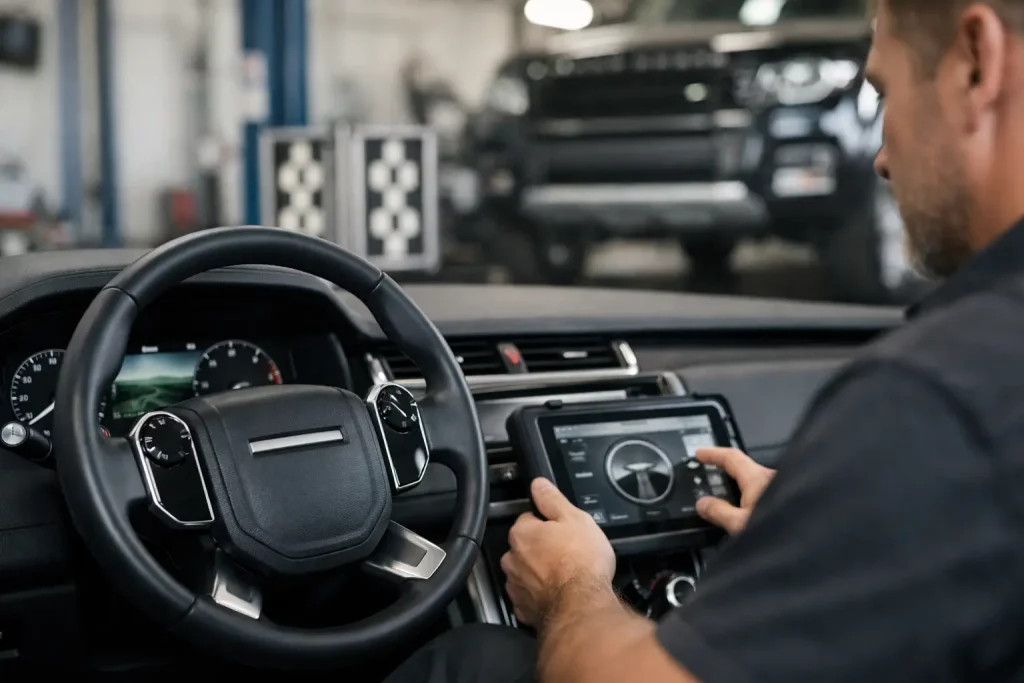
A Land Rover that drives straight can still require steering calibration. On many modern models, the steering angle sensor, electric power steering system and vehicle control modules need to agree on where the wheels are pointing. If that reference is wrong, the result may be warning lights, inconsistent assistance, stability-control faults or a steering wheel that is visibly off-centre despite a correct wheel alignment.
Land Rover steering calibration is therefore not a cosmetic finishing step. It is a vehicle-specific electronic procedure that may be required after steering and suspension work, wheel alignment, battery-related faults, replacement of certain components, or repairs to the steering rack and column. The correct approach depends on the model, its steering system and the fault codes stored in the vehicle.
What steering calibration does
Modern Land Rovers use a steering angle sensor to report steering-wheel position and steering direction to several control systems. Depending on the vehicle, that information is used by electric power steering (EPS), electronic stability control, traction control, hill-descent functions, lane-related driver assistance and terrain-response systems.
Calibration establishes a known straight-ahead position. It tells the relevant modules that, with the road wheels correctly aligned and the steering wheel centred, this is the vehicle’s true zero point. Some vehicles also require EPS configuration, end-stop learning or module coding following replacement of a rack, column or control unit.
These are related processes, but they are not interchangeable. A steering angle sensor reset will not correct poor geometry, and wheel alignment alone will not necessarily clear an EPS or stability-system fault. Accurate diagnosis identifies which procedure is actually required before parts are changed or calibration is attempted.
When Land Rover steering calibration is needed
Calibration is commonly required after a four-wheel alignment, especially when the steering wheel was not held centrally during adjustment or when toe settings have changed significantly. It may also be necessary after replacing or disturbing the steering rack, steering column, steering angle sensor, clockspring assembly, track rods, suspension components or subframe.
On EPS-equipped Land Rover models, a replacement or reconditioned rack can need vehicle-specific coding and commissioning. In some cases, a rack must be prepared correctly before installation, then coded and calibrated using suitable diagnostic equipment. The exact requirement varies between model years and platforms, so assumptions based on another Land Rover can lead to wasted workshop time.
Other situations are less obvious. A low battery voltage event, module communication fault, accident repair or incorrect previous repair can leave stored faults or implausible steering-angle readings. A warning message may appear even though the steering itself feels normal. Equally, a heavy or intermittent steering complaint may have a mechanical, electrical or hydraulic cause that calibration cannot resolve.
Signs that point towards a calibration issue
A warning for stability control, traction control, power steering or driver assistance following suspension or steering work is a common indicator. The steering wheel sitting off-centre while driving on a level road is another. Diagnostic equipment may show a steering angle that does not return close to zero with the wheels straight ahead, or may report that calibration has not completed.
However, these signs are not proof on their own. A crooked steering wheel can result from alignment settings or component wear. A steering warning can be caused by wiring, a failed sensor, low system voltage, internal rack faults or a communication issue. Reading fault codes and live data before clearing anything gives the repairer a better basis for deciding what to do next.
Alignment comes before electronic zeroing
The most reliable sequence starts with the mechanical condition of the steering and suspension. Worn ball joints, track rod ends, bushes, wheel bearings or damaged components should be addressed first. There is little value in electronically setting a straight-ahead point if movement in the system prevents the wheels from holding that position on the road.
Next comes a proper four-wheel alignment to the correct Land Rover specifications for the exact vehicle. Rear alignment matters because it establishes the thrust angle the front wheels must follow. Simply adjusting the front toe until the steering wheel looks straight can leave the vehicle tracking poorly and may cause the steering angle sensor to be referenced incorrectly.
Once the geometry is correct, the steering wheel can be held in its genuine centred position and the required calibration procedure performed. On suitable models, fault codes are then checked again and a road test confirms that steering assistance, warning systems and the vehicle’s straight-line behaviour are operating as expected.
This order is particularly relevant where a vehicle has had a steering rack removed or a subframe shifted during repair. Small changes in installation position or toe can have a noticeable effect on steering-wheel centre. Calibration should complete the repair, not compensate for an unresolved mechanical issue.
Why generic diagnostic tools are not always enough
Many scan tools can read and clear Land Rover fault codes, but not every tool supports the full calibration and coding functions required by every model. Some procedures require access to manufacturer-level routines, a stable battery support unit, precise preconditions and correct communication with multiple modules.
For example, the vehicle may require its wheels to be straight, the steering wheel to be centred, tyre pressures to be correct and no relevant active faults to be present before the procedure can run. If a routine repeatedly fails, forcing it through or repeatedly clearing faults is unlikely to fix the cause. The live data, installation condition and network faults need to be assessed.
This is also why a replacement steering rack should not be treated as a straightforward fit-and-forget part. Certain electronic racks hold configuration data and can require programming to the vehicle. A used unit may not be suitable, while a correctly reconditioned unit may still need coding and calibration once fitted. The repair route depends on the part number, vehicle specification and diagnostic findings.
Calibration after steering rack repair or replacement
A steering rack fault does not automatically mean the complete assembly must be replaced. Where a unit is suitable, component-level assessment and reconditioning can be a sound option. The rack should be inspected, rebuilt with appropriate OE or OE-quality parts where applicable, and tested before it leaves the workshop.
For applicable EPS racks, preparation may include flashing or virginising so the unit is ready for vehicle-specific coding after installation. That does not remove the need for correct fitting, alignment and final calibration at the vehicle. It simply provides the fitting garage with a properly prepared steering component and a clear next step.
There are limitations. Crash damage, severe corrosion, unavailable internal parts, electronic damage or an unsuitable core can make repair uneconomic or impractical. In those cases, replacement may be the correct answer. A specialist diagnosis helps distinguish a rack fault from faults in the column, sensor, wiring, battery supply or other vehicle systems before a costly decision is made.
A practical route for owners and workshops
If a Land Rover has a steering or stability-system warning after recent work, start by recording the warning messages, the vehicle details and any fault codes rather than clearing them immediately. Tell the repairer what has been replaced, whether alignment has been carried out and whether the steering wheel position changed after the repair. This history can save considerable diagnostic time.
For garages fitting a repaired or replacement rack, it is worth confirming coding and calibration requirements before the vehicle is dismantled. Check that the correct diagnostic capability, battery support and alignment equipment will be available at the final stage. If technical support is needed, having the VIN, part numbers and fault-code details to hand will make the conversation more productive.
Pro Power Steering supports suitable Land Rover steering units with specialist diagnosis, component-level reconditioning, workshop testing and direct technical advice for fitting garages. Where applicable, EPS racks can be prepared for vehicle-specific coding and calibration, while the final vehicle procedures are approached with the alignment and diagnostic checks they require.
A correctly calibrated Land Rover should not merely have its warning lights extinguished. It should leave the workshop with the wheel centred, steering assistance behaving predictably and the electronic systems receiving trustworthy information – the conditions needed for safe, smooth and precise steering.
