
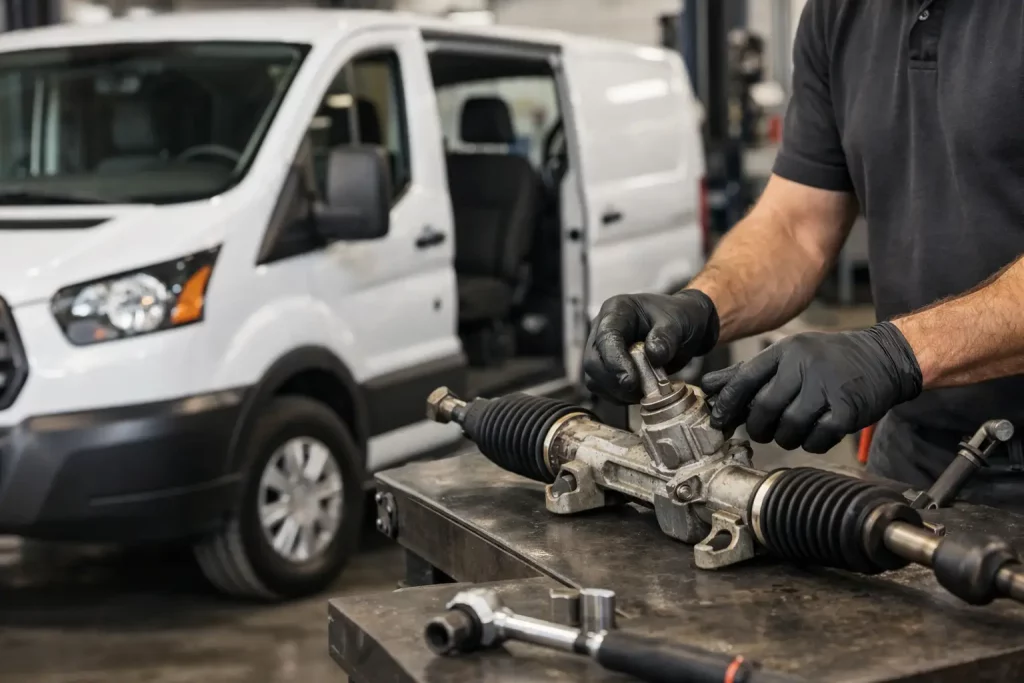
A Ford Transit is expected to feel stable and predictable, whether it is carrying tools, passengers or a full payload. When Ford Transit steering play develops, the driver may notice a delay between moving the steering wheel and the van changing direction. It can be subtle at first, but excess movement at the wheel should not be dismissed as a normal trait of a working vehicle.
Steering play is not one fault in itself. It is a symptom that can originate in the steering column, intermediate shaft, steering rack, track rods, suspension joints or wheel bearings. Accurate diagnosis matters because replacing the most obvious part without identifying the source of movement can leave the van with the same vague response – and add unnecessary cost.
What does steering play feel like on a Ford Transit?
Drivers commonly describe a loose or dead area around the straight-ahead position. The steering wheel may turn a noticeable amount before the road wheels respond, particularly when making small corrections on a motorway or uneven road. Some vans may wander, require frequent correction, or feel less settled when loaded.
The symptoms can vary with vehicle speed and load. A fault in an outer track rod end, for example, may be more obvious during low-speed manoeuvres or when a helper moves the steering wheel. Internal rack wear can give a more consistent free-play feeling through the steering wheel. A knock when changing direction, travelling over potholes or applying the brakes may point towards related suspension or steering-joint wear, but it is not proof on its own.
Tyre wear is another useful clue. Feathering, uneven inner-edge wear or rapid shoulder wear can be associated with incorrect alignment, worn joints or both. However, tyres alone cannot diagnose a steering fault. Alignment readings are meaningful only once the steering and suspension components are confirmed sound.
Common causes of Ford Transit steering play
Worn track rod ends and inner joints
Track rod ends transfer the rack’s movement to the steering arms at the wheels. Their ball joints operate constantly and eventually wear, especially on vans used over poor roads, kerbs and delivery routes. Inner track rod joints can wear too, creating movement closer to the rack that is not always visible during a quick external inspection.
Wear in either position can create inaccurate steering response and alter toe settings as the vehicle moves. These parts are often serviceable individually, provided the rack itself is in good condition and the correct geometry is restored afterwards.
Steering rack wear or mounting movement
A steering rack contains precision gears, bearings, seals and internal guidance components. Wear at the pinion, rack bar or internal support can produce free play, a knock, tight spots or an inconsistent feel. A rack may also appear to have excessive play when its mounting bushes or fixing points allow the assembly to move under steering load.
The correct repair depends on the rack type and the fault found. Some suitable units can be assessed and reconditioned at component level, replacing worn internal parts where available and appropriate. Other racks may be too damaged, too corroded, unavailable for parts support, or affected by a fault that makes replacement the sensible route. A specialist inspection avoids assuming that every loose rack needs a complete new unit.
Column, shaft and universal-joint wear
The steering wheel connects to the rack through the column and, on many Transits, an intermediate shaft with universal joints. Play in these components can feel particularly direct at the steering wheel. It can also be intermittent if a joint is stiff, corroded or worn at a particular angle.
Because the column area includes safety-critical components, electrical connections and, on some vehicles, steering-angle sensing equipment, it needs careful assessment. Movement should be identified at the exact joint or coupling rather than attributed to the rack by default.
Suspension and wheel-end faults that imitate rack play
Lower arm bushes, ball joints, anti-roll-bar links, strut top mounts and wheel bearings do not create play inside the steering rack, but they can make a Transit feel vague or unstable. A worn lower arm rear bush, for instance, can let the wheel move backwards and forwards under braking or acceleration, changing the vehicle’s direction without a clear steering input.
This is why a full front-end inspection is more valuable than simply checking for movement at the steering wheel. On high-mileage commercial vehicles, more than one component may have deteriorated at the same time.
How steering play should be diagnosed
A proper assessment begins with confirming the complaint. The technician should establish whether the free play is present with the engine running and switched off, whether it changes with road speed, and whether there are warning lamps or assistance faults. This helps distinguish a mechanical clearance issue from a power-steering assistance or electronic control concern.
The van should then be inspected with the wheels unloaded and, where appropriate, under normal load. By applying short, controlled movements at the steering wheel while observing the column shaft, rack input, rack housing, inner joints and outer joints, it is possible to see where motion is being lost. Checking both sides matters, as a single worn joint can be missed if the steering is held in the wrong position.
A road test can add valuable context, but it does not replace physical checks. The technician should also inspect tyre condition, wheel-bearing security, suspension bushes and subframe mounting points. Once mechanical faults have been corrected, wheel alignment should be set to the vehicle’s specification. Aligning a van before rectifying free play can produce readings that will not remain stable on the road.
For electrically assisted steering systems, diagnostic equipment may be needed to check fault codes, steering-angle data, voltage supply and communication faults. If an EPS rack or related component has been replaced or repaired, coding, calibration or a steering-angle reset may be required for the individual model. This is not a universal requirement, but overlooking it can leave warning lights, poor assistance behaviour or stability-control concerns.
Repair options for a loose Transit steering system
The appropriate repair is based on the source of movement, not the age of the van alone. Worn track rod ends, inner joints or selected suspension components may be replaced, followed by alignment. A damaged intermediate shaft or column coupling may require replacement or specialist repair where parts availability and design permit.
Where the steering rack is the confirmed fault, a tested reconditioned unit can be a practical alternative to automatic complete replacement with a new assembly. Component-level reconditioning is particularly relevant where the housing and core components remain viable but internal wear, seals or bearings require attention. The rack must be suitable for the process, rebuilt with appropriate parts and tested before dispatch or installation.
There are limits. A rack with severe casing damage, excessive corrosion, unavailable electronic parts or a non-repairable control fault may need replacement. Some later electric racks also require vehicle-specific programming after installation. A reliable repair decision should account for the exact Transit model, year, drivetrain, steering system, part number and whether it is right-hand drive.
Why prompt attention is worthwhile
Excess steering play can make a loaded Transit tiring to drive and less precise during emergency avoidance or crosswinds. It can also accelerate tyre wear and place extra stress on joints that are already worn. The effect may be gradual, which is why drivers often adapt to it before recognising how much steering accuracy has been lost.
For fleets and working vans, early diagnosis can reduce downtime by identifying whether the problem is a replaceable external joint, a rack issue or a wider front-end condition. It also gives a fitting garage the information needed to plan alignment, parts supply and any calibration work correctly.
Pro Power Steering assesses steering faults as a complete system rather than treating every loose steering complaint as a rack replacement. For suitable Ford Transit racks, component-level reconditioning, workshop testing and technical support can provide a dependable route back to smooth, precise steering. If your Transit no longer responds cleanly around the straight-ahead position, a focused steering inspection is the sensible next step before the wear develops further.
