
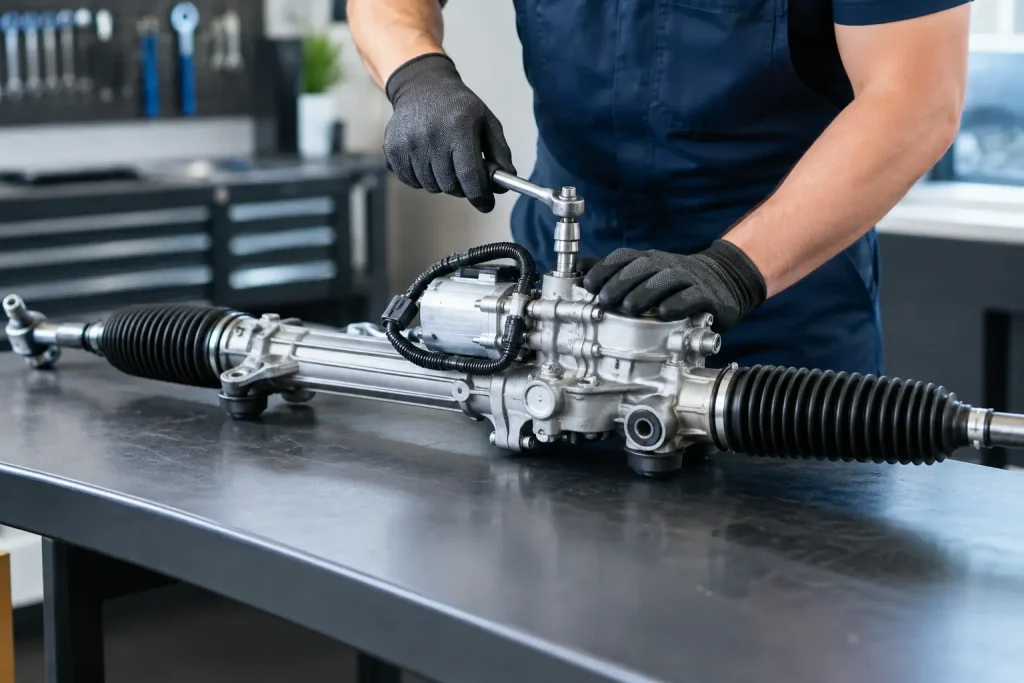
A dashboard steering warning can turn a normally straightforward repair into a difficult decision. When assistance disappears, becomes intermittent or the steering feels inconsistent, electric power steering rack repair may offer a sound alternative to fitting a costly new dealer unit. The right route depends on whether the fault is within the rack’s mechanical assembly, electric motor, control electronics or the vehicle systems that communicate with it.
For modern rack-mounted EPS systems, accurate diagnosis matters as much as the repair itself. A warning light and heavy steering do not automatically mean the entire rack has failed, but neither should they be dismissed as a simple battery or alignment issue. The rack is a safety-critical assembly and needs specialist assessment before a repair or replacement decision is made.
What makes an EPS steering rack different?
A rack-mounted electric power steering system combines the steering rack’s conventional mechanical function with an electric assistance motor, reduction gear and electronic control unit. Sensors monitor steering input and vehicle operating conditions, allowing the ECU to vary assistance rather than delivering the fixed feel associated with older hydraulic arrangements.
This layout is common on modern BMW, Mercedes-Benz, Audi, Porsche, Jaguar, Land Rover, Range Rover, Volvo and Ford models, among others. It can improve efficiency and give manufacturers greater control over steering weight, stability functions and driver-assistance features. It also means a fault may be mechanical, electrical or software-related – sometimes more than one at once.
The important distinction is that not every electric steering fault is a rack fault. Some vehicles use column-mounted assistance, which is a different component and repair path. Where the motor and ECU are integrated with the steering rack, however, diagnosis must focus on the rack assembly and its communication with the vehicle.
Common electric power steering rack repair symptoms
The most obvious symptom is a red or amber steering warning message accompanied by reduced or lost assistance. The steering may suddenly feel very heavy at parking speeds, then appear normal after an ignition cycle. Intermittent assistance is especially significant because it can point to an electronic fault, poor internal connection, motor issue or a fault recorded by the control unit.
Other faults are less dramatic. Drivers may notice uneven assistance, a notchy sensation through the wheel, excessive free play, a pull that requires further investigation, or an unnatural self-centring feel. A clicking or knocking noise over rough surfaces can indicate wear in the rack, inner joints or mounting-related components, although a technician should not assume the rack is responsible without checking the vehicle properly.
Water ingress is a frequent concern on some applications. Moisture can damage connectors, motors and internal electronics, while corrosion may affect the mechanical side of the assembly. Impact damage from kerbs or potholes can also cause physical damage or expose a pre-existing weakness. On premium vehicles with active steering functions, the fault may be accompanied by warnings for stability or driver-assistance systems because those modules rely on valid steering data.
Diagnosis comes before repair
A specialist steering diagnosis begins by confirming the exact vehicle, chassis details and rack type. Right Hand Drive racks can differ from their left-hand-drive equivalents in design, configuration and parts availability, so the correct application is essential from the outset.
Diagnostic equipment is then used to read fault codes from the EPS ECU and relevant vehicle modules. Codes provide a direction, not a complete verdict. A stored low-voltage code, for example, may result from a weak battery or charging issue, while a motor circuit, internal ECU or position-sensor code can justify closer inspection of the rack itself. Live data can help show whether the steering angle, torque input and motor demand are plausible.
Electrical supply, earth connections, wiring condition and connector integrity also need checking. Replacing a rack without identifying a supply or communication fault can leave the same warning light in place. Equally, clearing codes without addressing the underlying rack defect is not a repair.
The mechanical condition matters too. A rack can have an electronic fault and wear in the rack bar, pinion, bearings or inner joint areas. Inspection helps establish whether the steering is binding, loose, contaminated or damaged. This is where specialist experience makes the difference between a targeted solution and an expensive guess.
When can an EPS rack be repaired or reconditioned?
Repairability depends on the precise failure, the rack design and the condition of the assembly. Many suitable units can be repaired or reconditioned at component level. This may involve rectifying an electronic fault, addressing motor-related issues, renewing worn mechanical parts where available, replacing damaged seals or restoring the rack to correct operating condition.
A proper reconditioning process is more than cleaning and repainting a unit. The rack should be stripped and examined where appropriate, with worn or defective components identified before rebuilding. Mechanical operation, seals, preload and free movement must be checked, while electronic functions require controlled testing. The aim is to return the rack to smooth, precise and dependable operation rather than merely remove a dashboard warning.
There are limits. Severe corrosion, accident damage, unavailable internal parts or extensive electronic damage can make repair unsuitable. In such cases, a replacement or exchange steering rack may be the more reliable option. This is not a failure of the repair process – it is the correct technical decision for a safety-critical component.
For older, specialist or discontinued vehicles, reconditioning can be particularly valuable when a new rack is no longer readily available. For modern vehicles, it can also be a practical route where the original rack is otherwise serviceable and the fault is known to be repairable.
Programming, coding and calibration after refitting
An EPS rack is not always ready to use the moment it is bolted back into the vehicle. Depending on the manufacturer and system, the replacement or repaired rack may require coding, programming, commissioning or calibration. Some ECUs need to be virginised before installation, while others may retain vehicle-specific data that must be correctly managed.
Steering angle sensor calibration is commonly required after rack work, and some vehicles need end-stop learning, torque-sensor initialisation or fault-memory procedures. Where driver-assistance systems are fitted, incorrect set-up can lead to warning lights, poor steering feel or functions that do not operate as intended.
This is why an exchange unit must be supplied for the exact application and why garages should plan the electronic work before fitting. Coding capability varies by vehicle, particularly across premium makes, so it is sensible to confirm requirements at the quotation stage rather than after installation.
Repair, exchange or replacement: choosing the sensible route
The best option is not automatically the cheapest upfront choice. A repair may be appropriate when the original rack is suitable for reconditioning and the fault can be resolved reliably. It also retains the vehicle’s correct physical rack specification, which can be important for unusual or Right Hand Drive applications.
An exchange rack can reduce vehicle downtime where a suitable unit is available. This is often attractive to independent garages, fleet operators and workshops managing booked work. It still needs to be matched carefully to the vehicle and installed with the required programming and calibration steps.
A replacement rack may be necessary where the original unit is damaged beyond economic repair or a compatible reconditioned unit cannot be supplied. New units can be the right answer, but they are not automatically free of installation requirements. The vehicle may still need coding, calibration and a full post-repair fault check.
Whichever route is chosen, fitting should include checks for related causes of failure. Damaged wiring, water ingress pathways, weak electrical supply or impact-related suspension damage can compromise the outcome if left unresolved. Wheel alignment should also be checked after rack removal and refitting, but it should not be used as a substitute for diagnosing an EPS fault.
Why specialist testing protects the repair
Electric racks combine high mechanical loads with sensitive electronics. A useful repair process therefore needs both steering-rack knowledge and vehicle-specific electronic understanding. The goal is not simply to make the warning disappear, but to verify that assistance is consistent, fault codes are resolved and the rack responds correctly once installed and calibrated.
For garages, clear fault information, correct vehicle identification and details of prior work can speed up assessment. For owners, reporting exactly when the fault occurs – cold, hot, after rain, during parking or continuously – can provide valuable diagnostic clues. Avoid continuing to drive with intermittent heavy steering where possible, as reduced assistance can make low-speed control unexpectedly difficult.
Pro Power Steering assesses suitable rack-mounted EPS units for repair, reconditioning or replacement, including technically demanding Right Hand Drive applications. With a 12-month guarantee on completed work, the focus is on selecting a repair path that suits the condition of the rack and the needs of the vehicle.
If your steering warning is intermittent or the steering has become heavy, arrange a proper rack-focused diagnosis before authorising replacement. A clear assessment of the mechanical, electronic and programming requirements is the best starting point for restoring safe, precise steering.
