
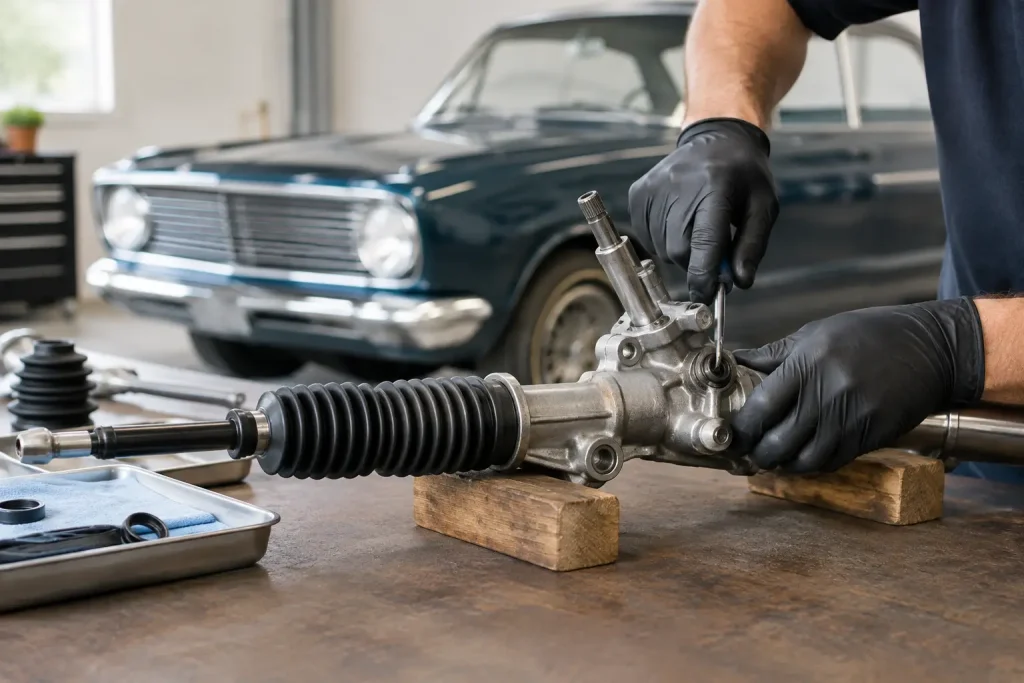
A manual steering rack can look deceptively simple: no electric motor, control unit or hydraulic assistance, just a mechanical link between the steering wheel and road wheels. Yet when it wears, corrodes or is incorrectly rebuilt, the result can be vague response, heavy steering, poor self-centring or an unsettling knock through the wheel. This manual rack restoration guide explains what proper assessment and reconditioning should involve, particularly for classic, performance and specialist vehicles where an original unit may be worth preserving.
Why a manual rack deserves specialist assessment
Manual racks are common on older cars, lightweight sports cars, competition-focused vehicles and certain commercial applications. Their directness is part of their appeal. With no assistance masking the feedback, the driver can quickly feel changes in tyre contact, suspension geometry and rack condition.
That also means defects are difficult to ignore. A rack that is stiff around centre, develops free play or feels notchy may affect confidence as well as directional control. The fault is not always inside the rack, however. Worn track rod ends, seized universal joints, damaged steering columns, incorrect tyre pressures, poor wheel alignment or suspension wear can all create similar symptoms.
Accurate diagnosis prevents a sound rack being removed unnecessarily and avoids fitting a reconditioned unit only to find that the original problem remains. For a restoration project, this matters even more: original components may be rare, vehicle-specific and costly to replace.
Manual rack restoration guide: what should be checked first
Before reconditioning is considered, the rack should be assessed as part of the complete steering system. The technician will establish whether the concern is excessive movement, high steering effort, noise, inconsistent feel or damage caused by corrosion or impact.
Free play at the steering wheel may point to internal wear in the pinion support, rack guide or gear teeth, but it may equally originate in outer joints, column couplings or steering box components on vehicles with more complex arrangements. A knock while turning can be caused by inner joints or mounting bushes rather than the rack mechanism itself.
Stiffness needs particularly careful investigation. A manual rack will naturally feel heavier than a power-assisted system, especially at parking speeds, but steering effort should remain consistent from lock to lock. Tightness in one area can suggest corrosion on the rack bar, damaged teeth, a distorted housing or an incorrectly adjusted rack guide. If stiffness changes when the vehicle is raised, tyre and suspension factors may be involved.
A visual inspection is equally useful. Torn gaiters allow water and grit onto the rack bar, leading to pitting that damages seals and accelerates wear. Bent track rods, damaged mountings, evidence of accident repair and poorly fitted aftermarket parts should all be identified before a repair route is agreed.
What proper rack reconditioning involves
A professional restoration is not simply a clean, paint and grease service. The rack is stripped so that its internal condition can be examined at component level. This is the stage at which a specialist can decide whether reconditioning is appropriate or whether replacement, alternative parts sourcing or further vehicle repairs are required.
The housing, pinion, rack bar, guides, bushes, bearings and threads are inspected for wear, distortion and corrosion. The condition of the gear teeth is critical. Light surface staining may be recoverable where dimensions and contact surfaces remain within acceptable condition. Deep pitting, damaged teeth, cracks or a bent rack bar can make a unit unsuitable for safe restoration.
Where suitable, worn serviceable components are renewed using appropriate OE or OE-quality parts. Bushes and bearings must support the rack accurately without creating binding. Seals and gaiters are renewed where applicable, while the rack guide preload is set carefully to balance two competing requirements: minimal free play and smooth movement through the full steering travel.
That balance is where experience matters. An overtightened rack can feel precise on a bench but become heavy, fail to self-centre properly and wear prematurely in service. Too little preload can leave excessive movement at the steering wheel. The correct setting depends on the rack design and the condition of its core components, not a generic adjustment.
Preservation matters on classic and specialist vehicles
For a classic car, maintaining the original steering rack can retain correct geometry, mounting positions and steering ratio. Some reproduction units are entirely suitable, but availability and quality vary. An apparently similar rack may have different travel, pinion orientation, thread type or inner joint arrangement, each of which can affect fitment and handling.
A restoration should also respect the vehicle’s intended character. A lightweight roadster may be expected to have firm low-speed steering, while a larger saloon should not require excessive effort or wander on the road. The aim is not to make every car feel artificially light. It is to return the system to smooth, predictable and accurate operation.
Bench testing is part of the repair, not an optional extra
Once rebuilt, a manual rack should be tested through its full travel before it leaves the workshop. This confirms consistent movement, suitable preload and correct operation of the renewed components. Threads, mounting points and relevant interfaces should also be checked for damage that could compromise installation.
Bench testing cannot reproduce every force experienced on the road. It does, however, identify problems that should never reach the vehicle, such as tight spots, excessive backlash or restricted travel. A quality reconditioning process combines this controlled testing with vehicle-specific knowledge of rack fitment and steering geometry.
Pro Power Steering assesses suitable units individually, reconditions them at component level and tests completed work before dispatch or fitting. This approach is particularly valuable where an original Right Hand Drive rack is difficult to source or where a generic replacement risks incorrect fitment.
Refitting: the work around the rack still matters
Even a correctly restored rack can perform poorly if it is fitted into a worn or misaligned steering system. Mounting bushes, column joints, track rods and track rod ends should be inspected during installation. Fasteners must be tightened to the vehicle manufacturer’s specification, and the steering wheel position should be confirmed before final alignment.
Wheel alignment is essential after rack removal or replacement. Toe settings affect straight-line stability, tyre wear and steering feel, while a steering wheel that is off-centre can be mistaken for a rack fault. On vehicles with modified suspension, altered ride height or non-standard wheels, alignment should be set with the intended use of the car in mind rather than relying blindly on a generic figure.
A road test after alignment gives the clearest answer. The vehicle should track consistently, respond progressively and return from a turn without abnormal resistance. Any remaining vibration, knock or heavy steering should be investigated as a wider chassis or steering-column issue rather than adjusted out at the rack.
When restoration is not the right answer
Not every manual rack can or should be rebuilt. Severe internal corrosion, crash damage, unavailable hard parts and damaged gear teeth may leave no safe or economical restoration route. In these cases, a replacement rack, a suitable exchange unit or a bespoke parts solution may be the better decision.
It also depends on the vehicle’s role. A concours restoration may justify preserving a matching original component where possible. A regularly used fleet vehicle may need the quickest dependable route back to service. A track-focused car might require a particular ratio or carefully specified setup. The right option is the one that delivers safe steering, correct fitment and realistic long-term support.
For owners and workshops, the useful starting point is not to assume that a stiff or loose steering system automatically needs a new rack. A proper diagnosis can establish whether the fault lies in the rack, surrounding components or vehicle geometry, then identify whether restoration is technically sound. That gives an older or specialist vehicle the best chance of retaining the precise, trustworthy steering it was designed to deliver.
