
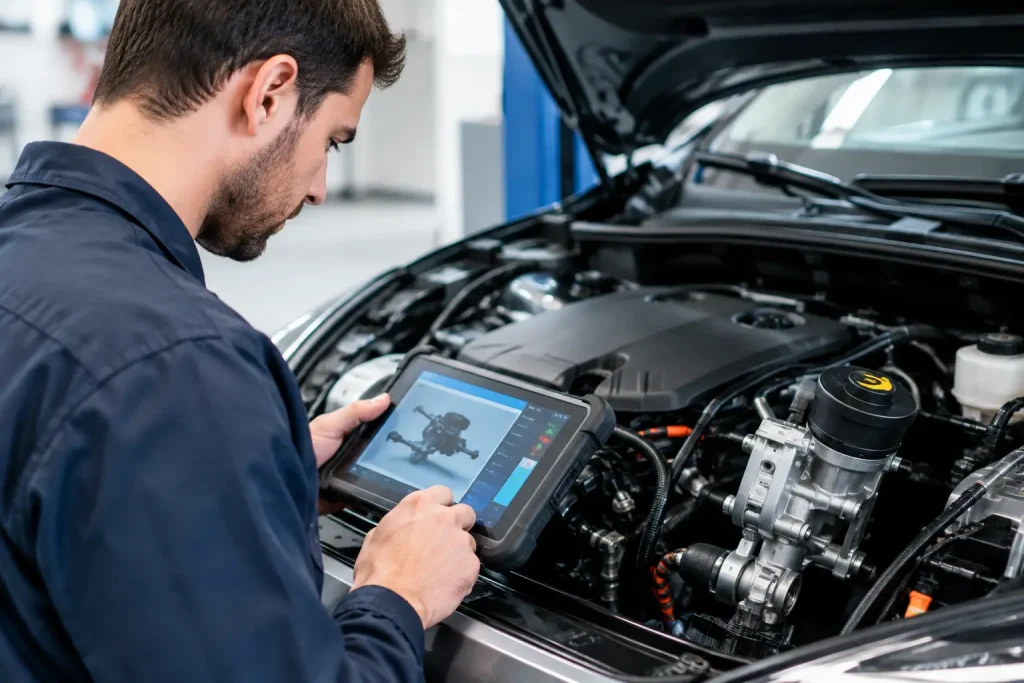
A realistic EPS fault diagnosis example begins with a driver reporting intermittent heavy steering on a modern right-hand-drive vehicle. The steering warning lamp has appeared twice, usually after start-up, yet the vehicle may feel normal by the time it arrives at the workshop. Replacing the steering rack immediately would be an expensive assumption. The correct route is to establish whether the fault is in the rack, column, power supply, communication network, sensor inputs or calibration.
Electronic Power Steering is a safety-critical system. Its fault finding needs to combine the driver’s report, a physical inspection, vehicle-specific diagnostic data and measured electrical tests. That approach avoids condemning a serviceable rack because of a low-voltage event or, equally, overlooking an internal fault that is likely to return.
What this EPS fault diagnosis example shows
Consider a late-model saloon fitted with an electrically assisted rack. The owner notices that assistance occasionally becomes very low during slow manoeuvres, particularly after the vehicle has stood overnight. The steering warning lamp illuminates, but clears after switching the ignition off and restarting. There is no obvious steering noise, no collision damage and no visible issue with the front suspension.
A generic code reader identifies a steering-related fault, but its description is limited. A vehicle-capable scan tool is then used to access the correct control modules. It records a stored fault referring to motor supply voltage outside the permitted range, together with an event in the steering control unit. The code is not treated as a diagnosis in itself. It is evidence that requires context.
The first checks focus on system voltage. The battery may start the engine adequately while still dropping below the EPS module’s operating threshold during cranking. Battery condition, terminal security, main earth points, charging voltage and voltage drop under load all matter. A poor connection can create a brief interruption that the driver never notices elsewhere, while the EPS unit logs it and reduces assistance as a protective measure.
In this example, battery testing reveals reduced capacity and a notable voltage dip during cranking. The main power connections are cleaned, the battery is replaced where justified, and fault memory is cleared. A road test and repeated start cycles are carried out before any steering component is considered. If the fault does not return, the rack has not been needlessly replaced.
That outcome is common enough to justify careful preliminary testing, but it is not the answer to every EPS warning lamp. A sound supply voltage does not rule out a rack, column or control-unit problem.
The right diagnostic sequence for EPS faults
A reliable diagnosis normally starts with the complaint rather than the fault code. Is the steering consistently heavy, only heavy in one direction, intermittent, or affected by vehicle speed? Did the warning appear after a flat battery, electrical repair, wheel alignment, accident damage or steering work? Details like these help separate an electrical supply concern from a mechanical restriction or a coding issue.
A technician should then inspect the steering system in its installed condition. This includes the rack mountings, track rods, gaiters, steering column joints, wiring routes and electrical connectors. The front wheels and suspension must also be assessed. A seized upper strut bearing, damaged ball joint or binding column universal joint can make a healthy EPS system feel weak, particularly at parking speeds.
Next comes a full module scan using suitable equipment. Relevant data may include system voltage, motor current, steering angle, torque sensor values, assistance request, vehicle speed input and communication status. Live data is often more revealing than a historic code. For example, a torque sensor reading that does not return close to its expected centre value with the wheels straight may point to a sensor issue, an incorrect set-up or the need for a valid calibration procedure.
Electrical testing must be performed with the circuit loaded where appropriate. Continuity alone can be misleading because a corroded terminal may pass a simple continuity check but fail when the EPS motor draws current. The diagnostic process should verify supply, ground integrity, connector condition and network communication against the vehicle’s wiring information and specifications.
When scan data points towards the rack
A second EPS fault diagnosis example involves a vehicle with permanent heavy steering and an EPS warning lamp that remains on. The scan tool communicates with other vehicle modules, but not with the steering rack control unit. Power and earth supplies at the rack connector are confirmed, the relevant fuses are intact and network wiring checks do not reveal an external issue.
At that stage, an internal rack fault becomes a credible diagnosis. Depending on the design, the underlying cause may involve the control electronics, motor assembly, internal position sensing or a failure within the rack-mounted module. The repair decision depends on the exact vehicle, fault findings and availability of suitable parts or reconditioning options.
A specialist assessment is valuable here because an EPS rack is not simply a motor attached to a mechanical component. It is an integrated steering assembly. A suitable unit may be assessed at component level, rebuilt using appropriate OE or OE-quality components where applicable, and tested before it leaves the workshop. Not every unit is economically repairable, and severe impact damage, unsuitable internal wear or unavailable electronic components can make replacement the more appropriate option.
For certain electronic racks, preparation may include flashing or virginising the unit so it can accept vehicle-specific coding after installation. This must be matched to the manufacturer’s procedure. Fitting a replacement or reconditioned rack without coding, steering-angle calibration or correct end-stop learning can leave warning lamps active, produce incorrect assistance or affect other driver-assistance systems.
Mechanical faults can mimic an EPS failure
An EPS warning does not automatically mean that the electric motor has failed. Equally, no warning lamp does not prove that the steering system is mechanically sound. A rack with internal wear may develop free play, an inconsistent feel around centre or a knock that is most apparent over uneven roads. A binding steering column joint may create stiffness that varies with steering position.
The key distinction is made through inspection and measured results, not guesswork. With the front axle safely assessed, a technician can establish whether resistance is present mechanically and whether motor current or assistance output corresponds with the steering load. If the steering is physically restricted, fitting an electronic control unit will not cure it. If the rack is receiving the correct command but cannot provide the required assistance, further rack-level investigation is justified.
This matters on premium vehicles, performance cars and commercial applications where steering systems can be more complex and the cost of an incorrect part decision is higher. It also matters on older specialist vehicles converted to electric assistance, where installation quality, controller settings and column geometry may affect the result.
Coding, calibration and alignment after EPS work
Once an EPS component has been repaired or replaced, the final stage is not merely clearing fault codes. The steering wheel must be centred correctly, wheel alignment checked and any required steering-angle sensor, torque sensor or EPS calibration procedure completed. Requirements differ between makes and models, so the vehicle-specific process should always be followed.
Alignment is particularly relevant after rack removal or replacement because track-rod adjustment affects toe angle and steering wheel position. A vehicle can drive straight enough to appear acceptable while its steering-angle data is offset. That can lead to warning messages or interfere with stability-control and driver-assistance functions.
A proper handover includes a road test, confirmation that warning lamps remain extinguished, and verification that steering assistance is smooth, even and predictable through the full range of movement. Where coding or adaptation is required, the fitting garage and steering specialist may need to work together to complete the job correctly.
When to involve an EPS steering specialist
Intermittent faults, communication errors and post-installation coding issues are good reasons to seek specialist help before ordering a complete rack. The same applies when a garage has confirmed correct power, earths and mechanical condition but the EPS system still reports an internal fault.
Pro Power Steering supports vehicle owners and workshops with specialist steering diagnostics, rack reconditioning and technical advice for suitable applications. The aim is not to force every fault into a repair. It is to identify the most reliable route, whether that is correcting an external electrical issue, reconditioning a suitable unit, completing the required coding and calibration, or fitting a replacement where repair is not viable.
When the steering warning lamp appears, treat it as a request for evidence rather than a verdict on the rack. A structured diagnosis protects the vehicle, the repair budget and, most importantly, the smooth, precise steering the driver should be able to rely on.
