
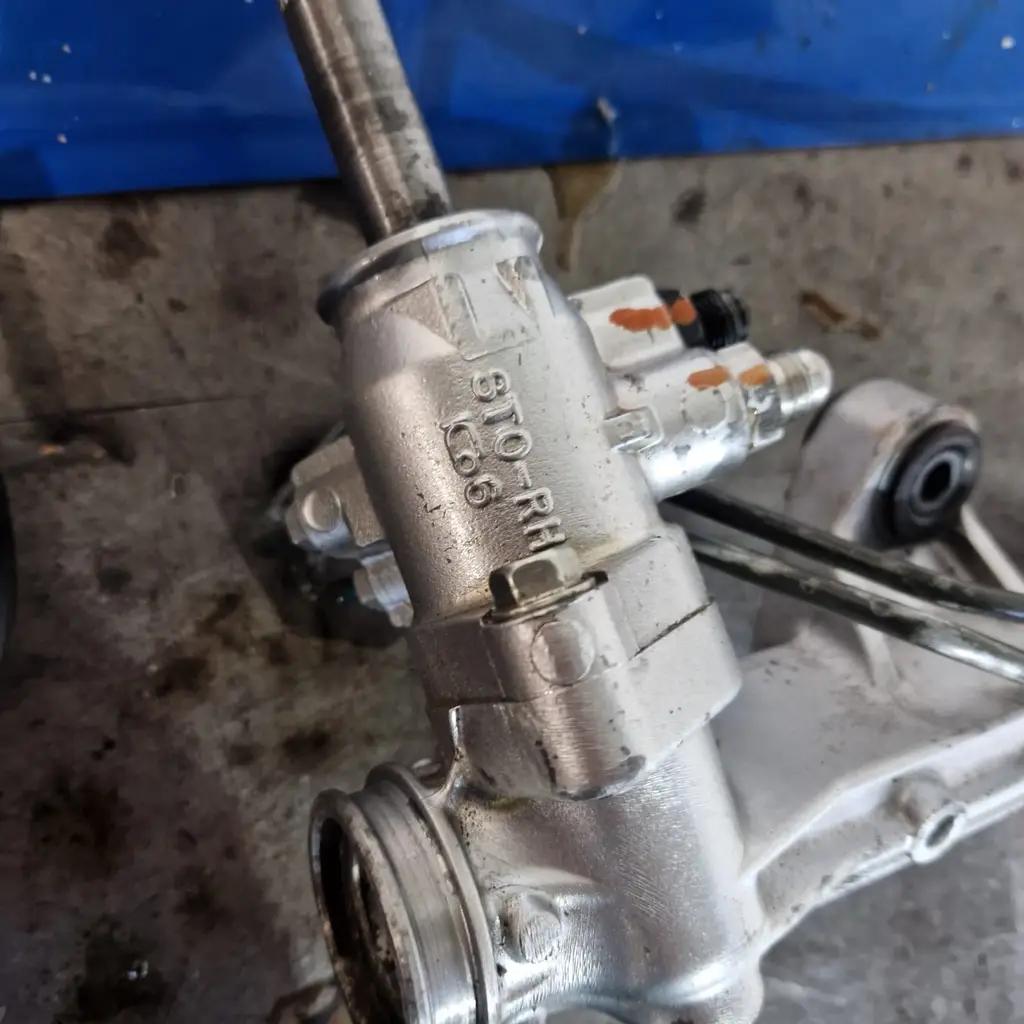
A steering rack can disappear from a manufacturer’s parts catalogue long before the vehicle itself becomes rare. A dealer may confirm that the unit is obsolete, an aftermarket catalogue may show no available replacement, and used examples may be listed with little proof that they are correct or serviceable. Knowing how to source discontinued racks properly can prevent wasted labour, incorrect purchases and a vehicle being off the road for far longer than necessary.
For a modern vehicle, classic car, performance model or commercial vehicle, the answer is rarely as simple as finding a rack that looks similar. The correct unit must match the vehicle’s steering geometry, mounting arrangement, input shaft, hydraulic or electronic specification and, where applicable, its control module requirements.
Start with diagnosis, not the parts search
A rack that feels heavy, leaks, knocks or produces an EPS warning does not automatically need complete replacement. A fault elsewhere in the steering system can imitate rack failure, while some rack faults can be resolved through component-level reconditioning.
Before sourcing a discontinued unit, establish the actual cause of the complaint. This may include checking for excessive internal play, damaged rack teeth, worn pinion bearings, corrosion in the working area of the rack bar, fluid contamination on hydraulic systems, or electronic faults affecting an electric power steering rack. The condition of track rods, column joints, steering shafts, suspension components and tyres also matters when assessing vague or uneven steering.
For EPS-equipped vehicles, diagnostic fault codes are useful, but they are not the whole diagnosis. A communication fault, power supply issue, torque sensor concern or motor problem may require a different repair route from a mechanically worn rack. Accurate assessment avoids sourcing an expensive component that will not rectify the underlying fault.
Identify the rack precisely before you buy
Vehicle registration details are a helpful starting point, but they should not be the only identification method. Manufacturers can fit different racks during the same model year, sometimes according to engine, trim level, wheelbase, suspension package, production date or market.
The strongest identification usually comes from the original rack itself. Record the manufacturer’s number and any OE part number from the housing label or casting. On electronic racks, note the motor, ECU and rack identification numbers where accessible. Clear photographs of labels, connectors, mounting points and the input shaft can also help a specialist compare the unit against known applications.
Useful information to collect includes:
- The vehicle VIN, registration number, make, model, engine and production year
- Whether the car is Right Hand Drive or Left Hand Drive
- OE numbers, manufacturer numbers and any suffixes shown on the rack
- The steering fault and any diagnostic codes present
- Whether the rack is hydraulic, manual or electric power steering
- Details of previous steering repairs, accident damage or modifications
Right Hand Drive specification deserves particular care. A Left Hand Drive rack may appear broadly similar, but its pinion position, hydraulic connections, motor layout, travel or mounting arrangement can differ. It is not a like-for-like substitute simply because it physically fits within the subframe.
Understand the realistic sourcing routes
When a rack is discontinued, there are usually three possible routes: a genuine new-old-stock unit, a used original unit, or reconditioning of the customer’s own rack or a suitable exchange core. The best route depends on availability, cost, the vehicle’s intended use and the exact condition of the original component.
New-old-stock can be attractive where the part number is confirmed and the unit has been stored correctly. However, age still matters. Seals can harden, surface corrosion may develop and electronic components may have been stored for many years. A genuine boxed rack is not automatically free from checks simply because it has never been fitted.
Used racks can be useful when the original rack is beyond repair, particularly for low-volume classics and specialist vehicles. The limitation is that a dismantled vehicle’s steering fault history is often unknown. A used rack may have internal wear, corrosion or an electronic defect that is not visible externally. It should be treated as a core for inspection or a temporary availability solution, not assumed to be ready for installation.
Reconditioning is often the most dependable option when the original housing and major hard parts remain serviceable. A specialist can inspect the rack at component level, replace worn or failed internal parts where suitable replacements are available, and test the completed unit before it leaves the workshop. This retains the correct vehicle-specific casing and fitment while avoiding reliance on an unverified used part.
How to source discontinued steering racks with confidence
The parts search should be based on verified numbers rather than general vehicle descriptions. A phrase such as “BMW 3 Series steering rack” or “classic Ford rack” is too broad to establish compatibility. Even within one model range, different steering ratios, active steering systems, suspension options and production changes can create several possible units.
Ask the supplier or specialist to confirm what is being supplied. Is it a used rack, a remanufactured rack, an exchange unit or new-old-stock? Has the unit been inspected and tested? Are the track rods included, and if so, are they correct for the application? Does an EPS rack require coding, flashing, virginising or calibration after installation?
For hydraulic racks, check the location and thread type of ports, the pinion input, mounting points and overall travel. For electric racks, the electronic identity is equally important. Two racks with matching housings may use different ECU software, connectors, torque sensor configurations or motor specifications.
It is also sensible to confirm whether the supplied rack needs to be returned as an exchange unit. If the original is missing, broken beyond identification or already dismantled, that can affect both availability and price.
When reconditioning is a better answer than replacement
A discontinued rack does not mean the vehicle has reached the end of a practical repair path. Many units can be rebuilt when a specialist can obtain the correct seals, bearings, bushes, rack bars, pinion parts or electronic components and the core is structurally sound.
There are limits. A cracked housing, severe corrosion, damaged mounting points, unavailable internal hard parts or a failed electronic assembly with no viable repair route can make reconditioning unsuitable. In those cases, sourcing a compatible donor unit, a remanufactured exchange rack or a manufacturer replacement may be the only appropriate solution.
The advantage of specialist assessment is that the decision is evidence-led. Rather than replacing the whole rack by default, the unit can be stripped, measured and inspected to establish whether repair is safe, worthwhile and technically viable.
At Pro Power Steering, suitable steering racks are assessed and reconditioned at component level using appropriate OE or OE-quality parts where applicable, then tested before dispatch. This can be particularly valuable for older, premium and Right Hand Drive applications where a direct replacement is no longer routinely stocked.
Do not overlook coding, calibration and alignment
Fitting the correct rack is only part of the job. Electric power steering systems may require vehicle-specific coding, end-stop learning, steering-angle sensor calibration or fault-code clearing after installation. Some racks need to be flashed or virginised before they can be correctly configured to the vehicle.
This work may require suitable diagnostic equipment and, on certain models, dealer-level access or manufacturer procedures. A rack can be mechanically sound yet still generate warnings or provide incorrect assistance if the required electronic commissioning is missed.
A full wheel alignment is also essential after rack replacement or removal. The steering wheel should be centred, toe settings adjusted to specification and the vehicle road-tested where appropriate. Skipping alignment can lead to poor straight-line behaviour, uneven tyre wear and misleading concerns about the replacement rack.
Plan around lead times and vehicle downtime
Discontinued parts require realistic expectations. Finding the correct core, carrying out a technical inspection and reconditioning a suitable unit can take longer than ordering a current-production part. That is often preferable to fitting an incorrect rack quickly, then paying for removal and replacement again.
For garages and fleet operators, providing the original rack details before removal can reduce delays. For restorers, it is often wise to assess the steering rack during the build rather than leaving it until the vehicle is ready for final assembly. Early identification gives more time to explore repairability and locate any necessary components.
A discontinued steering rack is a sourcing challenge, but it is not necessarily a dead end. The most useful next step is to preserve the original unit, record every identification number and have the fault assessed by a steering specialist before committing to a replacement. That approach gives the best chance of returning the vehicle to smooth, precise and safe steering without relying on guesswork.
