
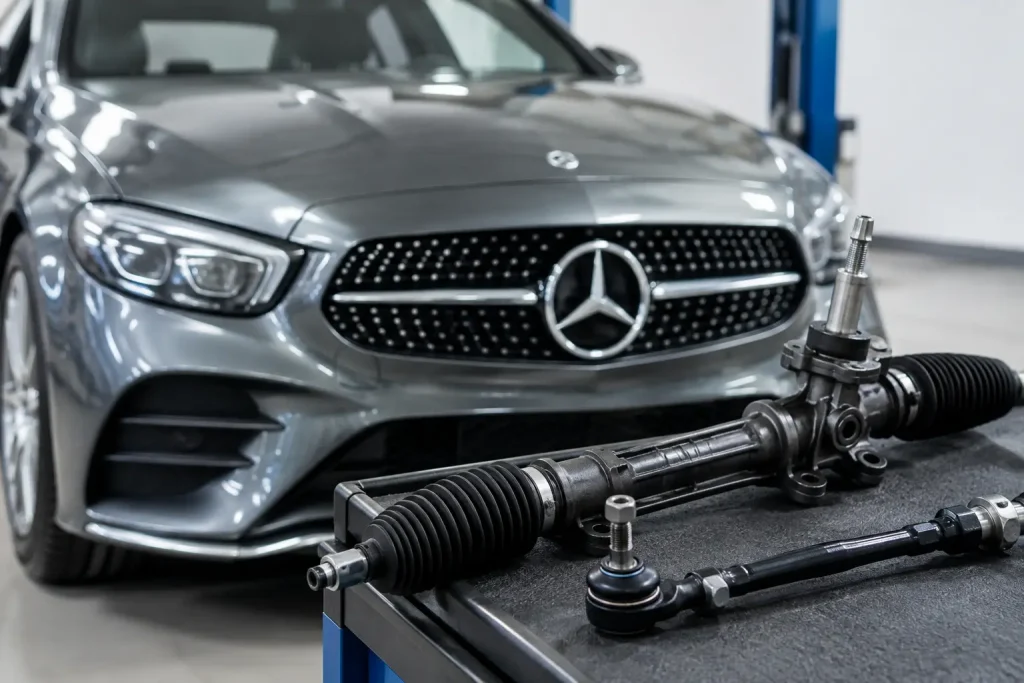
A Mercedes that no longer steers with the expected lightness, precision or consistency needs more than a quick parts quotation. The right Mercedes steering solutions begin with identifying exactly where the fault sits: inside the rack, in the electric assistance system, within the column and shafts, or in the wider steering and suspension geometry. That distinction matters because similar symptoms can have very different causes – and very different repair routes.
Modern Mercedes-Benz models use a broad range of hydraulic, electro-hydraulic and electric power steering arrangements. Older models may have a conventional steering box, while many later vehicles use electric power steering (EPS) racks that communicate with multiple vehicle systems. A warning message, stiff steering or an off-centre wheel can therefore require mechanical inspection, electronic diagnostics and final calibration rather than a single standard repair.
Why accurate Mercedes steering diagnosis matters
Steering faults are often reported in simple terms: the wheel feels heavy, the car wanders, assistance comes and goes, or there is a knock through the wheel. Those observations are useful, but they are the start of diagnosis, not the diagnosis itself.
For example, heavy steering can result from an internal rack fault, a seized universal joint in the intermediate shaft, low or inconsistent hydraulic assistance on applicable older systems, binding suspension joints, tyre-related issues or wheel alignment. On an EPS-equipped Mercedes, the cause may also involve a stored fault code, motor or torque-sensor failure, damaged wiring, low system voltage or a module that requires correct coding after replacement.
Replacing a steering rack without establishing the source of the problem can leave the original fault unresolved. Equally, assuming every rack can be repaired may be unrealistic where there is severe impact damage, an unavailable electronic component or extensive corrosion. A specialist assessment provides a clearer decision between component-level reconditioning, a replacement unit or further vehicle-side investigation.
Symptoms that should not be ignored
A steering warning light or message deserves prompt attention, particularly when assistance has reduced or become intermittent. Drivers may also notice a notch or tight spot as the wheel passes through part of its travel, an uneven self-centring action, excess play, fluid loss on hydraulic systems, or a steering wheel that no longer sits straight while travelling on a level road.
Noise is another useful clue. A knock may come from rack internals, inner joints, mounting points, track rod ends or suspension components. A groan on a hydraulic system can suggest an assistance issue but should not be used alone to condemn a particular component. The steering system needs to be inspected as a whole.
Mercedes steering solutions by system type
The most appropriate repair depends on the vehicle, steering design, fault findings and the condition of the unit. Mercedes ranges span many generations, so a repair approach suitable for an older E-Class may not apply to a newer C-Class, GLE or electric model.
Electric power steering racks
Electric racks combine mechanical steering gears with an electric motor, control electronics and sensors. They can deliver variable assistance and support driver-assistance functions, but their complexity means that diagnosis must account for both the rack and the vehicle network.
Where suitable, an EPS rack may be reconditioned at component level. This can involve addressing wear or faults in the relevant mechanical and electronic areas, followed by workshop testing. For applicable units, flashing or virginising may be required so that the rack can be coded and calibrated to the vehicle after refitting.
That final stage is not optional administration. Depending on model specification, coding, steering-angle sensor procedures, fault clearing and calibration may be necessary to restore correct operation and prevent warning messages. Wheel alignment should also be checked after steering work, especially if track settings have been disturbed or the steering wheel was previously off-centre.
Some faults originate outside the rack. Wiring damage, poor electrical supply, water ingress elsewhere in the vehicle or a related control-module issue can produce EPS symptoms. A replacement rack will not correct these issues without proper repair of the underlying vehicle fault.
Hydraulic racks and steering boxes
Hydraulic steering remains common on many older Mercedes models and specialist vehicles. Leaks, uneven assistance, free play and internal wear can make the car unpleasant to drive and may compromise its precise road feel. On classic Mercedes vehicles, the steering box is often central to the character of the car, so correct adjustment and refurbishment are preferable to guesswork.
A suitable hydraulic rack or steering box can often be stripped, inspected and rebuilt using appropriate OE or OE-quality components where applicable. The aim is not merely to stop a leak, but to restore controlled, consistent movement and minimise excess internal play. Completed units should be tested before leaving the workshop.
There are limits. A housing damaged by a collision, heavy corrosion in critical areas or unavailable internals may rule out a viable reconditioning route. In these cases, replacement or an alternative approved solution may be necessary.
Columns, shafts and mechanical connections
The rack is not the only part that transfers steering input. Steering columns, intermediate shafts, universal joints and couplings can develop wear, stiffness or corrosion-related binding. These faults can imitate a rack problem, particularly where the steering feels tight at certain points or has a delayed response.
A proper inspection considers the linkage from steering wheel to road wheels. It also checks whether the concern is genuinely within the steering system or influenced by worn suspension components, tyre condition or incorrect geometry. This broader view helps avoid fitting a costly component that was never the real cause.
Choosing repair, reconditioning or replacement
There is no single best answer for every Mercedes. Reconditioning can be a cost-effective, technically sound option where the unit is suitable and the fault is repairable. It is particularly relevant when a new original unit has a long lead time, is expensive or is no longer readily available for an older model.
Replacement may be the better route where the unit cannot be reliably rebuilt, where electronic damage cannot be resolved, or where the required parts are unavailable. A supplied unit must still match the vehicle specification, especially on Right Hand Drive vehicles and models with differing rack ratios, assistance levels or electronic configurations.
For garages, this is where direct technical support can save time. Supplying the correct rack is only part of the job. The fitting process may involve transferring components, observing centring procedures, carrying out alignment and completing manufacturer-appropriate coding or calibration. Skipping these steps can create a return visit even if the replacement unit itself is sound.
What a specialist steering assessment should include
The useful outcome of diagnosis is a defined repair path, not simply a list of possible faults. Vehicle details, symptoms and fault codes should be considered alongside a physical inspection. Where a rack, box or column is removed for assessment, its condition can be evaluated at component level rather than assumed from an external symptom alone.
For suitable steering units, Pro Power Steering provides specialist diagnosis, reconditioning, supply and fitting support across hydraulic, electric and manual steering systems. Units are assessed, rebuilt where viable and tested before dispatch or installation. Applicable completed work is supported by a 12-month warranty under the relevant terms.
UK-wide collection and delivery can also be useful when a garage or owner has a removable component requiring specialist attention. However, an off-vehicle assessment cannot always identify every vehicle-side electrical, coding or geometry issue. Clear communication between the steering specialist and fitting workshop remains essential.
Keeping the repair focused on safe, precise steering
The best Mercedes steering solution is the one that addresses the confirmed fault while respecting the vehicle’s system requirements. That may be a reconditioned rack, a refurbished steering box, column or shaft work, or a correctly specified replacement followed by coding and alignment. What matters is returning the vehicle to smooth, predictable steering with no unresolved warning lights, binding or unnecessary component replacement.
If the steering has changed noticeably, treat that change as useful diagnostic evidence rather than something to drive around. A focused assessment gives owners and workshops the information needed to make a sound repair decision and restore the confidence Mercedes steering is meant to provide.
