
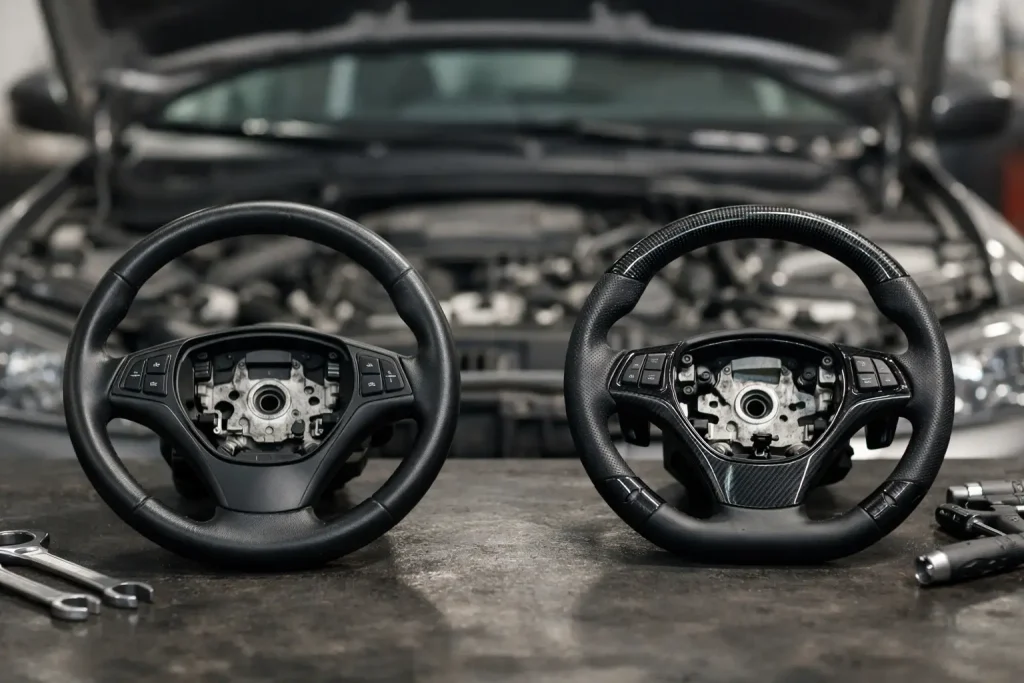
A steering fault can make a replacement unit sound like the obvious answer. Yet original steering versus replacement is rarely a simple choice between keeping an old part and fitting a new one. The right route depends on the fault, the vehicle, the availability of correct Right Hand Drive parts, and whether the existing unit is suitable for component-level repair.
For a modern car with an EPS warning, a leaking hydraulic rack on a working vehicle, or a steering box fitted to a classic, the aim is the same: restore safe, smooth and precise steering. What changes is the most sensible way to achieve it.
Original steering versus replacement: the real decision
“Original steering” usually means the factory-fitted steering rack, box, column or pump already on the vehicle. Keeping it does not necessarily mean leaving it untouched. A specialist can assess whether the unit can be repaired or reconditioned, replacing worn or failed internal components while retaining the correct housing, mountings and vehicle-specific configuration.
“Replacement” can mean several different things. It may be a new OE unit, an OE-quality replacement, a remanufactured exchange unit, or a used component. These options are not equal. A new part may be appropriate where the original cannot be rebuilt, but it can also bring high cost, lead-time issues and, on modern vehicles, coding or calibration requirements.
The useful question is not simply whether the original part is old. It is whether its core structure is sound, whether the fault is identifiable and repairable, and whether the repaired or replacement unit can be correctly installed and set up for that specific vehicle.
When retaining and reconditioning the original unit makes sense
A factory-fitted steering component can be worth retaining because it is already the correct specification for the vehicle. This matters particularly with premium, performance, classic and specialist models, where rack ratios, hydraulic connections, column interfaces, electronic modules and mounting points can vary considerably between apparently similar applications.
Where suitable, reconditioning allows the unit to be stripped, inspected and rebuilt around the actual fault. On a hydraulic rack, this might involve addressing internal wear, corrosion-related damage or sealing failure. On a steering box, it may involve restoring operation where wear has created excessive free play or inconsistent assistance. The precise work depends on inspection rather than a generic repair assumption.
For older vehicles and classics, the original unit may also be the most practical option because a correct new replacement is unavailable, supplied only on long lead times, or does not match the vehicle’s existing specification. Preserving the original housing and layout can avoid unnecessary adaptation while maintaining the intended steering character.
Reconditioning is not a shortcut. A suitable unit should be assessed at component level, rebuilt with appropriate OE or OE-quality parts where applicable, and tested before it leaves the workshop. The benefit is a repair based on condition and engineering judgement, not simply the age of the vehicle.
When replacement is the better route
There are clear cases where replacement is the correct recommendation. If the casing is badly damaged, critical mounting areas are compromised, a major internal part is unavailable, or previous repairs have made the unit unsuitable for a dependable rebuild, a replacement component may be necessary.
Replacement can also be the practical choice when a new, correct-specification part is readily available and the vehicle’s condition or intended use justifies it. A fleet vehicle with limited downtime, for example, may need the fastest reliable route back into service. The same can apply where a garage has diagnosed a component as beyond economical repair and an approved replacement can be fitted without uncertainty.
However, availability must be checked carefully. A listing that appears to match the make and model may still be wrong for handedness, steering ratio, connector type, control module, sensor arrangement or vehicle equipment level. This is one reason why VIN and part-number verification are valuable before a unit is ordered or fitted.
Used steering components deserve particular caution. Their history, internal condition and remaining service life may be unknown. They can look clean externally while carrying wear, corrosion or electronic faults that only become apparent once fitted. For safety-critical steering systems, initial purchase price should not be the only measure of value.
EPS racks need more than a mechanical decision
Electric power steering has made the original-versus-replacement choice more technical. An EPS rack is not only a mechanical assembly. Depending on the vehicle, it may incorporate a motor, torque sensor, control electronics and vehicle-specific software.
A replacement EPS rack may require coding, initialisation, end-stop learning, steering-angle sensor calibration or other diagnostic procedures after fitting. In some cases, a unit may need to be flashed or virginised in preparation for coding to the vehicle. Fitting the correct physical part alone does not guarantee that warning lights will clear or that steering assistance will operate correctly.
The original rack may be a strong candidate for specialist assessment where the electronic and mechanical fault can be identified and the unit is otherwise suitable for repair. Equally, there are cases where electronic damage, water ingress or unavailable components mean replacement is more appropriate. The point is to diagnose the system first, rather than treating every EPS warning as proof that a complete rack is required.
A proper assessment should also consider related causes. Low system voltage, damaged wiring, connector faults, vehicle network communication issues and steering-angle sensor errors can all affect EPS operation. Replacing a rack before those possibilities are checked can lead to unnecessary cost and repeat fault codes.
The fitting work matters as much as the unit
Whether an original unit is reconditioned or a replacement is selected, the installation process affects the result. Steering components must be fitted accurately, with associated parts inspected where relevant and all fasteners tightened to the manufacturer’s requirements. A rack that has been fitted correctly still needs the vehicle’s geometry checked and adjusted.
Wheel alignment is especially important after steering rack work. An incorrect toe setting can cause poor straight-line stability, an off-centre steering wheel, tyre wear and an unsatisfactory steering feel. On suitable vehicles, electronic steering systems may also need calibration once alignment is complete.
For garages, this is where direct technical support can be useful. Part identification, coding expectations and post-fit checks differ between manufacturers and models. A specialist steering supplier should be able to help establish what is required before the vehicle is dismantled, not only after a problem appears.
Cost should be measured against the complete repair
A new unit can appear simpler, while a reconditioned original may appear more labour-intensive. In reality, the total cost is shaped by more than the component price. Consider availability, exchange requirements, diagnostic time, coding, calibration, alignment, fitting labour and the risk of receiving an incorrect unit.
Reconditioning can offer a cost-effective route where the original component is structurally sound and repairable. It can also reduce delays when a new Right Hand Drive unit is difficult to source. But it is not automatically the lowest-cost option, nor should it be offered where the unit cannot be rebuilt to a reliable standard.
Likewise, complete replacement is not inherently excessive. It is the responsible choice when inspection shows that repair would be unsuitable or when a correct new component provides the clearest dependable outcome. Honest advice should explain both the likely work and the limitations before a decision is made.
Choose the route after diagnosis, not before
The best steering repair begins with a confirmed fault and an accurate part assessment. Symptoms such as heavy steering, fluid loss, knocking, free play, inconsistent assistance or warning messages can originate in several parts of the steering system. Assuming the rack, box or column is at fault without diagnosis can waste time and money.
Pro Power Steering assesses suitable units for repair and reconditioning, supplies and fits steering components where required, and supports applicable EPS coding and calibration work. Completed reconditioning work is backed by a 12-month warranty under the applicable terms, giving owners and fitting garages a clear basis for choosing the right route.
If your original component can be returned to dependable working condition, retaining it may be the most appropriate option. If it cannot, a correctly specified replacement with the right fitting and calibration process is the better answer. The useful next step is to establish the fault, the unit specification and the condition of the component before committing to either path.
