
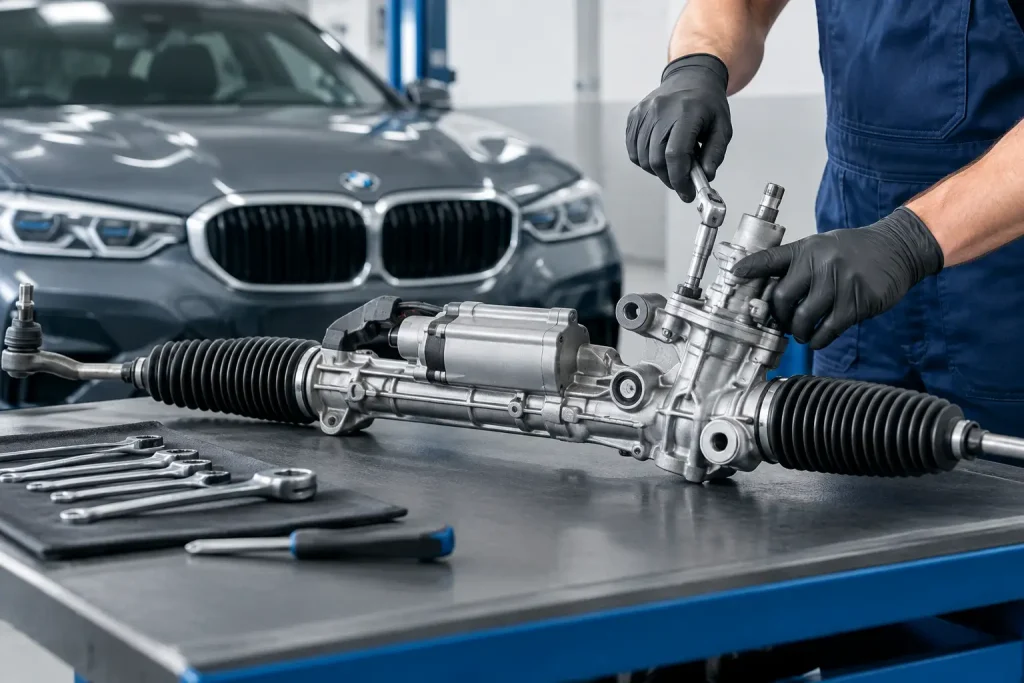
A BMW that suddenly feels heavy to steer, displays an EPS or steering assistance warning, or develops inconsistent assistance needs more than a fault-code clear. BMW electric steering rack repair starts with establishing whether the fault sits within the rack-mounted electric power steering assembly, its wiring and supply, its electronic control unit, or the mechanical rack itself. That distinction determines whether repair, reconditioning or replacement is the sensible route.
Modern BMW steering racks combine precision mechanical parts with an electric motor, reduction drive, torque sensing and electronic control. When everything is operating correctly, the result is light low-speed manoeuvring and stable, well-weighted steering at road speed. When one part begins to fail, the symptoms can range from intermittent warnings to a complete loss of power assistance.
What is fitted to a BMW electric steering rack?
Many later BMW models use rack-mounted Electric Power Steering, commonly referred to as EPS. Unlike a column-mounted system, the assistance motor and control electronics are integrated into the steering rack assembly. This is why a confirmed rack-related EPS issue often requires specialist steering-rack diagnosis rather than a general electrical repair.
The precise design varies by model, generation, drivetrain and whether the vehicle has options such as variable sport steering. A rack from a rear-wheel-drive 3 Series may not share the same internals, calibration or coding requirements as one from an xDrive model, a 5 Series or an SUV. Right Hand Drive racks also require correct vehicle-specific identification; they should not be treated as interchangeable with superficially similar Left Hand Drive units.
The rack contains both electronic and mechanical elements. The motor provides assistance, while the ECU processes inputs and controls motor output. Internally, the rack bar, pinion, bearings, gears, bushes and seals still need to deliver accurate, smooth steering. A warning lamp may point towards an electrical issue, but stiffness, free play, knocking or poor steering return can have a mechanical cause that fault codes alone will not identify.
Common BMW electric steering rack faults
An EPS warning message is a useful starting point, not a diagnosis. BMW electric steering rack faults may be intermittent at first, particularly if a wiring, voltage or electronic component is affected by temperature, vibration or moisture. The car may steer normally on one journey and have noticeably reduced assistance on the next.
Typical reported symptoms include heavy steering, assistance that comes and goes, a steering warning light, uneven assistance from lock to lock, or a steering wheel that does not return naturally after a turn. Some drivers notice a clunk through the steering on rough roads or excess movement before the wheels respond. These symptoms must be assessed carefully, as suspension wear, tyre condition, wheel alignment and steering-column issues can influence how the steering feels without being a steering rack failure.
Electrical faults may involve the rack ECU, motor circuitry, internal sensor signals, corroded connections or a problem with the vehicle’s power and earth supply. A weak battery, charging-system issue or low-voltage event can generate EPS-related faults, so an accurate assessment should establish whether the rack is the root cause before it is removed.
Mechanical faults are different. Wear in the rack mechanism, damage to internal gearing, failed bushes or water ingress can create play, noise, tight spots or inconsistent movement. In these cases, replacing an electronic module alone will not restore safe, precise steering. Equally, a mechanically sound rack with an electronic fault should not automatically be condemned as beyond repair.
BMW Electric Steering Rack Repair: the diagnostic process
A professional diagnosis combines electronic interrogation with physical inspection and informed testing. Reading BMW-specific fault information can reveal stored and current faults, but the context matters. A communication error, motor-related code or internal control-unit fault needs to be considered alongside battery voltage, wiring integrity and the actual steering behaviour.
The rack should then be identified by the vehicle details and unit numbers. This helps confirm the correct application, especially where BMW produced several rack versions within one model range. It also establishes whether active steering or variable-ratio equipment is present, as these systems may introduce additional programming and calibration requirements.
Once removed where appropriate, a specialist can inspect the rack assembly for mechanical wear, corrosion, water damage and evidence of previous poor repairs. Component-level assessment is valuable because it separates repairable faults from damage that makes replacement the safer option. A rack with a serviceable core and a defined fault may be suitable for reconditioning; a severely corroded, damaged or non-serviceable unit may not be.
This approach avoids two costly mistakes: fitting a replacement rack when the original fault is external to it, or refitting a rack after addressing only part of the problem.
Repair, reconditioning or replacement?
The right answer depends on the condition of the individual rack. Repair is appropriate where a specific electronic or mechanical issue can be rectified and the remaining assembly meets the required standard. Reconditioning is broader. It involves dismantling and examining the rack, renewing worn or failed serviceable components as required, addressing the identified fault and testing the completed unit before return.
For BMW EPS racks, the electronic side may require investigation of the motor and ECU as well as mechanical reconditioning. Depending on the application and fault, ECU work can include programming, coding, calibration or virginising where applicable. These steps are not interchangeable. Coding may configure the replacement or repaired unit to the vehicle specification, while calibration may be needed to establish correct steering-system reference values after installation.
Replacement is the better route when the original rack has damage that cannot be reliably repaired, when key components are unavailable, or when the unit fails assessment. A correctly specified replacement rack may be supplied as an exchange unit, subject to the condition and suitability of the returned core. It remains essential to establish any underlying voltage, wiring or vehicle-network fault before fitting it, otherwise the new unit could present the same symptoms.
A lower upfront price does not always represent the best outcome. An unverified used rack may carry unknown wear, an incompatible part number or coding challenges. A properly assessed reconditioned or replacement unit provides a clearer repair path, particularly for garages responsible for returning a vehicle to a customer with confidence.
Why coding and calibration matter after installation
Fitting the rack is not necessarily the end of a BMW steering repair. Many modern BMWs require electronic commissioning after a rack has been installed. The exact process depends on the model and rack type, but may include programming the ECU, coding vehicle-specific options, clearing fault memory and carrying out steering-angle or EPS calibration procedures.
Skipping these procedures can leave warning lights active, cause incorrect assistance behaviour or prevent the system from operating as intended. It can also lead to an incorrect conclusion that a repaired rack has failed. The vehicle must be assessed with suitable diagnostic equipment and in line with the relevant installation process.
Mechanical set-up remains important as well. The steering wheel position, track-rod adjustment and alignment should be checked following steering-rack work. This is not a substitute for electronic calibration, nor is electronic calibration a substitute for correct mechanical installation. Both affect how the vehicle steers and how its driver-assistance systems interpret steering inputs.
Information that helps get the repair right
For private owners and workshops, good information speeds up the diagnosis and avoids supplying the wrong unit. The registration, VIN, model year, engine and drivetrain are useful, as are any rack numbers visible on the original assembly. A concise description of the symptoms matters too: whether assistance has failed completely or intermittently, whether warnings are present, and whether there is noise, stiffness or play.
If diagnostic codes have been read, provide the exact wording and code numbers rather than a general description such as “steering fault”. It is also helpful to say whether the battery or charging system has recently caused problems, whether the rack has been removed before, and whether the vehicle has variable steering equipment. These details support a more accurate decision before a rack is sent for inspection or an exchange unit is selected.
Choosing a specialist route
BMW electric steering racks are safety-critical assemblies with electronic and mechanical requirements. The best repair route is rarely determined by a dashboard message alone. It requires a realistic assessment of the rack, the vehicle and the work needed after refitting.
Pro Power Steering provides specialist steering rack diagnostics, reconditioning and replacement solutions for suitable BMW applications, including the electronic work that modern EPS racks can demand. For owners and workshops, the useful next step is to confirm the rack type and fault evidence before authorising parts – that is how a steering repair is directed towards smooth, accurate and dependable operation rather than repeat visits.
