
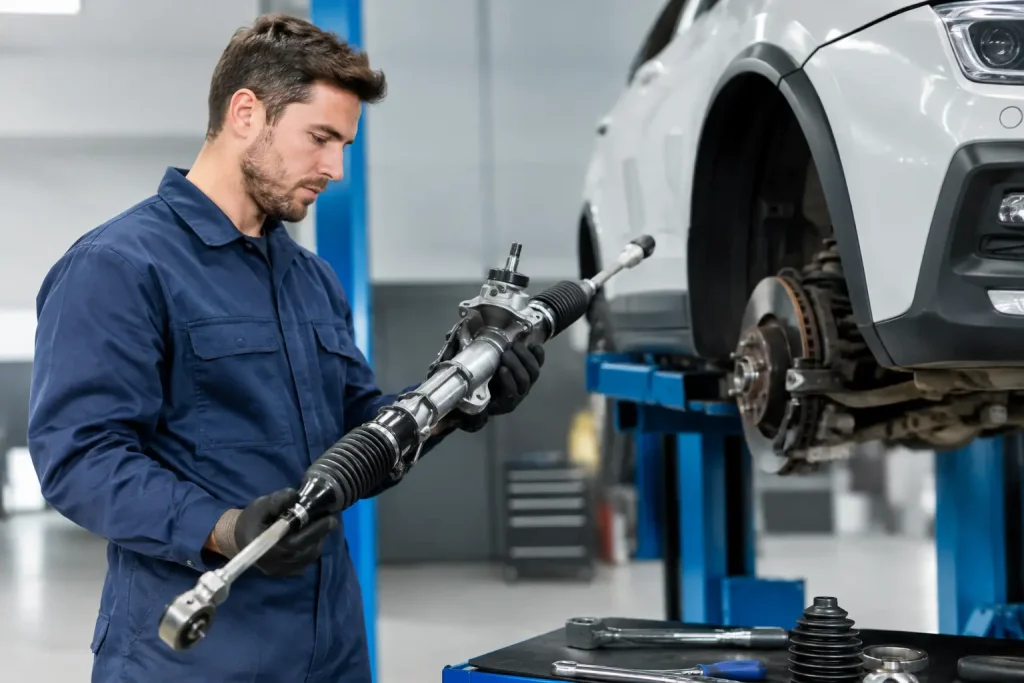
A steering rack can look identical to its left-hand-drive counterpart on a parts listing, yet its internal configuration, mounting, input arrangement and calibration requirements may be entirely different. That is why finding the best RHD steering specialists is about more than locating a replacement part. It means choosing a technical repair partner able to identify the exact fault, confirm the correct Right Hand Drive application and return the vehicle with steering that is safe, smooth and precise.
For a private owner, that may mean resolving a heavy steering complaint or an EPS warning without committing to an unnecessary new rack. For a garage, fleet operator or restoration business, it means having a dependable source of diagnosis, reconditioning and technical support when a steering system fault affects workshop time.
What Makes RHD Steering Work Different?
Right Hand Drive steering systems are not simply left-hand-drive units fitted on the other side of the vehicle. The steering column position, pinion orientation, rack housing, hydraulic or electrical connections, mounting points and track-rod geometry can all differ. On modern vehicles, the electronic control unit software and vehicle coding may also be application-specific.
This matters particularly on premium, performance and specialist vehicles, where several rack versions may have been fitted across one model range. A rack that appears correct by shape alone may have a different steering ratio, sensor specification or communication protocol. Fitting the wrong unit can lead to warning lights, poor steering feel, incorrect self-centring or a system that cannot be calibrated correctly.
A suitable specialist checks identification numbers, vehicle details and the original unit wherever possible. This is a more reliable route than making a decision from a broad make-and-model description alone.
Best RHD Steering Specialists: What to Look For
The strongest indicator of specialist capability is not a large stock list. It is the ability to assess a steering fault at component level and explain the appropriate repair route clearly. A good steering specialist should be comfortable working across hydraulic, manual and electronic power steering systems, while recognising when a unit is unsuitable for repair.
Accurate diagnosis before parts are ordered
Steering faults can produce similar symptoms. A heavy steering wheel may relate to an electric power steering rack, column, sensor, wiring issue, mechanical binding or an alignment problem. A knock or vague response may come from internal rack wear, but it can also be caused by external steering or suspension components.
A specialist approach begins by separating the fault from the symptom. This may include examining the rack mechanically, assessing play and resistance, reviewing fault codes on applicable EPS systems, and checking whether the reported issue can reasonably be attributed to the steering assembly. Clear diagnosis avoids the common and expensive outcome of replacing a major component without curing the original concern.
For garages, this is equally valuable. Direct technical discussion before a rack is removed can prevent avoidable downtime and help establish whether the unit should be sent for testing, reconditioning or replacement.
Component-level reconditioning rather than blanket replacement
A complete new steering rack is sometimes the right answer. It may be necessary where a unit is severely damaged, unavailable for repair, affected by an unserviceable electronic module or restricted by manufacturer parts and programming requirements. However, replacement should not be the automatic first choice.
Component-level reconditioning allows suitable units to be stripped, inspected and rebuilt using appropriate OE or OE-quality parts where applicable. Worn seals, bearings, bushes, internal components and other serviceable items can be addressed according to the rack design and identified condition. The aim is not merely to make a unit presentable, but to restore controlled, accurate operation.
This is especially relevant for older, classic and specialist vehicles, where an original RHD rack or steering box may be difficult to source. Retaining and properly rebuilding the correct assembly can be preferable to adapting an uncertain alternative. The same principle applies to some modern racks, where a quality repair may offer a cost-effective route without compromising on correct vehicle fitment.
Proper testing before the unit leaves the workshop
Reconditioning without testing leaves too much to chance. Steering racks should be assessed after repair so the workshop can verify operation before the unit is returned for fitting. Testing requirements vary by system type, but the principle remains the same: the repaired assembly should be checked for smooth movement, correct response and any relevant leakage or electronic performance concerns.
Ask what testing is carried out and whether the supplier can explain the process in practical terms. A technical business should be able to describe how it validates its work, rather than relying solely on a visual inspection or a generic statement that the unit has been rebuilt.
EPS Coding and Calibration Need Planning
Electronic Power Steering has changed the repair decision considerably. Many EPS racks contain motors, torque sensors, control electronics and vehicle-network communication. Installing a physically correct rack is only one part of the job. Depending on the vehicle, the replacement or repaired rack may need coding, programming, flashing, virginising or calibration before it operates as intended.
The exact process depends on the manufacturer and model. Some vehicles require a steering-angle sensor reset after alignment. Others require vehicle-specific configuration through suitable diagnostic equipment, and certain applications may still need dealer-level access or manufacturer procedures. No responsible specialist should promise that every EPS unit can be repaired or that coding can always be completed remotely.
What matters is that the repair provider understands the process before the unit is removed. They should be able to advise the fitting garage on likely coding and calibration requirements, and, where applicable, prepare an electronic rack for vehicle-specific programming. That early conversation protects the customer from a vehicle being left immobilised or displaying warning messages after installation.
Fitment, Alignment and Road-Test Results
Even an expertly reconditioned steering rack depends on correct installation. Track rods must be set appropriately, fasteners tightened to the vehicle manufacturer’s specifications and all disturbed components checked. The steering wheel must be centred, and wheel alignment should be carried out once the work is complete.
Alignment is not simply a finishing task. Incorrect toe settings can cause poor straight-line stability, uneven tyre wear and a steering wheel that sits off-centre. On vehicles with driver-assistance systems or EPS, it can also affect sensor calibration and warning-light behaviour.
For this reason, the best repair route often involves more than one capability: specialist rack diagnosis and reconditioning, competent fitting, accurate alignment and the right diagnostic equipment. A supply-only repair can work well for an experienced workshop with those facilities. For owners without a trusted fitter, supply-and-fit support may be the more straightforward option.
Questions Worth Asking Before You Commit
Before authorising work, ask whether the steering unit has been identified from the vehicle and original component, whether the suspected fault has been confirmed, and whether repair is genuinely suitable. It is also sensible to ask what components are renewed, how the completed unit is tested and what warranty applies.
For electronic racks, establish who will carry out coding, programming and calibration, and whether the vehicle will require alignment or a steering-angle reset afterwards. If a specialist gives a conditional answer, that is not necessarily a concern. Steering systems vary, and an honest explanation of what must be confirmed after inspection is usually more useful than a fixed promise made before the rack has been assessed.
Trade customers should also consider turnaround, collection and delivery arrangements, core-return requirements and access to technical support during installation. These practical points can make the difference between a controlled repair and an unplanned vehicle delay.
When Experience With Specialist Vehicles Matters
A basic rack repair process is not enough for every vehicle. Sports cars, high-performance models, classic vehicles, commercial applications and prestige cars may have unusual rack ratios, valve arrangements, steering boxes or electronic configurations. Older RHD vehicles can present additional challenges where parts availability is limited and the original unit is worth preserving.
In these cases, look for a business that treats steering as a dedicated engineering discipline rather than a sideline. Pro Power Steering supports RHD systems across a broad range of makes and models, providing steering diagnostics, component-level reconditioning, supply and fitting options, and technical advice for fitting garages. Suitable completed work is supported by a 12-month warranty under the applicable terms.
The right specialist will not force every fault into the same solution. They will assess the unit, explain the realistic options and identify where further vehicle-side checks, dealer involvement or complete replacement may still be necessary.
Steering is one of the vehicle systems a driver notices immediately, but its repair should begin well before the steering wheel is turned again. Choose expertise that values correct identification, measured diagnosis and tested workmanship, and the final result is far more likely to feel as it should: stable, controlled and confidence-inspiring on every journey.
