
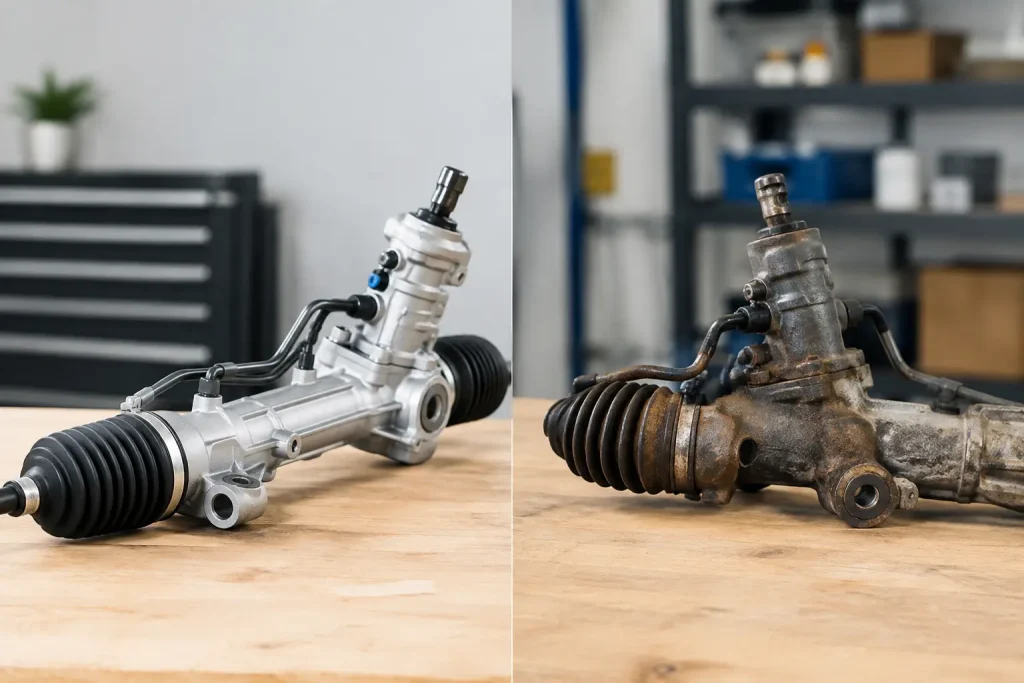
Why Choose a Reconditioned Steering Rack Instead of a Salvage Part?
When a steering rack fails, buying a cheap second-hand unit from a breaker or salvage yard can appear attractive. In reality, we do not recommend fitting salvage steering racks.
A steering rack is a safety-critical component. Many salvage steering units have been removed from vehicles that were involved in accidents, dismantled or declared insurance write-offs. Once the rack has been removed from the donor vehicle, it can be extremely difficult to establish exactly what happened to it, what forces it experienced or whether it had an existing fault before the vehicle was taken off the road.
A professionally reconditioned steering rack is completely different. It is assessed, repaired where necessary, tested before supply and backed by a warranty.
For us, there is therefore no real comparison between fitting an unknown salvage component and using a professionally reconditioned steering rack.
Why the history of a salvage rack matters
The biggest problem with a salvage steering rack is that you rarely know its complete history.
If the donor vehicle was involved in an accident, forces can be transmitted through the wheels, suspension, track rods and directly into the steering rack.
The rack may look perfectly normal externally while having suffered damage or excessive loading internally.
Potential problems can include:
- bent or damaged rack bars
- internal bearing damage
- damaged pinions or gears
- worn or damaged seals
- damaged housings or mounting points
- sensor faults
- electric motor problems
- ECU or control-module faults
- water ingress or corrosion
A visual inspection alone cannot confirm that these components are in good condition.
A relatively low-mileage salvage rack is not necessarily a good rack either. A vehicle could have covered very few miles before being involved in a serious accident.
A salvage rack may not even work on your vehicle
Another major problem is compatibility.
Modern steering racks cannot always be identified simply by the make, model and year of the vehicle.
Two steering racks can look almost identical and even have the same mounting points, yet still be different internally or electronically.
Compatibility can depend on:
- exact OE part number
- production date
- engine specification
- drivetrain
- suspension specification
- steering ratio
- wheelbase
- right-hand drive or left-hand drive configuration
- ECU version
- motor type
- sensors
- electrical connectors
- software version
- vehicle coding
This is particularly important with electric power steering (EPS).
A salvage EPS rack may physically fit the vehicle but still fail to operate correctly once connected.
It could produce warning lights, fault codes, limited steering assistance or no assistance at all.
Specialist equipment may be required
Modern EPS steering systems often require specialist diagnostic and programming equipment after a rack has been installed.
Depending on the vehicle, the steering rack may need:
- coding to the vehicle
- programming or flashing
- virginising
- steering-angle calibration
- end-stop calibration
- ECU configuration
- fault-code clearing
- communication checks with other vehicle control modules
These procedures cannot necessarily be completed with a basic diagnostic scanner.
Some racks require specialist equipment, manufacturer-specific software or detailed knowledge of the particular steering system.
This creates another problem with salvage units: even if the rack mechanically fits, it may contain information from the donor vehicle or have hardware or software that is incompatible with the receiving vehicle.
A cheap salvage rack can therefore quickly become an expensive problem when the fitting garage discovers that it cannot communicate with, code or calibrate the unit correctly.
Reconditioning your original rack avoids many compatibility problems
Where possible, professionally reconditioning the vehicle’s original steering rack offers a significant advantage.
You already know that it is the correct rack for the vehicle.
The correct:
- steering ratio
- mounting arrangement
- electrical connectors
- motor
- ECU
- sensors
- right-hand drive configuration
are already present.
The unit can be assessed, repaired and tested rather than replacing it with an unknown rack from another vehicle.
This is particularly important for right-hand drive vehicles, premium cars and specialist applications where there may be many different steering rack variants.
A professionally reconditioned rack is tested
A reconditioned steering rack should not simply be a used rack that has been cleaned and painted.
At Pro Power Steering, the purpose of reconditioning is to identify the problem with the steering unit, assess its overall condition and repair it appropriately.
Depending on the type of steering system, this can involve inspection and testing of:
- rack bars
- pinions
- bearings
- seals
- hydraulic valves
- electric motors
- torque sensors
- electronic control units
- connectors and wiring
- internal mechanical components
The unit is then tested before being returned or supplied.
That provides a level of confidence that simply cannot be obtained from an unknown rack removed from a salvage vehicle.
A reconditioned rack comes with a warranty
There is also an important difference when something goes wrong.
A salvage steering rack is an unknown second-hand component. Even where a breaker provides a limited guarantee, this may only cover the purchase price of the part and may not cover the cost of removing and refitting it.
Steering rack replacement can involve substantial labour.
Once the rack has been installed, the vehicle may also require:
- wheel alignment
- diagnostic testing
- coding
- calibration
If the salvage rack subsequently leaks, develops play, produces an electronic fault or simply turns out to be incompatible, much of that work may need to be carried out again.
A professionally reconditioned rack offers far greater reassurance.
Pro Power Steering provides a 12-month warranty on completed work, subject to the applicable warranty terms.
For both vehicle owners and garages, that provides a much clearer and more controlled repair route than fitting an unknown salvage component.
The cheapest rack can become the most expensive
A salvage rack may initially cost less.
That does not mean it is the cheapest repair.
Consider the potential costs of:
- buying the salvage rack
- fitting it
- wheel alignment
- diagnostics
- programming
- calibration
- discovering that it does not work
- removing it again
- finding another rack
- fitting the replacement
- carrying out another alignment or diagnostic procedure
The labour involved can easily exceed any initial saving on the part.
There is also vehicle downtime to consider.
For a garage, a car occupying a ramp while another rack is sourced creates additional cost and inconvenience. For the vehicle owner, it means being without the vehicle for longer.
Using the correct, professionally assessed steering component from the beginning is usually the more sensible approach.
Diagnose the fault before replacing the rack
It is also important to establish whether the rack itself is actually faulty.
Steering problems can be caused by:
- wiring faults
- poor electrical connections
- low battery voltage
- charging-system problems
- damaged suspension
- worn steering joints
- hydraulic pump faults
- contaminated fluid
- coding problems
- calibration issues
- communication faults between electronic modules
A steering warning light does not automatically mean that the complete steering rack needs replacing.
Proper electric steering diagnostics can help establish the real cause before unnecessary parts are fitted.
Why we do not recommend salvage steering racks
For a safety-critical steering component, there are simply too many unknowns.
With a salvage rack, you may not know:
- why the donor vehicle was dismantled
- whether it was involved in a serious accident
- whether the steering system absorbed an impact
- whether the rack already had a fault
- whether it has internal wear or corrosion
- whether the electronics are functioning correctly
- whether it is exactly the correct variant
- whether it can be coded to the vehicle
- whether specialist equipment will be able to communicate with it
- whether it will work correctly once installed
A rack can look right and fit physically but still be the wrong rack for the vehicle.
That is why we believe the better approach is to repair or professionally recondition the correct steering unit wherever possible.
You gain a known component, proper assessment and testing, technical support and a warranty rather than taking a chance on an unknown part from a written-off or dismantled vehicle.
When it comes to steering, saving a little on the part is not worth gambling on compatibility, reliability or safety.
#PowerSteering #SteeringRack #SteeringRackRepair #ReconditionedSteeringRack #ElectricPowerSteering #EPSRepair #SteeringDiagnostics #PowerSteeringRepair #RightHandDrive #RHDSteering #CarRepair #GarageServices #AutomotiveRepair #ProPowerSteering
