
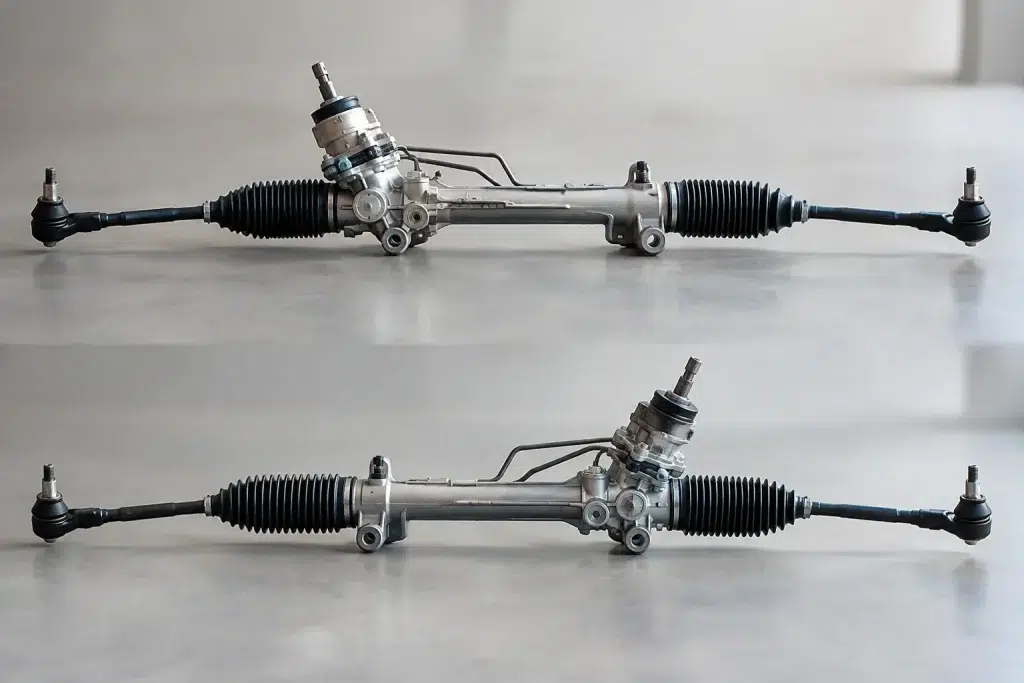
A steering rack can look identical from across a workshop bench yet be entirely wrong for the vehicle in front of it. RHD versus LHD steering racks is not simply a question of placing the steering wheel on the other side. The rack, pinion input, mounting points, hydraulic or electrical connections, software and steering geometry may all be specific to the vehicle’s driving position.
That distinction matters when sourcing a replacement, planning a restoration, repairing accident damage or investigating a rack that has already been fitted but does not feel right. Correct steering fitment is fundamental to safe, smooth and precise control.
Why RHD and LHD steering racks differ
The basic job of a rack is the same in any vehicle. Steering wheel movement passes through the column and intermediate shaft to the pinion, which moves the rack bar side to side. The inner track rods then transfer that movement to the front wheels.
On a right hand drive vehicle, however, the steering column approaches the rack from the right side of the cabin. On a left hand drive vehicle, it approaches from the left. The pinion housing therefore needs to be positioned and orientated to suit the column, the bulkhead, exhaust routing, pedals, engine components and front subframe layout.
A manufacturer may produce both RHD and LHD versions of the same model, but this does not mean the racks are mirror-image parts that can be swapped without further work. Even where the casting and rack bar appear similar, the input position, rack travel, mounting arrangement or internal specification can differ.
The pinion and column connection
The most immediate difference is usually the pinion input. The steering shaft must meet the rack at the correct angle, with the correct spline, clamp arrangement and shaft length. An LHD rack installed in an RHD vehicle may place the input on the wrong side or create an unsuitable angle through the intermediate shaft.
Trying to overcome that problem with improvised joints, modified shafts or altered mountings is not a sound repair approach. It can introduce binding, excessive play, restricted movement or a poor collapsible-column arrangement. These are safety-critical concerns rather than minor fitment inconveniences.
Mountings, rack travel and steering geometry
Rack mounting points are another major consideration. A rack must sit precisely in relation to the subframe, suspension arms and steering knuckles. Small changes in height, fore-and-aft position or rack-centre location can affect bump steer, toe change through suspension travel and the vehicle’s straight-ahead steering position.
Rack travel also matters. The distance the rack moves from lock to lock must match the steering arms and intended wheel angle. A unit with different travel can reduce turning circle, cause tyre-to-body contact at full lock, or place the rack internally under stress before the steering reaches its designed stop.
Track rods, inner joint lengths and gaiter arrangements may also vary between RHD and LHD applications. They should never be assumed interchangeable merely because a catalogue image looks familiar.
RHD versus LHD steering racks on hydraulic systems
Hydraulic steering racks add further vehicle-specific details. The position and thread type of pressure and return ports can vary, as can the direction in which pipes exit the pinion housing. Clearance around the engine, exhaust manifold, heat shields and subframe is often different between market versions.
The valve arrangement inside the pinion may also be calibrated for a particular application. A rack intended for a heavier engine, different axle loading or another steering ratio may not provide the expected assistance or feel when transferred to a different specification vehicle.
This does not mean every hydraulic rack is unique. Some shared platforms use common or closely related assemblies. The point is that compatibility must be confirmed from the actual vehicle specification and rack identification, not inferred from the vehicle shape or engine size alone.
Electric power steering racks need electronic checks too
With EPS racks, physical fitment is only one part of the decision. The motor, torque sensor, steering-angle data, control module and vehicle network must all communicate as intended. An RHD and LHD version may use different wiring routes, connectors, module calibrations or software references.
Certain units can be reconditioned at component level and, where applicable, flashed or virginised in preparation for vehicle-specific coding and calibration. That does not remove the need for correct diagnosis before fitting. A warning light or heavy steering can originate in the vehicle wiring, battery voltage, column sensor, CAN communication or configuration rather than the rack itself.
After an EPS rack is fitted, coding and calibration may be required. Depending on the vehicle, this can include steering-angle sensor calibration, end-stop learning and fault-code clearing with suitable diagnostic equipment. Wheel alignment is also essential after disturbing steering components. Without those final steps, a mechanically correct installation may still produce warning messages, off-centre steering or unsatisfactory assistance.
Can an LHD rack be converted for an RHD car?
Occasionally, particularly on classic, specialist or competition-based projects, there may be a technically viable conversion path. This might involve a purpose-designed rack, a steering box conversion, an approved modified column arrangement or a bespoke installation engineered around the vehicle’s suspension geometry.
That is very different from adapting an unsuitable standard rack because it is available. A proper conversion requires consideration of rack position, steering-arm geometry, column joints, mounting strength, lock stops and clearance through the full suspension range. The work should also account for applicable roadworthiness and insurance requirements.
For many modern vehicles, conversion is impractical or uneconomic. Electronics, crash structures, subframe design and integrated steering systems leave little scope for safe adaptation. In those cases, locating the correct RHD unit or assessing the original rack for repair is normally the more reliable route.
How to identify the correct steering rack
The vehicle registration and VIN are useful starting points, but they do not always reveal every steering variation. Manufacturers can fit different racks according to trim level, engine, axle load, wheel size, production date, active steering options and market specification.
A reliable identification process considers the original rack number, the vehicle’s exact model and build details, the type of assistance system and any relevant electronic part numbers. Clear photographs of the pinion input, mounting points, connectors and hydraulic ports can help distinguish similar units.
Before condemning a rack, the fault should be diagnosed as well. Knocking, stiffness, leakage, uneven assistance, wandering, poor self-centring and EPS warning lights can have several causes. Worn suspension joints, a seized universal joint in the steering shaft, alignment faults, low system voltage or a steering-column issue can all imitate rack failure.
For garages and vehicle owners, this is where specialist assessment saves time. Pro Power Steering assesses suitable units at component level, using vehicle-specific information and workshop testing to establish whether reconditioning, a replacement unit or further vehicle diagnosis is the appropriate next step.
Repair, reconditioning or replacement?
A correct RHD rack that has developed a fault is often worth assessing before a complete replacement is ordered. On suitable units, reconditioning can address worn internal components, seals, bearings, valves or electronic faults using appropriate OE or OE-quality parts where applicable. The finished assembly should be tested before it leaves the workshop.
There are limits. Severe accident damage, cracked housings, corrosion in critical areas, unavailable electronic components or unsuitable prior modifications may mean repair is not viable. Some EPS systems may also require dealer-level access or vehicle-specific programming after installation.
The best option depends on the rack’s condition, parts availability and the vehicle’s intended use. A daily-driven family car, fleet vehicle, cherished classic and performance model can each have different priorities, but none should compromise on correct fitment or steering geometry.
When an RHD steering rack is needed, treat the driving position as a core part of the part specification, not a late check. Confirm the exact vehicle details, diagnose the original fault properly and allow for coding, calibration and alignment where required. That approach gives the repaired or replacement steering system the best chance of delivering the calm, accurate response the vehicle was designed to have.
