
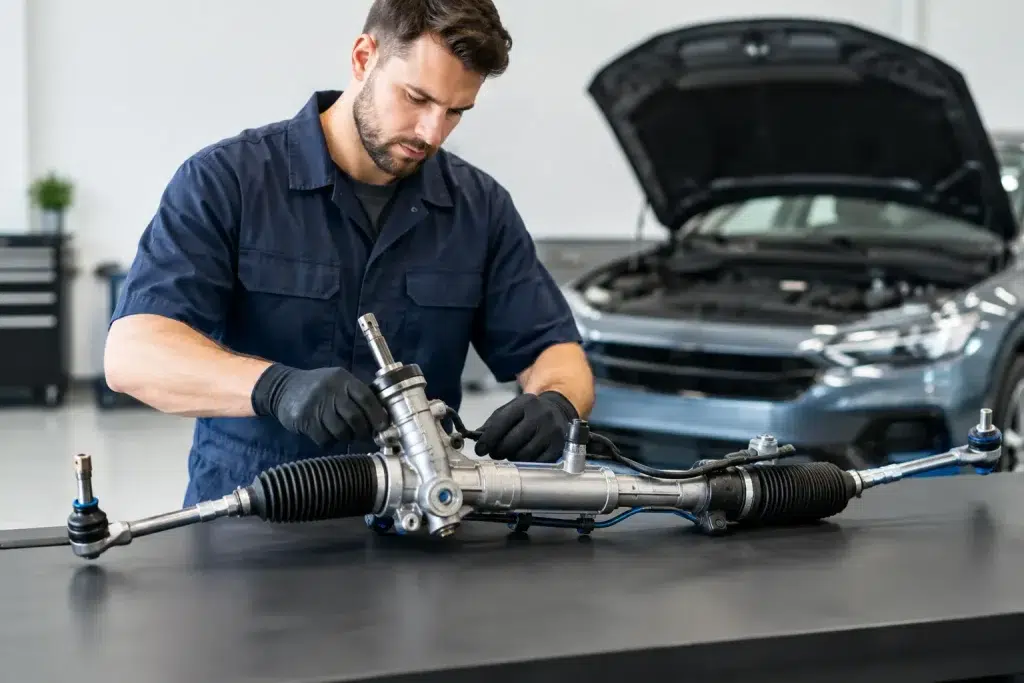
A steering rack that has become heavy, noisy, loose or electrically faulted does not always need to be replaced with a new complete unit. This UK steering collection delivery guide explains how to send a suitable steering component for specialist assessment, what information to provide, and what to expect when it is returned for fitting.
For vehicle owners and busy workshops, collection and delivery can make specialist reconditioning practical without taking the vehicle across the country. The key is identifying the correct component, recording the fault accurately and preparing the unit properly. Those steps give the repairer the best chance of diagnosing the underlying issue rather than simply treating a symptom.
Establish whether collection is the right route
UK-wide collection and delivery is generally suited to removable steering components such as hydraulic racks, electric power steering racks, steering columns, intermediate shafts and steering boxes. It is especially useful for older, specialist or Right Hand Drive units that may not be readily available on an exchange basis.
It is not the right answer for every fault. A steering problem can originate outside the rack or column itself, including worn suspension joints, incorrect wheel alignment, damaged wiring, poor battery voltage or a vehicle-specific coding issue. Sending a component away before basic diagnosis can create unnecessary delay and cost.
A garage should assess the vehicle first wherever possible. Check for fault codes, inspect mechanical steering joints and confirm whether the symptom remains with the relevant component. For an EPS rack, the recorded diagnostic codes, live data and vehicle history can be as valuable as the unit itself. For a hydraulic rack, details of leaks, steering effort and contamination are useful, but the cause still needs consideration before refitting.
Where a unit is suitable for inspection, a specialist repair route can offer a sound alternative to a complete new replacement. It depends on the condition of the core, parts availability and the nature of the failure. Severe crash damage, corrosion in critical areas, irreparable electronic damage or unavailable internal parts can mean replacement remains the sensible option.
UK steering collection delivery guide: information to provide
Before collection is arranged, identify the vehicle and component as precisely as possible. Registration number, VIN, make, model, year, engine, transmission type and whether the vehicle is Right Hand Drive all help prevent an incorrect assessment or supply decision.
Part numbers taken from the rack, column or steering box are particularly valuable. The same model can be fitted with several steering variants, and differences may include rack travel, mounting points, motor specification, sensor arrangement, software compatibility and electrical connectors. A clear photograph of labels and plugs can help where numbers are difficult to read.
Describe the fault in practical terms rather than relying only on a general phrase such as “steering fault”. Include when it occurs, whether it is intermittent, which warning lights are present, and whether the steering is heavy in one direction, both directions or only at low speed. If a diagnostic scan has been carried out, provide the exact trouble codes rather than an interpretation alone.
For trade customers, it is also useful to confirm whether the component has already been removed and whether it is required back in a particular condition. For example, an applicable EPS rack may need flashing or virginising before vehicle-specific coding and calibration. That requirement should be discussed before work starts, as the refitting garage must have the correct equipment and procedures to complete commissioning on the vehicle.
Preparing a steering component for transport
The component should be removed by a competent technician using the manufacturer’s procedures. Modern steering systems may require battery isolation, steering angle sensor handling, locking of the steering wheel position and electronic calibration after refitting. These are not details to overlook, particularly on vehicles with driver-assistance systems.
Once removed, clean excessive road dirt from the outside of the unit so labels, damage and connectors can be inspected. Do not dismantle the rack, column or steering box before sending it. Internal evidence can be lost, parts can be mixed, and a specialist may be unable to evaluate the original condition accurately.
Protect exposed splines, input shafts, electrical connectors and hydraulic ports from impact and contamination. If the original caps are available, use them. Otherwise, suitable protective covers and secure packing are essential. A heavy rack or steering box must not be able to move around inside its packaging during transit.
Use a strong carton or crate appropriate for the component’s weight and shape. Pack it with sufficient internal protection, paying particular attention to electric motors, ECUs and connector housings on EPS systems. Remove loose brackets or ancillary parts unless they are relevant to the fault or have been specifically requested. Include the contact details, vehicle information and job reference securely inside the package as well as on the outer label.
If a component contains residual fluid, make this clear when arranging transport and package it accordingly. The aim is to protect the carrier, the workshop and the unit itself. A package that arrives damaged or contaminated can delay inspection.
What happens after the unit arrives
A proper steering repair begins with assessment, not an automatic rebuild. The unit is identified, examined for external damage and assessed against the reported fault. Depending on the component and failure, this may include mechanical checks, electrical testing, inspection of wear points and examination of seals, sensors, gears, bearings or internal assemblies.
Where reconditioning is viable, the work should be carried out at component level using appropriate OE or OE-quality parts where applicable. This can preserve a serviceable original unit and avoid fitting an unsuitable pattern replacement. It also allows the repair to address the area that has actually failed, provided the remainder of the component meets the required standard.
Testing before dispatch is a critical part of the process. A rack or steering box needs to operate smoothly and accurately under the appropriate workshop test conditions. EPS components may require electronic checks alongside mechanical inspection. The exact test method varies by component, so it is worth asking what has been assessed and whether any additional vehicle-side work is needed on refitting.
If the unit cannot be repaired economically or safely, the best outcome is a clear explanation before further cost is committed. In some cases, an exchange unit, a new component or a vehicle-level diagnostic route will be more appropriate. Honest assessment matters because a steering fault should never be approached as a guess-and-fit exercise.
Delivery, refitting and vehicle setup
When the completed component is returned, fitting should be planned rather than treated as a simple swap. The garage should compare the returned unit with the removed part before installation, transfer only the specified external items and follow torque settings and routing instructions for the vehicle.
After a steering rack, column or box has been fitted, the vehicle may require wheel alignment. This is particularly important after rack replacement because the track rod settings will have been disturbed. Alignment should be completed using appropriate equipment, with the steering wheel centred and the vehicle set to its specified ride-height conditions where required.
Many modern vehicles also need electronic procedures after installation. Depending on the make and system, these can include steering angle sensor calibration, EPS coding, end-stop learning, fault-code clearing or calibration of driver-assistance functions. A virginised or flashed rack is not necessarily ready to operate until it has been coded correctly to the vehicle.
The refitting garage should road-test the vehicle carefully, confirm that warning lights have cleared and check for smooth, even assistance and accurate self-centring. If any issue remains, the original diagnostic information and details of the completed work make it easier to determine whether the cause is within the repaired component, the installation or another vehicle system.
Choose a repair partner that understands the component
Steering parts are safety-critical assemblies, and a collection service is only as useful as the technical assessment behind it. Pro Power Steering supports suitable UK steering components with specialist diagnosis, reconditioning, testing and direct technical advice for owners and fitting garages. Completed work is supported by a 12-month warranty under the applicable terms.
The most useful preparation is not elaborate packaging or a long fault description. It is accurate vehicle information, honest symptoms and a clear plan for coding, calibration and alignment after refitting. That gives the repaired steering system the best opportunity to return the vehicle to safe, smooth and precise operation.
