
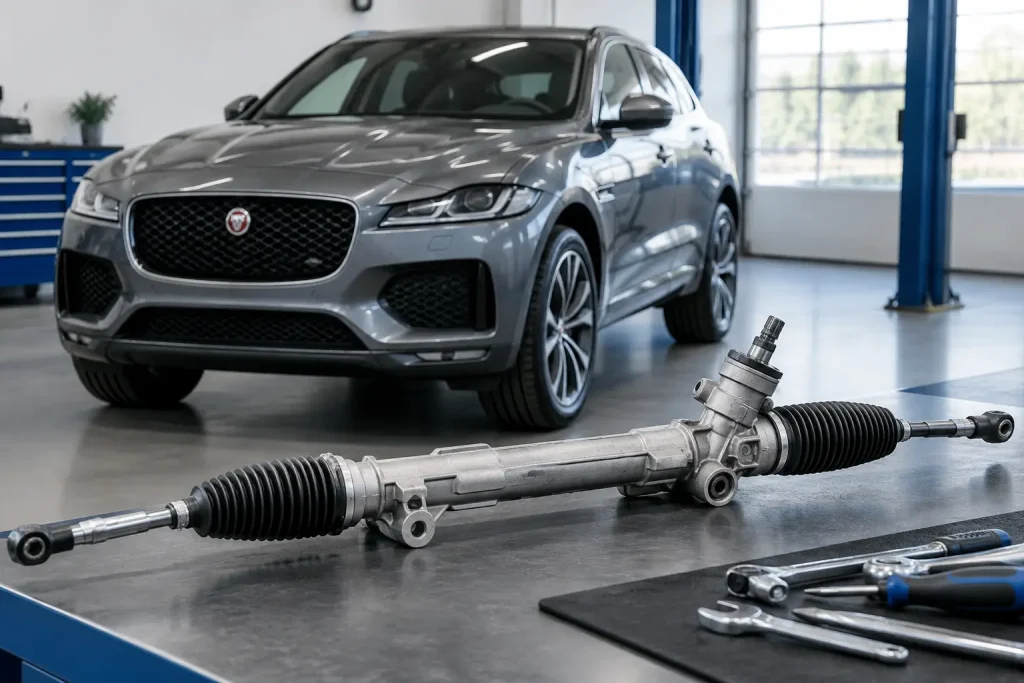
A warning message, heavy or inconsistent assistance, or a steering wheel that no longer self-centres properly can all point towards a rack-mounted electric power steering fault. Jaguar F-Pace steering rack repair is not simply a matter of fitting another unit: the rack, motor, control electronics and vehicle software must be assessed together before the right repair route is chosen.
The F-Pace is a premium SUV with a steering system designed to deliver light low-speed manoeuvring and controlled, accurate response at road speed. When that assistance becomes unreliable, the fault can affect both confidence behind the wheel and the vehicle’s safety. Accurate diagnosis is therefore the starting point, particularly where an EPS warning has been stored or steering assistance has reduced intermittently.
Understanding the F-Pace electric steering rack
Most Jaguar F-Pace applications use a rack-mounted Electric Power Steering (EPS) assembly. Rather than relying on a hydraulic pump and fluid pressure to provide assistance, an electric motor mounted on the steering rack supplies assistance according to signals from the vehicle’s control systems. The rack ECU monitors inputs including steering position, steering effort and vehicle speed, then adjusts assistance accordingly.
This arrangement gives the F-Pace its variable steering feel, but it also means a fault can be mechanical, electrical or electronic. A damaged inner joint, worn rack mechanism or water ingress may cause a physical problem. An internal motor failure, ECU fault, communication issue or incorrect configuration may produce warning messages and reduced assistance even when the rack appears mechanically sound.
Part numbers and software specifications matter. F-Pace steering racks can vary by model year, engine, trim and drivetrain, so an apparently similar used or replacement rack is not automatically suitable. For UK vehicles, the right-hand-drive application must also be confirmed rather than assumed.
Symptoms that warrant steering rack diagnostics
A complete loss of power assistance is the fault most drivers notice immediately, but it is not the only sign of a developing rack issue. Steering that becomes unexpectedly heavy at parking speeds, then returns to normal after a restart, may indicate an intermittent EPS or power-supply-related fault. A steering warning lamp or message should always be investigated with suitable diagnostic equipment, rather than cleared and ignored.
Mechanical symptoms can be more gradual. A knock transmitted through the steering wheel over uneven surfaces, free play around the straight-ahead position, a reluctance to self-centre, or an inconsistent feel from lock to lock can all justify inspection of the rack assembly. These symptoms can also arise from external steering and suspension components, so replacing the rack without diagnosis is an expensive gamble.
A vehicle that pulls or has an off-centre steering wheel after kerb contact may primarily need geometry checks, but this does not rule out rack damage. If the steering rack has suffered an impact or has internal stiffness, alignment alone will not restore the correct steering response. The condition of the rack, track rods and associated components needs to be established first.
What proper Jaguar F-Pace steering rack diagnosis involves
A professional assessment combines fault-code interrogation with physical checks and live-data analysis. The diagnostic process should identify whether the EPS module has logged internal electronic faults, motor-related codes, communication errors, low-voltage events or sensor plausibility issues. The stored codes are evidence, not a diagnosis by themselves. Their status, frequency and supporting live data help determine whether the rack is the source of the fault.
Battery condition and charging-system performance should be considered where EPS faults are intermittent. Electric steering systems are sensitive to voltage quality, and a low-voltage event can trigger warnings that resemble a rack failure. However, a voltage-related code does not automatically clear an internal rack defect, particularly if it returns after the electrical supply has been confirmed sound.
The rack also needs a mechanical inspection. A specialist will assess for excessive play, roughness through the travel, damage following impact, and signs of water or corrosion affecting the assembly. Checks should include the rack mounting points and the external joints, as these can imitate internal rack wear. This methodical approach prevents a costly replacement rack being fitted for a fault elsewhere on the vehicle.
When the original EPS rack can be repaired
Repair or reconditioning may be an appropriate option where the original F-Pace rack has an identifiable, serviceable fault. Depending on the assessment, this may involve attention to mechanical wear within the rack, the electric motor, internal electronics or connections. The exact work required depends on the rack version and the condition of the unit once inspected.
Component-level steering rack reconditioning can retain the vehicle’s correct rack housing and application while addressing the confirmed defect. It can be particularly valuable where a new genuine unit is costly or availability is limited. A reconditioned rack should be rebuilt to the required standard, tested before release and supplied only where the unit is suitable for the intended repair.
Not every rack is a candidate for repair. Severe impact damage, extensive corrosion, non-serviceable electronic failure, previous unsuitable repair work or damage to critical castings may make replacement the safer choice. The honest answer is sometimes that a replacement rack is required, but that decision should follow inspection rather than assumption.
Reconditioning versus replacement
A reconditioned exchange rack can be a practical route when downtime matters and an appropriate unit is available. It offers a replacement assembly that has been professionally assessed and reconditioned, while the removed rack may be returned as the exchange unit where applicable. For independent garages and workshops, this can simplify scheduling and keep the vehicle’s time off the road under control.
A new or replacement rack may be the better answer where the original unit cannot be economically or safely restored. The key is correct application matching. The rack must suit the specific Jaguar F-Pace, including its steering configuration and electronic specification. Selecting solely by physical appearance risks fitting a unit that cannot communicate correctly with the vehicle.
Used racks are often tempting, but their internal history, stored configuration and remaining mechanical condition may be unknown. They may also introduce the same fault that prompted the original repair. For a safety-critical component such as the steering rack, documented testing and correct vehicle compatibility matter more than a low initial purchase price.
Coding, calibration and post-fit checks
Fitting the rack is not necessarily the end of the job. Depending on the vehicle and replacement unit, programming, coding, configuration or commissioning may be necessary before the EPS system will operate correctly. Some electronic racks retain data from their previous vehicle and may require virginising or appropriate programming before installation.
Once the rack is installed, steering angle calibration and diagnostic checks may also be required. The steering wheel should be centred correctly and the vehicle’s wheel alignment checked where removal or impact damage has affected geometry. Calibration should be carried out with the mechanical steering position established correctly, not used as a shortcut for an off-centre wheel or worn external component.
A proper post-repair road test is equally important. Assistance should remain consistent through parking manoeuvres and at road speed, warning messages should not return, and the steering should self-centre and respond predictably. These checks confirm that the repair is working as a complete vehicle system, not merely that a fault code has been erased.
Choosing the right repair route
For owners, garages and fleet operators, the most useful first step is to provide the F-Pace registration, VIN, fault codes where available, and a clear account of the symptoms. Details such as whether the issue began after low battery voltage, water ingress, accident damage or intermittent warning messages can save time in the diagnostic process.
Pro Power Steering specialises in steering rack diagnostics, repair, reconditioning and replacement supply, including right-hand-drive EPS applications. Suitable Jaguar F-Pace racks can be assessed for repair or exchange, with UK-wide collection and delivery available for appropriate components. Completed work is supported by a 12-month guarantee.
If your F-Pace steering has changed character, do not wait for a minor intermittent warning to become a complete loss of assistance. A clear diagnosis gives you the best chance of choosing a repairable solution, fitting the correct rack where replacement is needed, and returning the vehicle to smooth, precise steering.
