
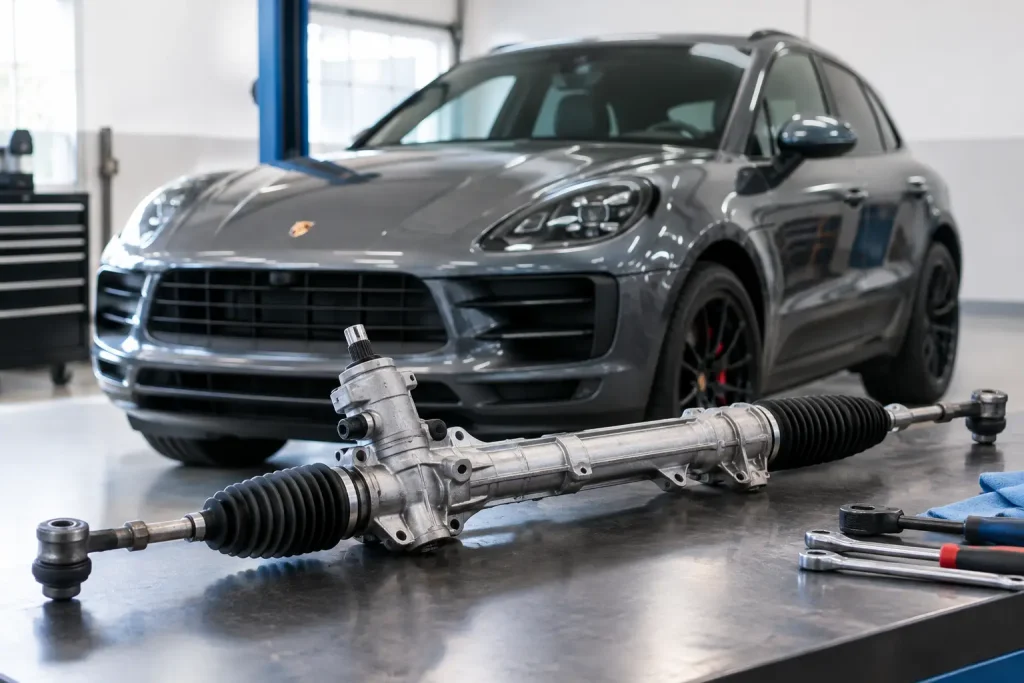
A Porsche Macan that suddenly feels heavy, inconsistent or reluctant to self-centre needs more than a generic steering check. Porsche Macan steering rack repair concerns the vehicle’s rack-mounted electric power steering (EPS) assembly: a safety-critical component that combines the mechanical rack, electric motor, torque sensing and electronic control. Accurate diagnosis matters because a warning message or poor steering feel does not automatically mean the entire rack requires replacement.
The Porsche Macan’s EPS steering rack
The Macan uses an electromechanical steering rack rather than a conventional hydraulic rack. Assistance is generated by an electric motor within the rack assembly, controlled in response to inputs including steering torque, vehicle speed and steering angle. This arrangement delivers the weighted, direct steering response expected of a Porsche, but it also means the rack must be assessed as both a mechanical and electronic unit.
A fault may lie in the rack’s internal mechanics, its motor or ECU, the wiring and connectors, or a related vehicle signal. On some vehicles, a calibration issue after battery voltage problems, accident repairs or previous steering work can affect operation. Treating every fault as a simple mechanical failure risks unnecessary expense; equally, clearing a code without understanding why it appeared can leave an intermittent issue unresolved.
For UK vehicles, the exact rack specification is also significant. Right Hand Drive racks are not interchangeable with every Left Hand Drive version, even where the vehicle appears otherwise identical. Part-number verification, vehicle configuration and the original fault report should guide the repair or supply decision.
Signs that warrant steering rack diagnostics
The most obvious symptom is an EPS or power steering warning on the instrument display, sometimes accompanied by reduced assistance. Steering may become markedly heavier at parking speeds, while still feeling manageable once the vehicle is moving. This can indicate a rack-related electrical fault, although low system voltage, damaged wiring or a communication issue must be ruled out first.
Other owners report a notchy sensation through the steering wheel, uneven assistance from lock to lock, a tendency for the steering not to return cleanly, or a vague area around the straight-ahead position. These symptoms can arise from wear or binding within the rack, but suspension joints, tyres and alignment condition can produce similar complaints. A specialist should separate those causes before authorising a steering rack repair.
A knock transmitted through the steering, excessive free play or visible movement at an inner joint may indicate mechanical wear within or around the rack assembly. Water ingress and corrosion around connectors or the rack housing can also create faults, particularly where a vehicle has been exposed to severe weather or has sustained underbody damage.
The warning lamp alone does not establish the remedy. Stored fault codes, live data, supply and earth checks, connector condition and a road assessment all help establish whether the rack is at fault and whether it is repairable.
Common Porsche Macan steering rack faults
Electronic and EPS motor faults
The electric motor and rack ECU are integral to the EPS system. Internal electronic failures can lead to loss of assistance, intermittent warnings or fault codes that return after being cleared. In suitable cases, component-level investigation and reconditioning can address the underlying electronic fault rather than simply replacing the complete assembly.
However, repair suitability depends on the rack variant, the nature of the damage and the condition of the unit. A rack with extensive corrosion, severe impact damage or an unsupported control-unit failure may not be an appropriate candidate for reconditioning. A replacement rack may then be the safer and more dependable route.
Mechanical wear and binding
The rack bar, pinion mechanism, bearings, bushes and internal guides must operate smoothly with controlled preload. Wear can create play and imprecise response; corrosion or internal damage can cause stiffness and tight spots. These faults are not corrected through software coding, and they should not be dismissed simply because diagnostic equipment also records an EPS-related code.
A professional reconditioning process involves dismantling, cleaning, inspection and measurement of the rack’s mechanical components. Worn or damaged serviceable parts are renewed as required, before the completed unit is assembled and tested. The aim is to restore smooth, precise operation, not merely to make a warning light disappear.
Wiring, voltage and communication issues
Not every Macan EPS complaint originates inside the steering rack. Poor battery condition, charging-system concerns, damaged harnesses, water-contaminated connectors or CAN communication faults can all prevent the rack from operating correctly. These checks are particularly relevant when the fault is intermittent or began after body repairs, electrical work or a flat battery.
This distinction protects the customer. Removing a rack before checking its power supplies and communications can add cost and downtime without resolving the original problem.
What Porsche Macan steering rack repair involves
Once diagnostics identify a rack fault, the practical choices are usually repair or reconditioning of the existing unit, an exchange reconditioned rack, or replacement where the original unit is unsuitable for repair. The correct option depends on availability, turnaround requirements, the condition of the rack and whether a matched reconditioned unit is available for that exact application.
A proper EPS rack repair is not a cosmetic refurbishment. The unit needs technical assessment of the mechanical rack and its electronic elements, followed by appropriate repair work and controlled testing. For an exchange unit, compatibility must be checked carefully against the vehicle’s part number and specification. This is especially important on premium vehicles where minor specification differences can affect installation, coding or steering response.
After refitting, the vehicle may require fault-code clearing, steering-angle sensor calibration and EPS commissioning or coding, depending on the rack and vehicle configuration. The workshop must also confirm that the steering is centred and that no related fault remains active. Where alignment has been disturbed during removal and refitting, it should be checked and corrected as part of completing the job, but alignment alone cannot repair a faulty rack.
Repair, reconditioning or replacement?
Reconditioning is often a sensible option when the original rack is structurally sound and its fault can be addressed with approved component-level repair and testing. It retains the correct vehicle-specific housing and configuration while avoiding replacement of sound parts. For owners and workshops, it can also be valuable where new units are costly or restricted in availability.
Replacement is appropriate where the rack has sustained impact damage, severe corrosion, irreparable internal wear or electronic damage beyond viable repair. It can also be preferable when vehicle downtime is critical and a verified exchange rack is available. The trade-off is that replacement still requires correct configuration, installation and post-fit calibration. A new or replacement rack is not automatically plug-and-play.
The right decision comes from evidence. A specialist should be able to explain whether the diagnosis points to an internal rack fault, whether the unit is viable for reconditioning, and what commissioning work will be needed once it is back on the vehicle.
Choosing a specialist for a Macan rack fault
The Macan’s steering rack is a safety-critical EPS component, so the repairer’s process matters as much as the part supplied. Look for a business that deals specifically with rack-mounted EPS systems, understands mechanical and electronic rack faults, and can advise garages on coding, calibration and correct rack identification.
For vehicle owners, it is useful to provide the registration, VIN where requested, full fault-code report and a clear description of the symptoms. For independent workshops, retaining diagnostic scan results and noting whether the fault is permanent, intermittent or linked to battery voltage can save time during technical assessment.
Pro Power Steering assesses Porsche steering rack faults with repairability, correct application and safe post-repair operation in mind. Where suitable, UK-wide collection and delivery can make specialist reconditioning practical without treating a complex EPS fault as a routine parts swap.
If your Macan’s steering has changed in feel or an EPS warning has appeared, arrange informed rack diagnostics before committing to replacement. A precise diagnosis gives you the best chance of restoring the steering to the smooth, accurate response the vehicle was designed to deliver.
