
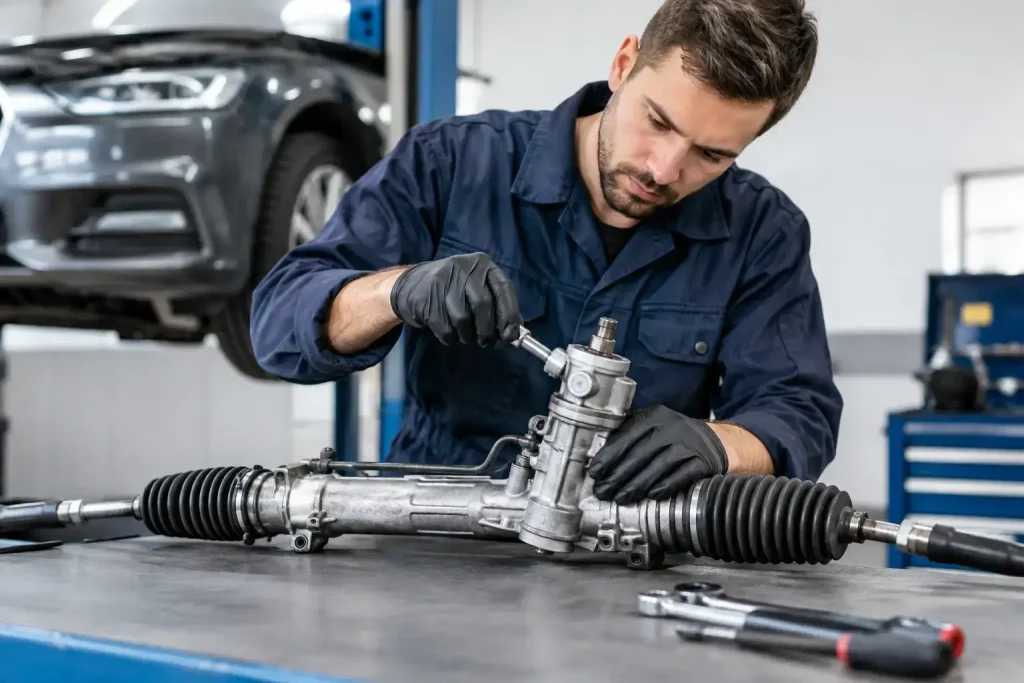
A warning light, heavy steering or a growing patch of fluid beneath the front of the vehicle can all lead owners to search for UK steering repair options. The right answer is rarely a generic steering-system replacement. It depends on the type of steering rack fitted, the confirmed fault, the condition of the rack housing and internals, and whether the vehicle requires electronic coding or calibration afterwards.
For many cars, a specialist steering rack repair or reconditioning service can retain the original unit and restore precise, dependable steering. In other cases, a tested exchange or replacement rack is the more sensible route. Proper diagnosis comes first, particularly on modern rack-mounted electric power steering systems where a mechanical symptom and an electronic fault can appear similar from the driver’s seat.
UK steering repair options start with the rack type
The steering rack converts movement at the steering wheel into the movement that turns the road wheels. It is a safety-critical assembly, and the repair path differs significantly between electric, hydraulic and manual designs.
A rack-mounted EPS rack combines conventional mechanical rack-and-pinion components with an electric motor, torque or position sensing, and an electronic control unit. It is common on newer BMW, Mercedes-Benz, Audi, Jaguar, Land Rover, Range Rover, Volvo and Porsche applications. Depending on the vehicle, the ECU may be integral to the rack and may need programming, coding, calibration or virginising after repair or replacement.
A hydraulic steering rack uses pressurised fluid to assist steering effort. These racks are widely fitted to older premium, performance and commercial vehicles. Leaks from rack seals, corrosion-related damage, inner wear and uneven assistance are typical concerns, but a leak alone does not automatically mean the rack is beyond repair.
Manual steering racks are usually simpler mechanically, but they still require skilled inspection and accurate rebuilding. They remain particularly relevant to classic, specialist and discontinued vehicles, where an original rack may be worth restoring because an off-the-shelf replacement is unavailable or unsuitable.
The first decision: diagnose before authorising replacement
A vehicle may pull, feel vague, knock over bumps or develop heavy steering for reasons outside the rack. Worn suspension joints, tyre issues and alignment faults can affect steering feel. Equally, a steering rack can have an internal fault without producing an obvious leak or warning message.
A proper steering rack assessment looks for evidence rather than relying on symptoms alone. On a hydraulic rack, this can include checking for fluid contamination, external leakage, corrosion on the rack bar, excessive play, tight spots and damage to mountings or gaiters. On an EPS rack, the diagnostic process also includes fault-code investigation, live data where appropriate, power and earth checks, communication faults and assessment of motor, sensor and ECU operation.
This distinction matters commercially as well as technically. Replacing a rack when the cause is elsewhere can leave the original fault unresolved. Conversely, clearing an EPS warning without addressing the underlying rack electronics or mechanical wear can create a repeat failure.
Symptoms that merit specialist rack diagnosis
Heavy steering may be constant, intermittent or present only in one direction. A hydraulic rack may feel heavy because of internal wear or loss of assistance, while an electric rack may restrict or remove assistance following an electronic fault. A notchy feel near the straight-ahead position can indicate wear or corrosion affecting the rack mechanism, although the full vehicle should always be assessed.
Other warning signs include fluid leaking from the rack gaiter area, a dull knock transmitted through the steering, free play at the steering wheel, wandering on the road, or an EPS warning lamp. These symptoms should not be treated as a home repair project. Steering accuracy and predictable response are essential to safe vehicle operation.
Repair and reconditioning: when the original rack is viable
Reconditioning is not simply fitting seals and applying paint. A meaningful steering rack refurbishment process should begin with strip-down and inspection, followed by a decision on whether the principal components are serviceable. The work may involve replacing seals, bearings, bushes and other worn service parts, addressing internal mechanical wear where feasible, and testing the finished unit.
For hydraulic steering racks, reconditioning commonly addresses fluid leaks caused by failed seals, worn internal surfaces or deterioration around the rack bar. The condition of the rack bar is important. Severe corrosion or pitting in the seal travel area can prevent a reliable repair, even if a new seal initially reduces the leak. In that situation, a replacement or exchange rack may offer the more dependable outcome.
For manual racks, refurbishment can preserve a vehicle-specific component that is no longer readily available. This is especially valuable for classic cars, specialist models and restoration projects, where maintaining correct fitment and steering geometry matters more than selecting a universal alternative.
EPS rack repair requires a broader approach. A specialist may need to investigate the motor, control electronics, position or torque sensing, internal wiring and mechanical rack assembly. Some faults can be repaired at component level and the unit returned to service after appropriate testing. Others may involve damaged electronics, unavailable components or faults that make replacement the safer choice.
A reconditioned original unit can be a strong option when its core structure is sound and the fault is identifiable. It also helps retain the correct right-hand-drive configuration, which is particularly relevant for racks that differ from equivalent left-hand-drive applications.
When a replacement or exchange rack is the better option
Not every steering rack is repairable, and a responsible specialist will say so. A rack may require replacement if the housing is damaged, the rack bar is excessively corroded, critical internals are beyond service limits, or an EPS electronic failure cannot be reliably rectified. Availability also matters. For some vehicles, a tested exchange unit is the most practical way to reduce downtime.
An exchange rack is generally a reconditioned unit supplied in place of the customer’s original rack, subject to the condition and return of the old core. This can suit garages and fleet operators needing a predictable repair path, while a repair of the customer’s own rack may be preferred for rare, classic or difficult-to-source applications.
The choice should not be based on price alone. Correct part identification is essential because racks can vary by model year, engine, drivetrain, steering configuration and software specification. Premium vehicles may have multiple rack variants within the same model range. Vehicle registration details are helpful, but part numbers and diagnostic findings can be equally important.
EPS programming, coding and calibration after fitting
Electronic steering racks often need more than physical installation. The replacement or repaired rack may require coding to the vehicle, programming of its control unit, steering-angle calibration, end-stop learning or configuration of vehicle-specific settings. The exact procedure depends on the manufacturer and rack design.
Failure to complete required setup work can leave warning lights active, produce incorrect assistance characteristics or prevent the system operating as intended. In some cases, an ECU may need virginising before it can be paired to another vehicle. These processes should be considered when comparing repair quotes, because the cheapest supplied rack is not necessarily the complete solution.
After any steering rack installation, the vehicle must also be checked for correct mechanical fitment and wheel alignment. Alignment is not a repair for an internally faulty rack, but it is an essential final operation when steering components have been removed and refitted.
What garages and owners should provide for an accurate assessment
Clear information speeds up the diagnosis and helps avoid incorrect supply. The vehicle make, model, year, engine, registration and rack part number are useful, along with a description of the symptoms. For EPS issues, diagnostic trouble codes and the circumstances in which the warning appears can make a substantial difference. Does the assistance fail when hot, after starting, while manoeuvring or continuously? Does the fault return immediately after codes are cleared?
For a leaking hydraulic rack, details on where the fluid is visible and whether the steering has become noisy, heavy or inconsistent are relevant. A specialist will still inspect the unit, but good initial information helps identify whether collection, repair, an exchange rack or a replacement unit is likely to be appropriate.
Pro Power Steering supports suitable steering rack repairs, reconditioned and exchange rack supply, and UK-wide collection and delivery, with technical advice for owners and trade workshops. Completed work carries a 12-month guarantee, providing a clear basis for confidence when a repair is viable.
The best steering repair is the one matched to the actual rack fault, not the most convenient label attached to a steering symptom. Whether the vehicle needs a hydraulic rack reseal, a manual rack restoration, an EPS electronic repair or a correctly configured replacement, accurate diagnosis gives the driver the best prospect of returning to smooth, precise and predictable steering.
