
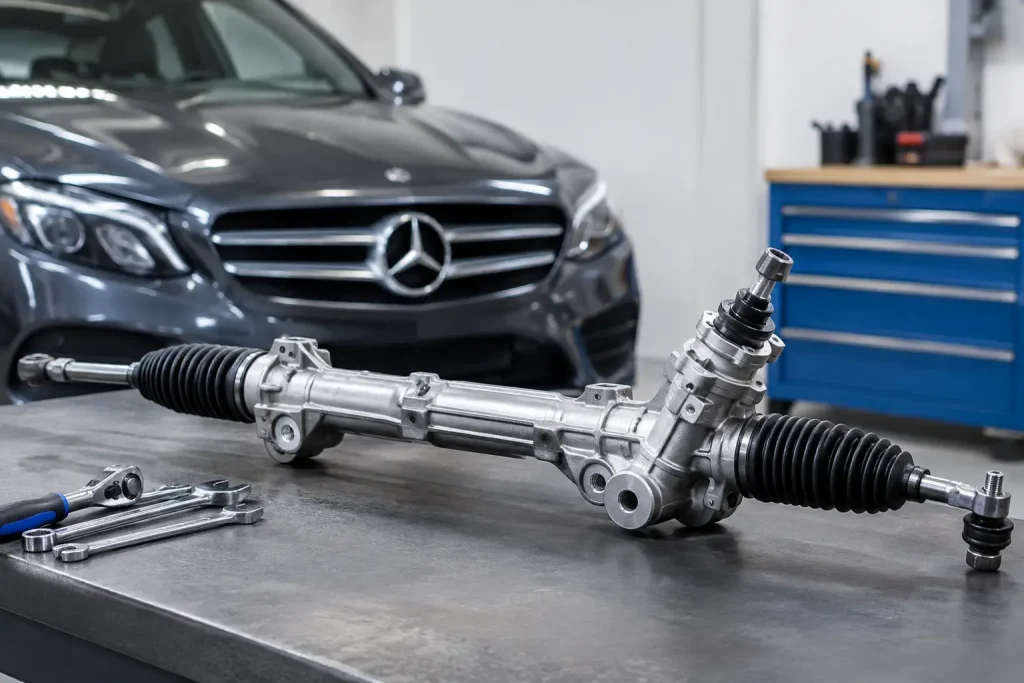
A Mercedes that wanders on the motorway, feels inconsistent through the wheel or displays an EPS warning needs more than a quick parts swap. Mercedes steering rack refurbishment is a component-level repair process intended to restore accurate, safe steering where the original unit is suitable for reconditioning. The right route depends on the fault, the rack type and, on later models, whether electronic coding and calibration are required after refitting.
Mercedes-Benz has used hydraulic, electro-hydraulic and electric power steering systems across its range. That breadth matters. A fault that appears to be a failed steering rack may originate in the steering column, shaft, wiring, control unit, suspension geometry or another part of the steering system. Accurate diagnosis protects the customer from replacing a major component unnecessarily and gives the fitting garage a clearer repair plan.
When Mercedes steering rack refurbishment is appropriate
Refurbishment can be a sound alternative to fitting a new rack when the core structure of the unit is serviceable and the defect can be repaired with the correct internal components. On hydraulic systems, this may include fluid leaks from seals, wear affecting steering feel, damaged internal components or faults in associated valving. On electric power steering, the process may involve mechanical repair alongside assessment of the motor, sensors, electronics and communication fault codes.
The objective is not simply to stop a leak or clear a warning light. A properly reconditioned unit should be returned to smooth, predictable operation, then tested before it leaves the workshop. That is particularly valuable for older Mercedes models, specialist variants and Right Hand Drive applications where the correct replacement rack may be expensive, delayed or difficult to source.
However, reconditioning is not appropriate in every case. A rack with severe impact damage, extensive corrosion, a compromised casing, unavailable electronics or a design-specific issue that cannot be rectified reliably may need replacement instead. An honest assessment is more useful than promising that every original unit can be saved.
Symptoms that need proper steering diagnostics
Heavy steering is the symptom most drivers notice, but it is not specific to the rack. The steering may be heavy only at parking speeds, intermittently heavy after a warning message, or uneven from lock to lock. Each pattern points the diagnosis in a different direction.
Other common concerns include a knock or tight spot felt through the steering wheel, excessive free play, poor self-centring, fluid loss on hydraulic models, or a steering warning on models fitted with EPS. Some drivers report that the car feels vague rather than obviously faulty. On a Mercedes with sophisticated suspension and steering assistance, even a modest loss of precision can affect confidence at speed.
A workshop should also consider tyre condition, suspension joints, track rod ends, steering-column couplings and wheel alignment. These components can imitate a steering-rack fault, and wear in more than one area is common on higher-mileage vehicles. Diagnosing the system as a whole is safer and usually more cost-effective than treating the rack as the default cause.
Why warning lights require more than a code read
On electric systems, diagnostic trouble codes are a starting point, not a final verdict. A recorded EPS fault may relate to a supply-voltage issue, a wiring concern, a sensor reading outside its expected range or a communication problem elsewhere on the vehicle network. Clearing the code without establishing why it appeared risks a repeat fault.
The diagnostic process should combine fault-code information with live data, vehicle history, physical checks and an assessment of how the steering behaves. This is especially relevant after accident repairs, low-voltage events or previous steering work. The rack may be the correct repair, but it should be identified through evidence rather than assumption.
What happens during reconditioning
A specialist refurbishment begins with identification of the exact unit. Mercedes rack specifications can differ across model years, engine variants, suspension options and left- or right-hand-drive configurations. Matching by registration alone is not always sufficient, so part numbers and unit details may be needed before work starts.
The rack is then stripped and inspected at component level. Wear, corrosion, contamination and damage are assessed before appropriate OE or OE-quality service parts are selected where applicable. The work required varies by unit: seals and bearings may be renewed, worn mechanical elements addressed, and faults within the steering mechanism investigated rather than concealed.
For suitable electronic racks, attention must extend beyond the mechanical assembly. The electronic motor, torque sensing and control functions must be considered as part of the repair decision. Certain applicable EPS racks can be flashed or virginised in preparation for vehicle-specific coding after installation. That does not remove the need for the vehicle and fitting garage to complete the correct programming, calibration or adaptation procedure.
Completed units are tested before dispatch. Testing is a vital distinction between engineering reconditioning and an unverified used part. It provides a controlled check that the repaired rack operates correctly before it is returned for installation.
Coding, calibration and wheel alignment after fitting
A reconditioned rack is only one part of a finished repair. Depending on the Mercedes model, the vehicle may require steering-angle sensor calibration, rack coding, software configuration or a basic setting after the unit has been fitted. Some systems will not perform correctly, or may retain warning messages, until these procedures have been completed using suitable diagnostic equipment.
Wheel alignment is equally important. Removing and refitting a steering rack or disturbed steering components can alter the relationship between the steering wheel, rack centre and front-wheel geometry. Alignment should be carried out after installation, with the steering wheel centred and the vehicle set to the manufacturer’s specifications where available.
This is not merely a finishing touch. Incorrect geometry can cause uneven tyre wear, a crooked steering wheel, poor straight-line stability and an inaccurate impression that the replacement or refurbished rack is at fault. Where a vehicle has suffered kerb impact or collision damage, the garage may need to investigate suspension and subframe positions before alignment can be finalised.
Refurbishment, replacement or a used unit?
The best option depends on availability, fault type, vehicle value and how long the owner intends to keep the car. A new genuine unit can be the right answer where it is readily available and the vehicle requires a complete assembly. It may also be the only practical route for units with unrepairable electronic or structural damage.
A specialist refurbished rack is often attractive because it retains the correct original specification while addressing the confirmed defect at component level. It can reduce unnecessary replacement of a complete assembly and may avoid longer supply chains for certain Mercedes applications. For trade customers, a tested unit with clear technical support can also make workshop scheduling more predictable.
A used rack can appear cheaper at the point of purchase, but its internal condition and remaining service life are unknown. There may also be part-number, coding or handedness issues. On a steering component, the initial saving should be weighed against the labour involved in fitting it again if the used unit proves unsuitable.
Choosing the right repair partner
Mercedes steering systems reward model-specific knowledge. The repairer or supplier should be able to establish the rack type, assess the reported fault and explain what is included in the proposed work. It is reasonable to ask whether the unit will be tested, whether coding or calibration may be required, and what warranty applies to the completed repair.
Pro Power Steering provides specialist steering diagnostics, reconditioning and supply-and-fit support for suitable Mercedes racks, including Right Hand Drive applications. Units are assessed individually, rebuilt where viable and tested before leaving the workshop, with completed work supported by a 12-month warranty under the applicable terms. UK-wide collection and delivery can also help garages and owners dealing with suitable removable steering components.
For owners, the most useful information to provide at the outset is the Mercedes model, registration, part number where available, exact symptoms, dashboard messages and whether the vehicle has had previous accident, suspension or steering work. For garages, a concise diagnostic report and fault-code record can prevent delays and help establish whether refurbishment is the right route.
A precise diagnosis, a tested repair and correct commissioning after fitting are what turn a steering-rack repair into a dependable result. If the steering no longer feels as it should, arrange specialist assessment before a minor symptom becomes a larger safety or handling concern.
