
A vehicle that needs constant small corrections on a straight road can feel tiring long before it feels obviously unsafe. On cars, classics, 4x4s and commercial vehicles fitted with a steering box, that vague response is often blamed on the box itself. Knowing how to identify steering box wear properly matters because a similar symptom can come from steering linkage joints, tyres, suspension bushes, wheel alignment or the steering column.
A steering box should convert steering-wheel movement into controlled movement at the road wheels, with predictable effort and a positive self-centring feel. Wear can develop gradually, which makes it easy for drivers to adapt to the change without noticing how much precision has been lost. Accurate diagnosis separates a worn steering box from faults elsewhere in the system and avoids replacing a major component unnecessarily.
What steering box wear feels like on the road
The most familiar symptom is excessive free play at the steering wheel. This is the amount the wheel can be moved before the road wheels begin to respond. A small amount may be normal on some older designs, particularly classic vehicles, but noticeable movement without a corresponding change in direction warrants investigation.
Wear may also make the vehicle wander or feel reluctant to hold a chosen line. The driver may need to make repeated corrections, especially on uneven roads, in crosswinds or when braking. That does not automatically prove a steering-box fault. Incorrect alignment, uneven tyre wear, tired suspension components and movement in track-rod ends can create much the same impression.
A worn box can sometimes feel inconsistent rather than simply loose. It may be vague near the straight-ahead position but feel tighter once the steering is turned further. Some drivers report a notch, tight spot or roughness through the wheel. On a hydraulic system, heavier steering can also be related to assistance problems, but a box with internal wear, damaged bearings or poor adjustment should not be ruled out.
The signs that point more directly to the steering box
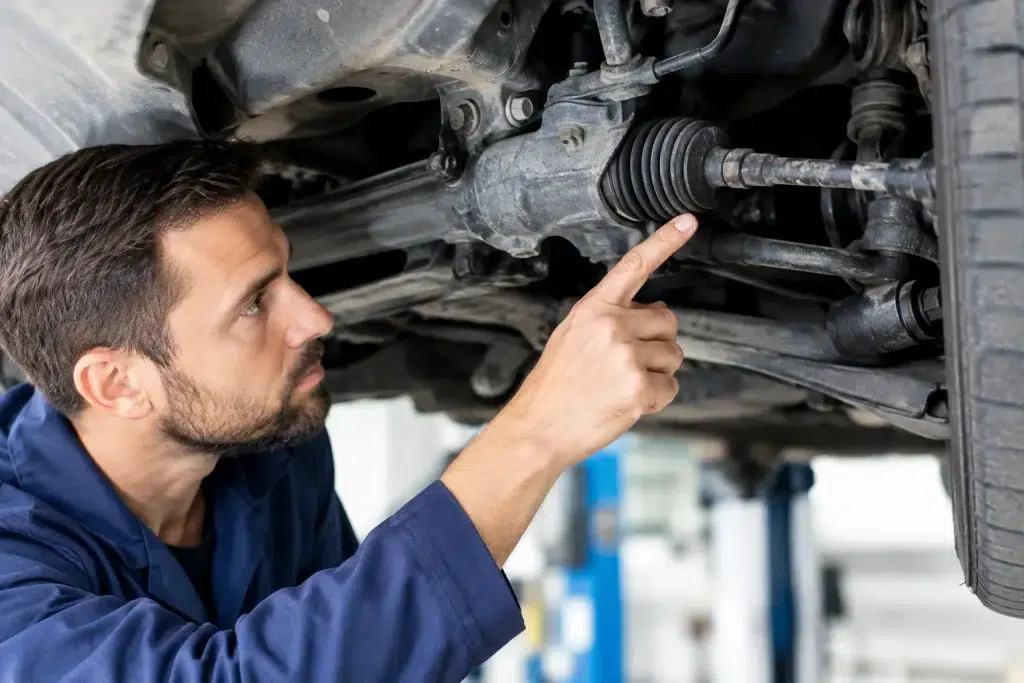
A professional inspection focuses on where movement begins and where it is lost. With the vehicle safely assessed, a technician can observe the steering wheel, input shaft, box output shaft and steering linkage while the steering is moved through its free-play range. If the input shaft turns but the output arm does not respond promptly, internal box wear becomes more likely.
Oil leakage is another useful clue on hydraulic steering boxes. Fluid around the input shaft, sector shaft, cover or housing may indicate deteriorated seals, shaft wear or corrosion in the sealing area. A leak does not confirm that every internal component is worn, but it does justify a closer assessment. Continuing to use a box with low fluid can accelerate wear and may reduce power assistance.
Listen as well as feel. Knocking during direction changes may come from a worn box, but it is commonly caused by external joints or mounting points. A steering box that moves on its chassis mounts can imitate internal backlash. The condition of the mounting bolts, chassis bracket and associated linkage therefore forms part of the diagnosis, not an afterthought.
Free play is not always a box fault
The steering box sits within a chain of components. Movement at any point is added to the movement felt at the steering wheel. On a typical recirculating-ball system, possible sources include the steering-column coupling, box input joint, drop arm, drag link, idler arm, track rods and ball joints. On older vehicles, worn bushes and chassis mounting points may contribute substantially.
This is why measuring only steering-wheel free play is not enough. A vehicle can have a sound box and still steer poorly because several external joints each have a small amount of movement. Equally, a recently replaced linkage will not cure a worn box. The correct repair depends on locating the actual source of the lost motion.
How to identify steering box wear without mistaking normal design traits
Some older steering systems are inherently less direct than a modern electric power steering rack. A classic car may have a slower steering ratio, more steering-wheel turns from lock to lock and a degree of straight-ahead clearance that would feel unusual in a newer vehicle. The question is not whether it feels like a new car, but whether it behaves consistently and safely for that vehicle.
Compare the current behaviour with the vehicle’s known history where possible. Has the steering recently become less accurate? Does the car pull, wander or react differently after hitting bumps? Is there a change in effort, noise or leakage? A gradual worsening pattern is more suggestive of wear than a long-standing characteristic of the model.
Tyres should also be considered before a steering box is condemned. Mismatched tyres, incorrect pressures, damaged sidewalls and irregular tread wear can make a vehicle feel unsettled. Alignment settings, including caster and toe, affect straight-line stability and self-centring. An alignment check is often appropriate after steering repairs, but it should not be used as a substitute for finding mechanical play first.
Why adjustment is not a universal cure
Many steering boxes have an external adjustment intended to set internal mesh or reduce clearance. It can be tempting to treat this as a quick answer to steering play. It is not.
An adjustment may be appropriate where a specialist has confirmed that the box is otherwise serviceable and requires a minor correction. However, tightening a worn or damaged box can create tightness around the centre position, poor return to centre, accelerated internal wear or binding as the steering approaches full lock. A box can feel tighter while becoming less safe and less consistent.
The adjustment must also be made with an understanding of the box’s internal condition and the manufacturer’s specification. It should never be used to disguise wear in external steering or suspension parts. For this reason, steering-box adjustment is best treated as a diagnostic and repair decision, rather than routine maintenance.
When reconditioning may be the right repair
If inspection confirms internal steering-box wear, a suitable unit can often be assessed for component-level reconditioning. This may involve stripping the box, examining gears, bearings, shafts, seals and housings, then replacing serviceable wear items with appropriate OE or OE-quality parts where applicable. The rebuilt unit should be tested before it leaves the workshop.
Reconditioning is not identical to fitting a seal kit. A leaking box may have worn shaft surfaces, damaged internal bearings or corrosion that needs proper assessment. Equally, not every box is a viable candidate for rebuild. Severe housing damage, unavailable hard parts or unsuitable previous repairs can mean replacement is the more sensible route.
For classic, specialist and Right Hand Drive applications, retaining the correct original steering box can be particularly valuable. Availability of replacement units may be limited, and a generic alternative may not suit the vehicle’s mounting arrangement, steering geometry or intended driving character. A specialist assessment helps establish whether refurbishment, a reconditioned exchange unit or replacement offers the most reliable outcome.
Information that helps a specialist diagnose the fault
A clear description saves time and helps narrow the likely causes. Note whether the issue occurs only when driving, while stationary, when hot or cold, or over particular road surfaces. Mention any visible fluid loss, prior steering work, accident damage, recent alignment work and changes to tyres or suspension.
For trade customers and restoration workshops, vehicle identification details, the steering-box part number where available, photographs of the unit and a description of the linkage arrangement can be useful before removal. This is especially relevant where a vehicle has been modified, imported or converted, as apparently similar boxes can have important differences in input shafts, drop arms, mounting points and ratios.
A specialist steering inspection should also account for the rest of the system. Pro Power Steering assesses suitable steering components at unit level and can advise owners and fitting garages on the practical repair route, including reconditioning, supply options and the need for alignment after refitting. That approach is particularly helpful where more than one source of play is present.
Do not delay when steering precision changes
Excessive play, fluid loss, binding or an unpredictable response should not be accepted as part of owning an older vehicle. Steering is a safety-critical system, and the underlying cause can worsen with mileage. If the vehicle suddenly develops heavy steering, severe wander, a pronounced knock or a steering wheel that does not return normally, arrange a professional inspection before regular use.
A properly diagnosed repair does more than remove a symptom. It restores the confidence that the vehicle will track straight, respond cleanly and deliver the controlled steering feel its design intended.
