
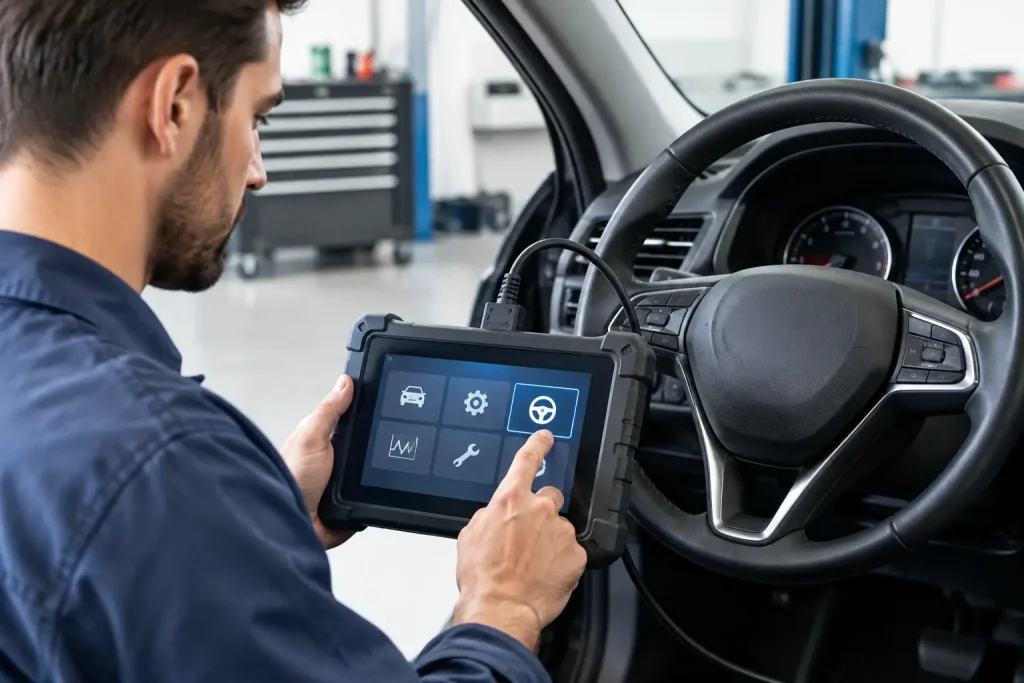
A steering warning light, heavy assistance or vague response does not automatically mean the steering rack has failed. The best steering diagnostic tools help separate a genuine rack fault from a sensor issue, wiring defect, poor supply voltage, worn linkage or an alignment problem. That distinction matters: steering systems are safety-critical, and replacing a major component before the cause is established can add unnecessary cost without curing the complaint.
For owners, garages and trade customers, the right equipment depends on the steering system fitted to the vehicle. A modern electric power steering system needs a different diagnostic approach from a hydraulic rack on an older vehicle, while a classic steering box may require largely mechanical assessment. Good diagnosis combines appropriate tools, accurate vehicle information and the experience to interpret what the results actually mean.
Best steering diagnostic tools by steering system
Manufacturer-capable scan tools for EPS faults
A capable diagnostic scan tool is the starting point for most modern vehicles with Electronic Power Steering (EPS). It should communicate with the relevant steering control module, read manufacturer-specific fault codes and display live data rather than only generic engine codes.
Useful live data can include steering angle, torque sensor values, motor current, assistance demand, vehicle speed input, battery voltage and control-module status. On some systems, comparing the steering angle and torque readings at centre and through lock can reveal implausible signals or an intermittent fault that a simple code read may miss.
The limitation is equally important. A stored EPS fault code does not prove that the rack itself is defective. Low voltage during cranking, corrosion in a connector, a damaged loom, a failed steering column sensor or a communication fault elsewhere on the vehicle can all generate steering-related codes. The scan tool identifies a direction for investigation, not always the failed part.
For independent workshops, multi-brand diagnostic equipment with strong manufacturer coverage is often practical. However, some coding functions, security access procedures and current software routines may require dealer-level equipment or an approved specialist platform. This is particularly relevant after fitting certain EPS racks, columns or modules.
Coding and calibration equipment
Coding and calibration capability is one of the most valuable features when diagnosing and repairing later electric steering systems. Depending on the manufacturer, a replacement or reconditioned unit may need programming, configuration, steering-angle sensor calibration or an end-stop learning routine before correct operation is restored.
A rack that has been physically installed correctly may still show a warning light or provide uneven assistance if these procedures have not been completed. Equally, a calibration that repeatedly fails can be useful evidence. It may point to wheel alignment, a steering-angle issue, incorrect component configuration, communication faults or an underlying mechanical restriction.
Some applicable EPS racks can be flashed or virginised in preparation for vehicle-specific coding. This does not remove the need for the correct final programming and calibration on the vehicle. Garages should confirm the exact requirements before ordering a unit, especially on premium, performance and right-hand-drive applications where part numbers, software versions and rack variants can differ.
Digital multimeters and electrical test equipment
For electrically assisted steering, a quality digital multimeter remains essential. It is used to check battery condition, supply voltage, voltage drop, grounds, fuses and continuity where the diagnostic process calls for it. EPS systems can draw considerable current, so a connection that looks acceptable with no load may become a fault when steering assistance is demanded.
Advanced workshops may also use an oscilloscope and CAN network test equipment. These tools can help identify distorted sensor signals, intermittent communication issues or wiring faults that are not apparent during a static inspection. They require trained interpretation. Incorrect probing around sensitive vehicle electronics can cause further problems, so this is not a substitute for a structured diagnostic process.
Electrical testing is particularly valuable where a steering fault is intermittent. A warning light that only appears after a long drive, in wet conditions or during parking manoeuvres may require data capture and loaded circuit testing rather than a quick code check on the ramp.
Hydraulic pressure and flow test equipment
Hydraulic systems need a different set of checks. A pressure gauge and appropriate test adaptors can assess whether the system is generating and regulating pressure correctly, while fluid condition and signs of external leakage provide further evidence. These tests help establish whether poor assistance is likely to be connected with the rack, the hydraulic supply or a restriction within the system.
Pressure readings must be interpreted against the vehicle specification. A single reading without engine speed, temperature and steering-load context can be misleading. Test procedures also involve high-pressure fluid, so they should be carried out by competent technicians using the correct equipment and safety measures.
A hydraulic test does not replace a mechanical rack assessment. Internal wear, corrosion on the rack bar, damaged seals and valve issues can affect steering feel in ways that are not fully explained by a basic pressure check. This is where component-level inspection becomes useful if the rack is removed for specialist assessment.
Wheel alignment equipment and mechanical inspection tools
Not every steering complaint is an electronic or hydraulic fault. Modern four-wheel alignment equipment is a diagnostic tool as much as a set-up tool. It can identify toe, camber, caster and thrust-angle discrepancies that cause a crooked steering wheel, instability, tyre wear or poor self-centring.
Alignment figures must be considered alongside a physical inspection. Worn track rod ends, inner joints, bushes, ball joints, suspension mounts and steering column couplings can create play or imprecision that no calibration will fix. A steering rack may be blamed for wander or knocking when the fault sits elsewhere in the front suspension or steering linkage.
On older cars, classics and vehicles with steering boxes, mechanical checks are especially significant. Measuring free play at the steering wheel, inspecting linkages and assessing box adjustment can establish whether reconditioning is appropriate. Over-tightening a worn steering box to mask play is not a reliable repair and can lead to poor return-to-centre or binding.
A better diagnostic sequence than parts swapping
The strongest diagnostic process begins with the customer’s exact symptom. Heavy steering all the time is different from assistance that fades once warm. A warning light after battery replacement is different from a metallic knock during low-speed manoeuvres. Road-test observations, where safe and appropriate, should be matched to the fault codes, live data and physical findings.
The next stage is to confirm the vehicle specification. Steering racks can vary by engine, trim level, axle arrangement, drive configuration and model year. Part-number verification is vital before any repair, reconditioning or replacement decision. It is also sensible to check for accident damage, kerb impact, water ingress and previous repair work, as these can alter the likely cause.
Only then should the workshop decide whether the existing unit requires removal and specialist evaluation. A removed rack can be assessed for mechanical damage, corrosion, leakage, internal wear and, where applicable, electronic condition. Suitable units may be reconditioned at component level using appropriate OE or OE-quality parts and tested before leaving the workshop. Not every rack is economically repairable or suitable for reconditioning, particularly if there is severe housing damage, unavailable internal parts or significant electronic damage.
What garages should look for in a steering specialist
The best steering diagnostic tools are only as useful as the technical process behind them. For difficult faults, choose a specialist able to discuss the symptom, vehicle details, diagnostic evidence and intended repair route before a unit is supplied or rebuilt.
Pro Power Steering supports garages and vehicle owners with specialist rack diagnosis, reconditioning and testing across electric, hydraulic and manual systems. For applicable EPS repairs, the practical question is not simply whether a rack can be supplied, but whether it is correct for the vehicle and what coding, calibration and alignment work will be needed once fitted.
A 12-month warranty on completed work provides reassurance, but it should sit alongside correct installation and diagnosis. If an external electrical fault, worn suspension component or incorrect alignment remains unresolved, fitting a sound steering unit alone cannot guarantee the desired steering feel.
The useful outcome is not a longer list of fault codes or a quick assumption that the rack is at fault. It is a clear explanation of what has failed, what evidence supports that decision and what work is needed to return the vehicle to smooth, precise and predictable steering.
