
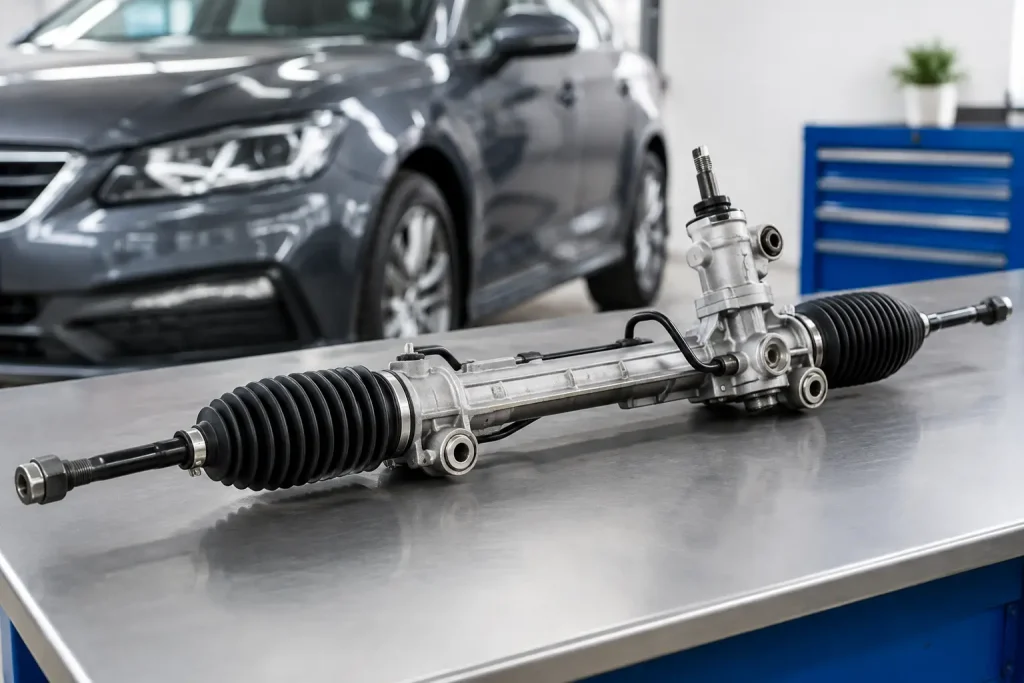
A steering rack can become difficult to source long before the vehicle itself is ready to leave the road. For owners, workshops and restoration specialists, discontinued rack options are often the difference between returning a sound vehicle to service and facing an unnecessary write-off. The correct route depends on the rack type, the fault, parts availability and, on modern vehicles, the electronic requirements after fitting.
A discontinued part number does not automatically mean the rack is beyond repair. Equally, fitting the first used unit found online is rarely a dependable answer. Steering is a safety-critical system, so the decision should begin with accurate diagnosis and a realistic assessment of the original component.
Why steering racks become discontinued
Manufacturers eventually stop producing replacement steering assemblies for older models, lower-volume variants and certain specialist vehicles. This can affect hydraulic racks, manual racks, steering boxes and electric power steering systems. Right Hand Drive applications can be especially challenging because they may use different housings, pinions, pipe positions, mounts, input shafts or electronic configurations from Left Hand Drive equivalents.
The issue is not limited to classic cars. A premium vehicle with a relatively low production volume may have an unavailable rack while still being perfectly practical to own. Performance models, commercial vehicles and imported specialist vehicles can present the same problem.
When a rack is listed as obsolete, it is worth confirming exactly what has been discontinued. Sometimes the complete assembly is unavailable while serviceable internal parts, sensors, motors, seals or housings remain obtainable. In other cases, a manufacturer may have superseded the part number, but the replacement requires different coding, associated components or a modified installation. Those distinctions matter.
Discontinued rack options worth considering
The most appropriate solution is normally found by working from the existing rack outward, rather than starting with a catalogue search. A specialist should identify the vehicle precisely, including VIN details, steering system specification, rack number, software requirements and whether the car is Right Hand Drive.
Reconditioning the original steering rack
Where the original unit is structurally sound, component-level reconditioning is often the strongest option. The rack can be stripped, inspected and assessed for wear or damage to the housing, rack bar, pinion, bearings, bushes, seals and relevant hydraulic or electronic components.
This approach retains the correct vehicle-specific casing, mountings and connections. That is particularly valuable where a direct replacement has been discontinued or where the vehicle has an unusual specification. Suitable units can be rebuilt with appropriate OE or OE-quality parts where applicable, then tested before leaving the workshop.
Reconditioning is not suitable for every rack. Severe corrosion, a damaged housing, destroyed gear teeth, significant rack-bar pitting or unavailable critical electronic parts can make repair impractical. A proper assessment should identify those limitations before work proceeds, rather than promising a repair simply because a replacement is hard to find.
A reconditioned exchange unit
An exchange rack may be suitable when an identical reconditioned unit is already available. This can reduce vehicle downtime, particularly for trade customers managing workshop schedules or fleet vehicles that need to return to work promptly.
The key word is identical. The donor unit must match the vehicle application, handedness and specification. Similar-looking racks can have different lock-to-lock travel, pinion geometry, pressure characteristics, sensor arrangements or motor control units. On electronically assisted systems, the hardware may fit physically but still require programming or may be incompatible altogether.
An exchange unit should be clearly identified, professionally rebuilt and tested. Its provenance and warranty position are more meaningful than a broad description such as “fits multiple models”.
New old stock and manufacturer-superseded units
New old stock can be an excellent solution when a genuine, correctly stored unit becomes available. It is still sensible to confirm the part number against the vehicle, rather than relying only on model and year. Production changes within the same model range are common.
A superseded manufacturer part can also be appropriate, but it may not be a straightforward bolt-on replacement. It could require revised pipes, a different steering coupling, updated software or a steering angle sensor calibration. In some cases, main dealer support is necessary to complete coding or to verify the vehicle’s software compatibility.
New old stock is not automatically fault-free because age, storage conditions and the condition of seals or electronics can vary. It remains a viable route, but it should be treated as a specific engineering part, not simply as an old item in unopened packaging.
Used racks from donor vehicles
A used rack can appear attractive when availability is limited, but it carries the highest uncertainty. The internal condition is usually unknown, and the donor vehicle may have been dismantled because of collision damage, water ingress or an unrelated mechanical fault. Mileage alone says little about seal condition, bearing wear or the health of an EPS motor and control electronics.
For a low-value vehicle, a tested used unit may sometimes be a practical short-term choice. For a vehicle intended for long-term ownership, restoration or regular commercial use, a properly assessed reconditioned original rack is usually the more controlled route where feasible. If a used unit is considered, it must be an exact match and should still be checked for condition, compatibility and any required coding before installation.
Specialist conversion or adaptation
For certain classic, competition and specialist applications, a conversion can be considered where the original steering arrangement cannot be repaired or sourced. This might involve adapting a suitable rack or adding electric assistance to reduce steering effort while preserving predictable control.
This is not a universal solution. Geometry, steering ratio, bump steer, column arrangement, mounts, joint angles and vehicle approval considerations all need careful attention. A conversion that makes the steering lighter but alters the vehicle’s handling characteristics is not a satisfactory outcome. These projects need vehicle-specific engineering judgement rather than a generic kit approach.
Diagnosis before selecting a replacement
A heavy steering complaint, vague response, fluid loss warning or EPS fault does not always mean the steering rack has failed. The root cause may lie elsewhere in the steering system, such as the column, intermediate shaft, wiring, sensor inputs, suspension components or wheel alignment. Replacing a discontinued rack without confirming the fault can create cost and delay without curing the original problem.
For hydraulic systems, diagnosis should establish whether the rack itself is leaking internally or externally and whether the steering assistance and pressure behaviour are correct. For EPS systems, fault codes are only part of the process. Live data, power and earth checks, communication faults, motor operation and sensor plausibility may all need investigation.
This diagnostic stage is particularly useful when the original rack is potentially repairable. It prevents a serviceable unit being rejected because of a fault outside the rack, while also preventing reconditioning work on a component that cannot deliver a reliable repair.
Coding, calibration and alignment after fitting
Modern electric steering racks are often part of a wider vehicle network. Depending on the application, a replacement or reconditioned unit may require flashing, virginising, vehicle-specific coding or commissioning. Steering angle sensor calibration and diagnostic clearing may also be required.
Physical installation is only one part of the repair. The vehicle must have correct wheel alignment after rack removal or replacement, and the steering wheel should be centred. Incorrect alignment can produce poor straight-line behaviour, uneven tyre wear and steering angle sensor errors, even when the rack itself is operating correctly.
A fitting garage should have the equipment and information required for the specific vehicle. Where dealer-only functions are needed, that should be identified early so the job can be planned properly rather than discovered after the car is reassembled.
Choosing a specialist route
For discontinued steering components, the most useful question is not simply, “Can you get a rack?” It is, “What is the safest reliable route for this vehicle?” The answer may be reconditioning the original unit, supplying a tested exchange rack, sourcing a verified replacement, or confirming that a different fault is responsible.
Pro Power Steering assesses suitable racks at component level and supports customers and fitting garages with practical technical advice. For applicable EPS units, preparation for coding and calibration can also form part of the process. Completed work is supported by a 12-month warranty under the applicable terms.
When a steering rack is discontinued, careful identification and diagnosis give you more options than a parts catalogue may suggest. Preserving the correct steering characteristics, electronic compatibility and safe road behaviour is worth more than finding the quickest available substitute.
