
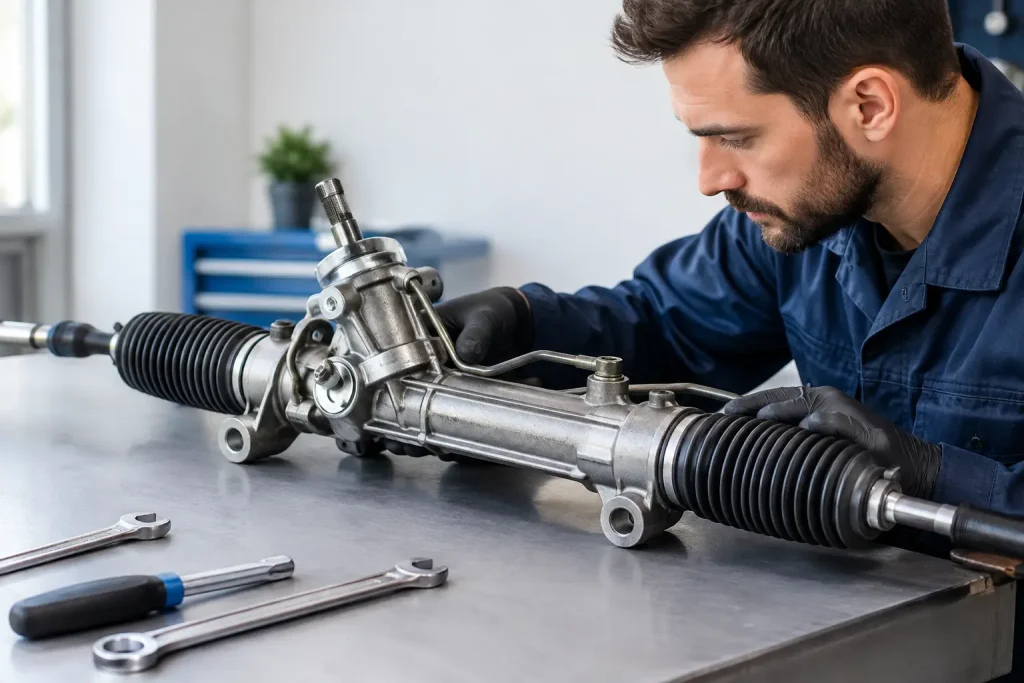
A steering rack fault can quickly become an expensive-looking problem, particularly on a right-hand-drive vehicle where a like-for-like replacement may be harder to source. So, are RHD racks repairable? In many cases, yes – but repairability depends on the rack’s internal condition, the type of steering system fitted and whether the underlying fault has been diagnosed accurately.
A leaking hydraulic rack, inconsistent assistance, excessive play or an Electronic Power Steering warning does not automatically mean the complete unit is beyond use. A specialist assessment can establish whether the fault is confined to serviceable internal components, electronics or external parts, or whether replacement is the safer and more practical route.
Why Right Hand Drive Rack Repairs Need Careful Assessment
A right-hand-drive steering rack is not simply a left-hand-drive rack fitted to the other side of the car. The pinion position, input shaft arrangement, hydraulic ports, mounting points, track rod geometry and electrical connections can differ. On modern vehicles, the rack may also be programmed to work with the vehicle’s control modules and driver-assistance systems.
That matters when sourcing a replacement, but it also matters during repair. The correct seals, bearings, bushes, rack bar specification and electronic components must suit the exact unit. Fitting an apparently similar rack can create clearance issues, incorrect steering geometry, warning lights or steering assistance problems.
For older, classic and specialist vehicles, the challenge can be availability. A new RHD rack may no longer be supplied, while a used unit may carry the same wear or corrosion that caused the original failure. Where the core structure is sound, component-level reconditioning can be a sensible way to retain the correct RHD steering arrangement.
When an RHD Steering Rack Can Be Repaired
The most repairable racks are those with faults in components designed to wear over time, rather than serious damage to the rack housing, rack bar or electrical architecture. Hydraulic racks commonly suffer from seal deterioration, internal leakage, worn support bushes, damaged gaiters that have allowed contamination inside, and wear in the pinion area.
During a proper inspection, the rack is stripped and checked rather than judged only by its external appearance. The condition of the rack bar is especially significant. Light marks may sometimes be addressed within specification, but deep corrosion, pitting in the seal travel area, bending or damaged teeth can rule out a reliable rebuild. The housing and pinion assembly must also be measured for wear and damage.
Electric Power Steering racks require a broader diagnostic process. The mechanical assembly may be serviceable while the fault lies in the motor, torque sensor, control electronics, wiring or a communication issue elsewhere on the vehicle. Conversely, a dashboard warning may be accompanied by genuine mechanical free play or stiffness. Reading fault codes is useful, but it is not a substitute for testing the steering system and assessing the rack itself.
On suitable EPS applications, a repaired or reconditioned rack may need flashing or virginising before it can be coded to its vehicle. Steering angle sensor calibration and wheel alignment may also be required after refitting. These final steps are part of restoring predictable steering behaviour, not optional extras to overlook.
Faults that are often suitable for reconditioning
A rack may be a viable reconditioning candidate where there is internal seal failure, worn bushes or bearings, measured mechanical play, a serviceable rack bar with deteriorated seals, or a correctable fault in an applicable EPS assembly. The decision always depends on the exact part number and inspection findings.
Reconditioning is more than fitting a seal kit. A dependable repair should address the cause of the fault, replace worn serviceable components with appropriate OE or OE-quality parts where applicable, and include bench testing before the unit leaves the workshop. For electric systems, that may also involve electronic checks and preparation for vehicle-specific programming.
When Repair Is Not the Right Option
Not every rack should be repaired. A specialist should be clear about that from the outset. Structural cracking, severe housing damage, a heavily corroded or bent rack bar, damaged gear teeth, fire or flood damage, and unavailable critical electronic components can make a rebuild unsuitable.
Some modern racks are also restricted by manufacturer security systems or software access. In those cases, the rack may require dealer-level programming after installation, or complete replacement may be the only practical answer. This is particularly relevant where the steering system is closely integrated with lane assistance, adaptive cruise functions or other driver-assistance features.
Replacement can also be preferable where the vehicle has suffered collision damage. If a kerb strike or accident has damaged suspension arms, subframe mountings, steering column joints or wheels, repairing the rack alone may not resolve the problem. The whole steering and suspension arrangement needs checking before any component is condemned or refitted.
A good repair decision considers the unit’s condition, parts availability, software requirements, total fitted cost and the intended use of the vehicle. A fleet vehicle may need the quickest reliable path back into service. A restoration project may justify preserving an original RHD component that is no longer available new. Neither approach is automatically right in every case.
Diagnosis Comes Before Parts Ordering
Heavy steering, wandering, a knocking sensation or a warning light can originate outside the rack. Tyres, alignment, suspension joints, steering column couplings, electrical supply faults and vehicle network issues can all affect steering feel or trigger faults. Ordering a rack before confirming the cause risks unnecessary cost and downtime.
For hydraulic systems, diagnosis should distinguish between an external fluid leak, internal bypassing and a mechanical restriction. For EPS systems, it should combine fault-code analysis with live data, power and earth checks, communication checks and a physical inspection of the steering gear. The vehicle’s history is useful too. Intermittent faults after a flat battery, collision repair or water ingress often point the investigation in a different direction from a gradual increase in steering play.
Independent garages benefit from this process as much as owners do. Clear findings help the fitting workshop plan for the correct rack variant, additional parts, coding requirements and alignment. It also prevents a repaired rack being blamed for a pre-existing vehicle fault.
What Happens During Specialist Rack Reconditioning?
Once a suitable RHD rack has been accepted for repair, it is dismantled for inspection and cleaning. Components are assessed for wear, corrosion and dimensional condition. Serviceable parts are renewed as required, while the rack bar, pinion, housing and critical interfaces are checked before reassembly.
The rebuilt unit is then tested to confirm smooth travel, correct operation and freedom from unacceptable leakage or play. The exact test procedure varies between hydraulic, manual and electric racks, but the aim is the same: to return a unit that is ready for correct installation, not simply one that looks refurbished.
Pro Power Steering carries out this type of component-level assessment across hydraulic, manual and electric steering systems, with direct technical support available where a fitting garage needs clarity on the repair path. Completed work is supported by a 12-month warranty under the applicable terms.
Fitting, Coding and Alignment Still Matter
A repaired steering rack is only one part of the finished job. The correct rack must be fitted without twisting or damaging pipes, looms, gaiters or steering column connections. The steering wheel must be centred, track rods adjusted correctly and the vehicle aligned to the proper specification.
On EPS-equipped vehicles, coding and calibration requirements should be confirmed before installation. A rack that needs commissioning may not provide normal assistance until this work has been completed. Where advanced driver-assistance systems are fitted, further calibration may be needed after alignment or steering work.
For vehicle owners, the practical message is simple: do not judge a repair only by the price of the rack. Ask whether diagnosis, bench testing, coding support, alignment and warranty are accounted for. For workshops, recording fault codes and vehicle details before removal makes technical support far more effective.
The right question is not only whether an RHD rack can be repaired, but whether the complete steering system can be returned to smooth, precise and safe operation. A specialist assessment gives you the evidence to choose repair, reconditioning or replacement with confidence.
