
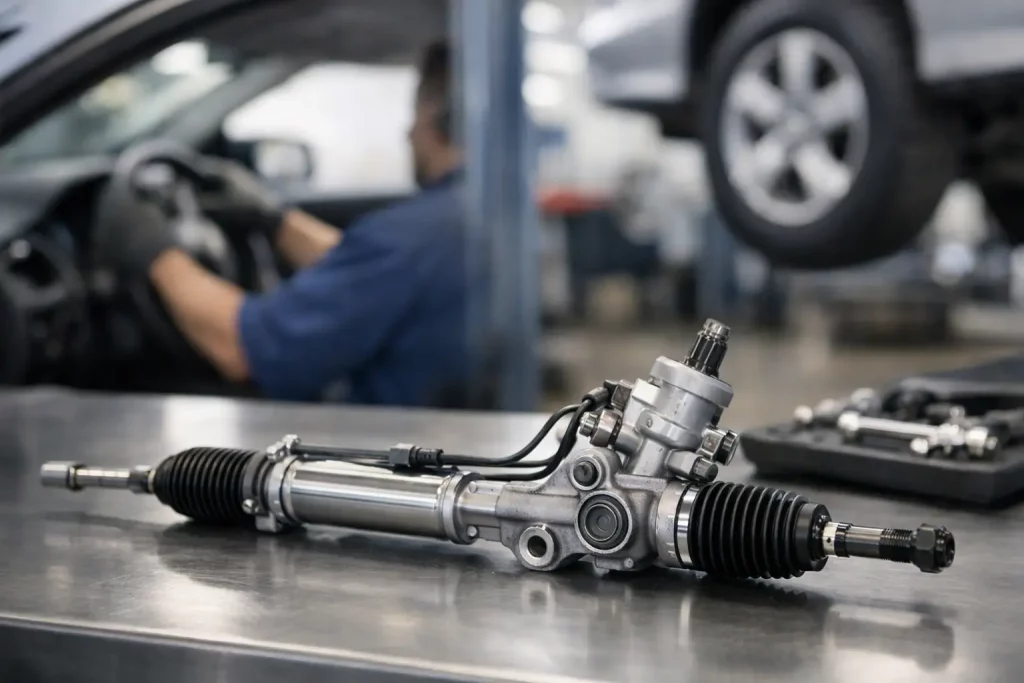
A steering rack that leaks, feels notchy or triggers an EPS warning does not automatically need replacing as a complete unit. Steering refurbishment can be the correct and cost-effective route where the core component is suitable, the fault is accurately identified and the finished unit can be properly tested. The key is separating a repairable internal problem from damage or electronic failure that makes replacement the safer option.
For vehicle owners, garages and restoration specialists, that distinction matters. Steering is not simply about making the wheel turn. It affects directional control, tyre wear, driver confidence and the precise feel expected from anything from a working van to a performance car.
What steering refurbishment actually involves
Steering refurbishment is a component-level engineering process, not a cosmetic clean-up or a basic seal change. A specialist strips the steering rack, steering box, column or other applicable component to assess the condition of its working parts. The aim is to identify wear, corrosion, contamination, damaged surfaces and faults that are not always apparent when the unit is still on the vehicle.
For a hydraulic rack, this may involve inspecting the rack bar, pinion, bearing surfaces, valve assembly, seals and internal guides. A manual rack or steering box has its own wear points, including gears, bushes, shafts and adjustment mechanisms. Electric power steering systems add motors, torque sensors, electronic control modules and vehicle-specific software requirements to the assessment.
Suitable units are rebuilt with appropriate OE or OE-quality parts where applicable. Components are cleaned, measured and renewed or reconditioned as required, then the unit is assembled to the correct specification. Before it leaves the workshop, testing is used to check function, leaks and operating performance. This is where a properly reconditioned unit differs from an unknown used part with no meaningful history.
The symptoms that justify a proper assessment
A heavy steering wheel is a common reason for enquiry, but it is not a diagnosis by itself. The fault could be within the rack or box, yet it could also relate to an EPS issue, a seized steering joint, suspension condition, tyre specification, alignment or an electrical supply fault. Replacing a rack without confirming the cause can leave the original complaint unresolved.
Other signs that merit specialist steering diagnostics include fluid loss around a hydraulic rack, excessive free play at the wheel, knocking felt through the steering, inconsistent assistance, a steering wheel that does not self-centre correctly, or a vehicle that wanders despite sound tyres and correct pressures. On electrically assisted systems, warning lights, intermittent assistance and communication faults need particular care because the fault may be mechanical, electronic or both.
A fault that changes with temperature can be especially revealing. Assistance may be normal when cold but deteriorate after a longer drive, or an EPS warning may appear only after vibration or a voltage drop. These patterns help direct testing, but they should not be treated as proof of one failed component. Accurate diagnosis remains the first stage of a reliable repair.
When refurbishment is a sensible option
Refurbishment is often a strong option when the original unit is correct for the vehicle, its main casing and critical structure remain serviceable, and replacement internal parts are available. This can be particularly valuable for older vehicles, classics, specialist models and right-hand-drive applications, where a readily available replacement may be difficult to source or may not be an exact match.
Retaining and reconditioning the original assembly can also avoid unnecessary replacement of serviceable material. For trade customers, it can provide a dependable route when a new unit has long lead times or when the vehicle needs a specific rack variant, steering box or column arrangement.
It depends on the condition found during strip-down. A rack with internal scoring beyond acceptable limits, severe corrosion, accident damage, a cracked housing or an unsupported electronic fault may not be a suitable refurbishment candidate. In those cases, a replacement unit, a different repair path or manufacturer-level support may be required. Honest assessment is more useful than promising a repair before the component has been examined.
Why right-hand-drive specification matters
Right-hand-drive vehicles can use different rack layouts, input positions, pipe routing, steering shafts, wiring arrangements and calibration data. This is especially relevant to imported vehicles and premium models offered in multiple markets.
Using the wrong part can create fitting difficulties or compromise steering geometry and electronic operation. A specialist should identify the vehicle accurately using its registration, VIN details and component numbers where available, rather than relying only on a broad model description.
Electric power steering needs more than mechanical repair
Modern EPS racks combine precision mechanics with electronics. They may contain a motor, control unit, torque sensing and position information that must communicate correctly with the vehicle. A mechanical repair alone may not resolve a warning light or loss of assistance if the underlying fault sits in the electrical system, wiring, vehicle network or configuration.
On applicable models, an EPS rack may need flashing or virginising before it can be coded to the vehicle. Coding and calibration can be required after installation, alongside steering angle sensor procedures and wheel alignment. Some vehicles need dealer-level or manufacturer-specific diagnostic capability for final commissioning.
This is not a reason to dismiss refurbishment. It is a reason to plan the job as a complete repair process. The workshop fitting the component needs to know what coding, calibration and alignment steps apply before the vehicle is booked in. Clear technical support between the steering specialist and fitting garage reduces avoidable delays.
Fitting and alignment are part of the result
Even an accurately refurbished rack can perform poorly if installation work is incomplete. The steering wheel must be centred, joints and fasteners correctly fitted, and suspension geometry checked after refitting. Wheel alignment is not an optional finishing touch when steering components have been removed or replaced. It is essential for straight-line stability, tyre life and correct steering-wheel position.
The condition of connected parts also matters. Worn track rod ends, inner joints, steering couplings, column shafts or suspension bushes can imitate a rack fault or mask the improvement from a repaired unit. A competent inspection should consider the whole steering system while keeping the repair focused on evidence, rather than replacing parts by assumption.
For hydraulic systems, correct fluid specification and a clean system are equally relevant. Contamination left in the system can shorten the life of replacement seals and precision internal components. The fitting process should therefore follow the vehicle manufacturer’s procedure, including any flushing or bleeding requirements.
Refurbished, used or new: choosing the right route
A used steering unit may be cheaper initially, but its internal condition and remaining service life are generally unknown. It may have the same age-related wear as the component being removed, and it may not carry the correct software or specification. It can be appropriate in limited circumstances, but it is rarely the most predictable option for a long-term repair.
A new unit can be the preferred route where the manufacturer supplies the correct part, the price and availability are acceptable, or the old unit is not viable for reconditioning. For some modern vehicles, it may also simplify electronic compatibility, although coding and calibration can still be necessary.
A professionally refurbished unit sits between those choices. It is not automatically the right answer in every case, but where the component is suitable, it offers an engineered repair based on inspection, renewed wear parts and testing. At Pro Power Steering, completed work is supported by a 12-month warranty under the applicable terms, giving owners and fitting garages a clear basis for the repair.
Information that helps a specialist diagnose the fault
The quality of the initial assessment improves when the vehicle history is clear. The make, model, year, engine, registration, VIN and part number can help identify the exact steering variant. It is also useful to describe when the fault occurs, whether warning lights are present, what diagnostic codes have been read and whether the vehicle has had impact damage, water ingress or previous steering work.
For a component sent in for assessment, protect it carefully and include the relevant details. UK-wide collection and delivery can be practical for suitable components, but fitting, coding and alignment arrangements should be considered before the unit is removed. This avoids a vehicle occupying workshop space while a necessary calibration step or associated part is still outstanding.
If the steering feels unsafe, has excessive play, binds, leaks heavily or loses assistance unexpectedly, arrange an inspection rather than continuing to use the vehicle. The best next step is not guessing at a replacement part, but obtaining a diagnosis that matches the vehicle, the fault and the work needed to return the steering to smooth, precise operation.
