
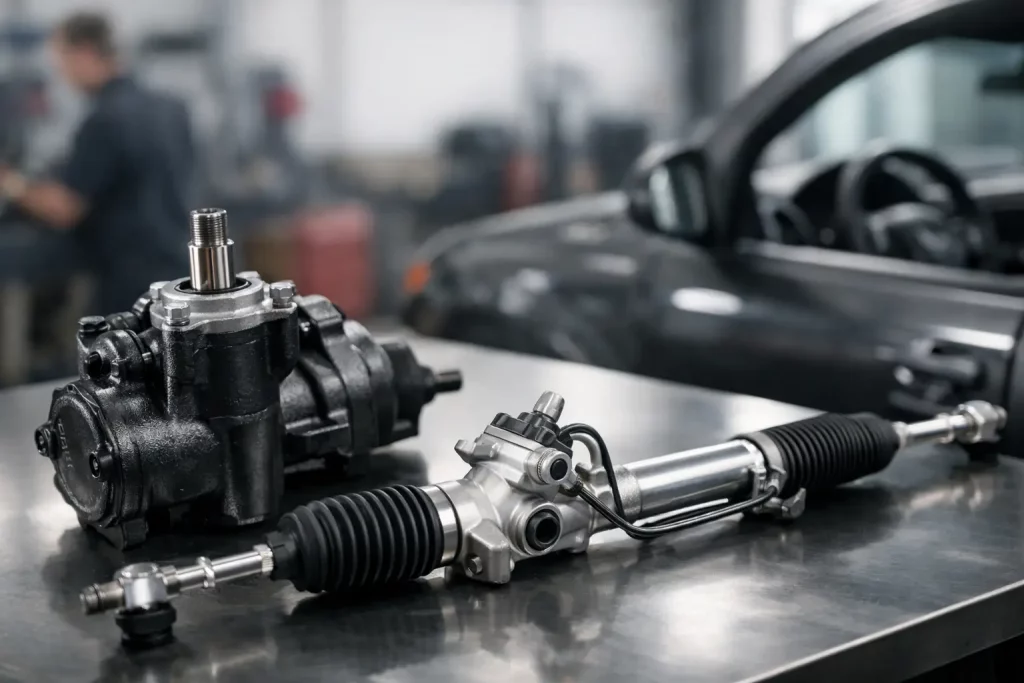
A steering fault rarely arrives at a convenient time. The wheel may become heavy at low speed, the vehicle may begin to wander, an EPS warning light may appear, or fluid may start leaking from the rack. When replacement costs are quoted, owners and workshops often ask the same question: are remanufactured steering parts reliable?
The answer is yes, provided the component has been properly diagnosed, professionally reconditioned and tested before it leaves the workshop.
A correctly reconditioned steering rack, steering box, EPS unit or column is not simply a second-hand part that has been cleaned and painted. It should be dismantled, inspected at component level, rebuilt using appropriate OE or OE-quality parts where applicable, adjusted correctly and tested for proper operation.
That distinction matters because steering is a safety-critical system. Reliability depends far more on the quality of the diagnosis, rebuilding process and testing than on the label placed on the box.
Are remanufactured steering parts reliable?
A professionally reconditioned steering component can provide dependable service and restore smooth, accurate steering at a substantially lower cost than a completely new dealer-supplied assembly.
Reliability depends on three main factors: whether the original fault has been diagnosed correctly, whether the reconditioning process addresses the actual cause of failure, and whether the finished unit is correct for the vehicle.
A hydraulic steering rack may suffer from internal leakage, worn seals, corrosion, excessive play or damage to the rack bar and pinion. An electric power steering system may develop motor, torque-sensor, electronic, wiring or calibration faults alongside mechanical wear.
These problems cannot be corrected by a cosmetic refurbishment. They require component-level inspection by a specialist who understands how the steering system should operate.
When the correct process is followed, remanufacturing offers a reliable alternative to complete replacement for modern cars, commercial vehicles, premium models, classics and performance vehicles.
Remanufactured, reconditioned and second-hand are not the same
The terms are sometimes used loosely, but there is an important difference between a professionally reconditioned component and an unknown second-hand rack.
A second-hand steering rack has normally been removed from another vehicle and sold in its existing condition. Its mileage, internal wear, accident history, exposure to water and remaining service life are usually unknown.
It may already contain worn bearings, internal corrosion, damaged seals, excessive play, faulty sensors or electronic problems. It may also have the same common weakness as the rack being replaced.
With an EPS rack, physical fitment does not guarantee correct operation. A used unit may retain donor-vehicle information, use a different software configuration or require coding that cannot be completed successfully.
It may display warning lights, provide intermittent assistance, fail to communicate with the vehicle or not work at all after installation.
The customer may then have to pay for removal, fitting, coding attempts, calibration, wheel alignment and a second replacement. For a safety-critical steering component, an unknown used rack can therefore be both risky and a false economy.
A professionally reconditioned steering rack is different. It is inspected, rebuilt and tested before dispatch, giving the customer and fitting garage much greater confidence in its condition.
What a reliable reconditioning process involves
A reputable steering specialist begins with assessment rather than assumption.
Heavy or inconsistent steering may point towards a steering rack fault, but similar symptoms can also be caused by poor wheel alignment, suspension wear, damaged tyres, low battery voltage, wiring faults or incorrect calibration.
Replacing the wrong component will not produce a reliable repair.
Once the steering unit has been confirmed as faulty, it should be assessed to establish whether it is suitable for rebuilding. A severely damaged casing, extensively corroded rack bar or major impact damage may make reconditioning impractical.
A professional specialist should explain when a unit cannot be safely or economically repaired rather than forcing an unsuitable rebuild.
Where reconditioning is possible, the unit is dismantled, cleaned and inspected. Worn or damaged parts are repaired or replaced using appropriate OE or OE-quality components where applicable.
Seals, bearings, bushes, gears, critical surfaces and mechanical adjustment are checked before the unit is rebuilt. On electric power steering racks, motor, sensor and electronic testing may also be required.
The completed unit is then tested before leaving the workshop. Depending on the type of rack, testing may include smooth mechanical movement, correct adjustment, internal free play, hydraulic operation, leakage, motor function, sensor signals and electronic communication.
Testing is what separates professional reconditioning from an uncertain second-hand replacement.
Flashing and virginising EPS steering racks
Some electric power steering racks retain coding, configuration or vehicle information from the car in which they were previously installed.
For suitable models, Pro Power Steering may be able to flash or virginise the EPS rack before supply. This resets relevant stored information so the unit is properly prepared for coding and calibration to the receiving vehicle.
Virginising is model-dependent, and the vehicle may still require specific EPS coding or calibration after installation.
However, supplying a properly prepared unit can help prevent communication faults, warning lights, rejected coding and loss of steering assistance caused by donor-vehicle configuration.
This is a significant advantage over purchasing an unknown used EPS rack and hoping it will work after fitting.
Main dealers may also supply remanufactured racks
A main dealer does not always supply a completely new steering rack.
Depending on the manufacturer, model and availability, the dealer may offer a refurbished, remanufactured or exchange unit. These components are often rebuilt by an external steering specialist before being supplied through the manufacturer or dealership network.
Pro Power Steering also provides specialist steering services and reconditioned components to main dealerships, independent garages and trade customers.
The choice is therefore not always between a new dealer rack and a reconditioned specialist rack. In some cases, both routes may involve the same type of professionally rebuilt component.
Going directly to a steering specialist can provide access to professional diagnosis, reconditioning, testing and warranty support without all the additional costs associated with the dealer supply chain.
A main dealer remains the most suitable route when the vehicle is covered by the manufacturer’s warranty, when a recall or service campaign applies, or when the manufacturer is paying for the work.
Why the exact vehicle specification matters
Steering racks are not always interchangeable simply because they look similar.
Right-hand-drive and left-hand-drive units may differ in casing design, pinion position, mounting points, travel, pipe routing, sensors and electronic configuration.
Variations can also exist between engines, production years, trim levels, suspension types and optional steering systems.
This is particularly important on premium and performance vehicles, where several steering-rack versions may be fitted within the same model range.
Supplying the registration, VIN and original part number where available reduces the risk of receiving an incorrect unit.
For classic and specialist vehicles, reconditioning the original component may be especially valuable. A new rack may no longer be available, while rebuilding the vehicle’s own unit preserves the correct housing, mounting arrangement and steering characteristics.
Fitting and calibration affect reliability
Even a professionally reconditioned steering component can perform poorly if it is installed incorrectly.
Mountings must be tightened correctly, electrical and hydraulic connections secured, and the steering wheel centred before alignment.
On EPS systems, stored faults should be investigated rather than simply cleared. Coding, basic settings or steering-angle calibration may be required depending on the vehicle.
Wheel alignment is also essential after steering-rack work. Incorrect geometry can leave the vehicle pulling, wearing its tyres unevenly or feeling unstable, even when the rack itself is operating correctly.
A final road test should confirm that assistance is consistent, the steering self-centres properly, the vehicle tracks accurately and there are no unusual noises, warning lights or excessive free play.
Direct technical support when needed
Reliability does not depend only on the component itself. Correct identification, fitting, coding and diagnosis of associated faults are also important.
Unlike purchasing through a general parts supplier, Pro Power Steering can provide direct technical advice to trade customers and vehicle owners when required.
This may include help identifying the correct rack, checking part numbers, confirming right-hand-drive compatibility, understanding fitting requirements and establishing whether coding or calibration may be needed.
If a warning light remains after installation, direct access to a steering specialist can help the fitting garage determine whether the issue relates to the rack, vehicle wiring, battery voltage, calibration or another unresolved fault.
This support can be far more useful than dealing with a supplier that can only arrange a return without understanding the internal steering system.
Warranty and accountability
Pro Power Steering provides a 12-month warranty on completed work, comparable with the cover commonly supplied with many main-dealer steering units.
The value of that warranty is supported by specialist diagnosis, professional reconditioning, appropriate OE or OE-quality components, workshop testing and direct technical advice when needed.
Warranty terms should always be read carefully. Supply-only work normally requires the fitting garage to complete installation, coding, calibration and wheel alignment correctly. Damage caused during fitting or by an unresolved fault elsewhere on the vehicle is different from a defect in the reconditioned component.
The strongest protection comes from choosing a specialist that understands the unit, can explain the repair and remains available if a technical concern arises.
Choosing a reliable remanufactured steering component
The dependable option is not simply the cheapest rack available.
Choose a steering specialist that confirms the fault, identifies the correct vehicle specification, rebuilds the unit using appropriate components, tests it before dispatch and provides clear warranty and technical support.
A properly reconditioned steering rack can offer reliable, safe and cost-effective service while avoiding the expense of a complete new assembly and the risks associated with an unknown second-hand part.
Contact Pro Power Steering to discuss whether your original steering rack can be professionally reconditioned or whether a correctly prepared exchange unit is available.
