
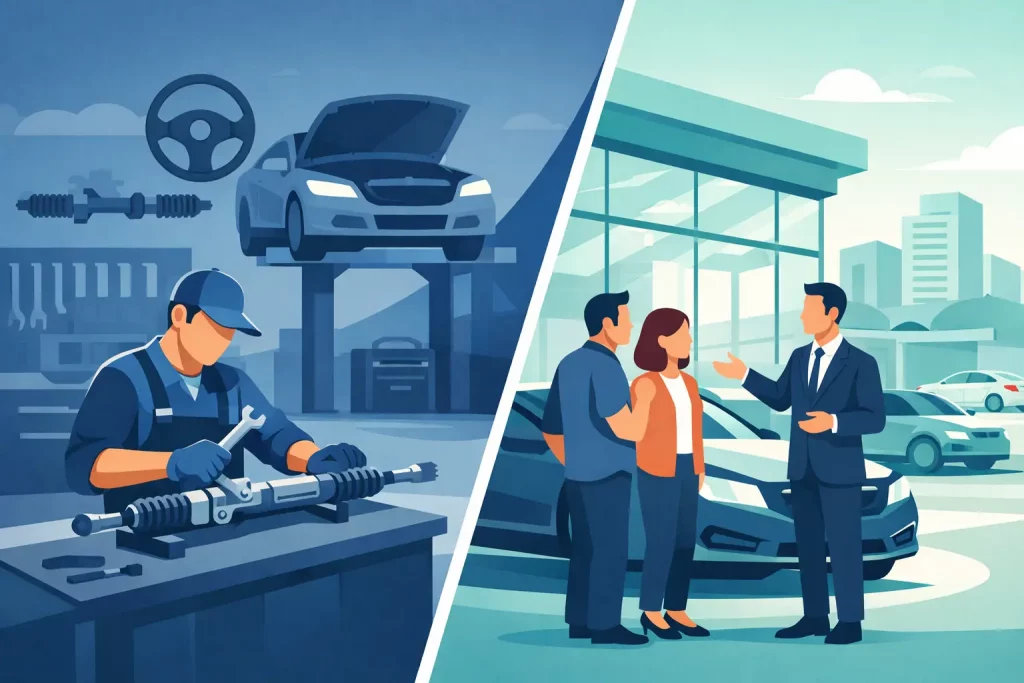
A warning light, heavy steering or a knock through the wheel can quickly turn a routine journey into a question of safety. When comparing a steering specialist versus dealership, the key difference is not simply labour rate. It is whether the fault is diagnosed at component level and repaired appropriately, or whether the recommended route is replacement of a complete assembly.
For many vehicles, particularly modern premium models, classic cars and performance vehicles, both routes can have their place. The right choice depends on the fault, the availability of parts, the vehicle’s age and value, and whether a safe, warrantied repair can restore precise steering without the cost of a new dealer-supplied unit.
Steering specialist versus dealership: the core difference
A main dealership is set up to support its own manufacturer’s vehicles using factory diagnostic equipment, approved service procedures and genuine new parts. This can be a sensible route for a vehicle still under manufacturer warranty, for software-related campaigns, or where a new component is the only approved and available solution.
A steering specialist focuses specifically on the systems that convert steering-wheel movement into controlled direction: steering racks, electric power steering units, steering boxes, columns, shafts and associated mechanical components. Rather than treating the rack or EPS assembly as a sealed item to replace, a specialist will assess wear, internal leakage, electronic faults, corrosion, damaged mountings and calibration issues where applicable.
That focus matters because similar symptoms can have very different causes. A vague steering feel may be caused by rack wear, but it can also arise from play in a steering column joint, worn suspension components, incorrect wheel alignment or tyres. A steering warning light does not automatically mean the complete electric rack has failed. Accurate diagnosis should come before any high-value replacement decision.
Why dealership repairs can cost more
Dealership pricing often reflects genuine-parts supply chains, manufacturer procedures, trained technician time and the overheads of a franchised operation. There is value in that model, especially for new vehicles and manufacturer-backed work. However, dealerships commonly work to a replace-rather-than-recondition process.
If an internal rack fault is identified, the usual dealer recommendation may be a complete new rack assembly, followed by coding, calibration and wheel alignment. On some cars, that is the correct and efficient repair. On others, it can be expensive when the original unit is suitable for professional reconditioning.
The cost difference can become more noticeable on older executive vehicles, sports cars, 4x4s and classics. A new unit may be costly, unavailable, or no longer produced. A properly reconditioned original component can preserve the correct fitment and steering characteristics while avoiding an unnecessary complete-assembly bill.
This is not an argument that new parts are always wrong. A replacement assembly may be the best option if a casing is beyond repair, essential parts are unavailable, the unit has suffered severe impact damage, or a manufacturer update requires a later specification. The useful question is whether replacement has been proven necessary.
Component-level diagnostics change the repair decision
A specialist diagnosis is intended to establish what has actually failed before work begins. That may include checking the vehicle’s fault codes, power and earth supplies, communication signals, steering angle data, mechanical free play, rack condition and the operation of the electric assistance system.
On hydraulic and manual steering systems, inspection may identify external leakage, internal wear, stiffness or damage to the rack and pinion mechanism. On EPS systems, the diagnostic process can be more involved. Torque sensors, motors, control electronics and vehicle-network communication can all affect steering assistance and warning lights.
A code reader alone is not enough. Fault codes provide a starting point, not always a final answer. A vehicle can store an EPS-related code because of a low-voltage event, wiring issue or calibration concern rather than a failed steering unit. Equally, clearing a warning light without finding the underlying cause is not a repair.
This is where specialist experience is particularly valuable. A technician who works with steering assemblies every day is more likely to recognise recurring failure patterns across particular makes and models, including common RHD-specific fitment and configuration issues.
Reconditioning is not a cosmetic repair
Proper steering rack reconditioning is a controlled technical process, not a quick clean-up or a set of seals fitted without inspection. The unit is stripped, assessed and rebuilt using serviceable components, with worn or damaged elements replaced where required. Critical surfaces, seals, bearings and adjustment are addressed before the assembly is tested.
The exact process varies by unit type and fault. An electric rack may require electronic diagnostics and testing alongside mechanical reconditioning. A steering box requires its own inspection and set-up procedure. The objective remains the same: restore safe, smooth and accurate steering performance to a standard suitable for road use.
For owners, the practical benefit is clear. Where reconditioning is viable, it can provide a cost-effective alternative to a new complete assembly without accepting an unknown used part. A used rack may look like a saving, but its internal condition, history and remaining life are often impossible to verify before fitting.
Warranty, accountability and what to ask
Warranty should be compared carefully rather than assumed. A dealership may provide parts and labour cover according to manufacturer terms. A specialist should explain what its guarantee covers, how long it applies and whether the repair includes the testing and set-up needed for the vehicle.
Pro Power Steering provides a 12-month guarantee on completed work, giving owners and trade customers assurance that the repair is supported after installation. For a workshop sourcing a reconditioned unit, that backing can be significantly more valuable than a low-cost second-hand component with limited traceability.
Before authorising work, ask whether the diagnosis has identified the failed part, whether reconditioning is technically appropriate, and whether coding or calibration will be required after refitting. It is also worth confirming whether wheel alignment will be checked. Steering geometry is essential after rack removal or replacement, and poor alignment can leave the car pulling, wearing tyres unevenly or feeling unsettled on the road.
A clear estimate should separate diagnostic work, the steering repair or replacement, fitting, calibration and alignment where relevant. That makes it easier to compare like for like. A low initial quote is not necessarily lower once additional labour, programming and geometry checks are added.
When a dealership is the better choice
There are situations where a franchised dealer is the most suitable route. If the vehicle is under a comprehensive manufacturer warranty, if there is a recall or service campaign, or if a software update and manufacturer authorisation are central to the repair, dealer involvement may be required.
A dealership can also be preferable where the vehicle has a very recent, highly integrated steering system and the manufacturer has not released repair information or component support outside its network. For company vehicles on strict manufacturer maintenance agreements, the required process may already be defined.
Even then, obtaining a specialist assessment can be useful where the diagnosis is unclear or the dealer has recommended a costly complete assembly. A second technical opinion may confirm that replacement is necessary, or identify a repairable fault that has not yet been explored.
When a steering specialist makes more sense
A steering specialist is often the stronger option when the priority is repairing the actual fault, preserving the original assembly where practical, and managing cost without compromising safety. This is especially relevant for vehicles outside manufacturer warranty, high-mileage premium cars, classics, specialist imports and performance models.
It is also a practical route for independent garages and fleet operators. They need dependable diagnosis, predictable turnaround and access to reconditioned components that can be supplied and fitted correctly. A specialist can support that requirement with vehicle-specific expertise rather than a broad, general repair approach.
For RHD vehicles, correct rack specification matters. Left-hand-drive and right-hand-drive units are not interchangeable simply because they appear similar. Mounting points, pinion position, pipe routing, electronic configuration and travel can differ. A specialist familiar with RHD steering systems helps prevent costly ordering and fitment mistakes.
Choose the repair route, not just the lowest price
The best decision is rarely based on the headline price alone. It should be based on a confirmed diagnosis, the condition of the original unit, the quality and traceability of replacement options, and the warranty behind the work.
If your steering feels heavy, noisy, imprecise or inconsistent, do not wait for the fault to worsen. Ask for a proper steering assessment, understand whether the unit can be reconditioned, and choose the repair path that returns the vehicle to safe, smooth and accurate operation.
