
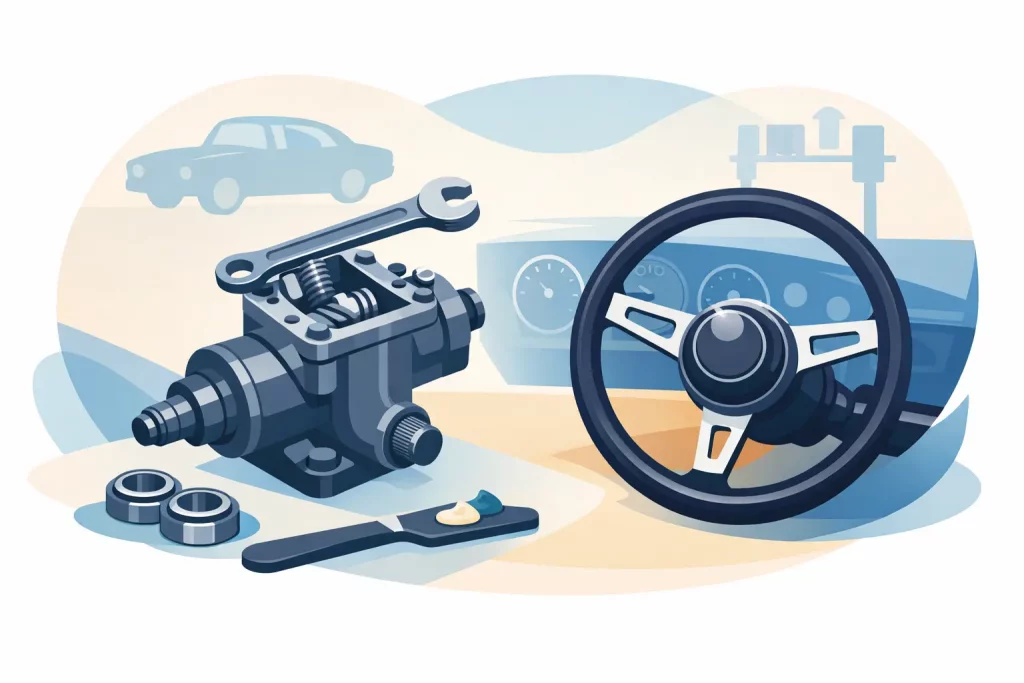
A classic car can look immaculate and still feel wrong from the driver’s seat. Excessive movement at the steering wheel, a vague straight-ahead position or a heavy spot through a bend can take the confidence out of every mile. Proper classic steering box repair is not simply about removing play. It is about restoring the controlled, predictable steering response the vehicle was designed to deliver while preserving a valuable original component wherever possible.
Many classic vehicles use a steering box rather than a rack. Depending on the vehicle, this may be a worm-and-sector, worm-and-roller, recirculating-ball or cam-and-lever design. Each has its own wear pattern, adjustment method and internal parts arrangement. Treating every steering box as though it needs a quick adjustment can turn a repairable unit into a more expensive restoration job.
Why steering boxes need specialist attention
A steering box transfers the driver’s input through a geared mechanism before it reaches the steering linkage. It works under repeated load, often for decades, and usually with less protection from moisture, dirt and ageing lubricant than modern components receive. Wear is therefore rarely confined to one obvious part.
The first symptom is often free play at the steering wheel. Some movement may be normal on an older vehicle, particularly where the original design allowed a less direct feel than a modern car. However, a noticeable delay between turning the wheel and the road wheels responding should be investigated. The same applies to wandering on a straight road, uneven resistance, a tight point around centre, knocking through the wheel or fluid loss around the steering box seals.
These faults can originate inside the box, but not always. Worn track rod ends, idler arms, steering-column couplings, suspension bushes, incorrect alignment or loose mounting points can all produce similar symptoms. This is why diagnosis matters before any steering box is removed or adjusted.
Classic steering box repair starts with diagnosis
A specialist assessment begins by checking the steering system as a complete assembly. The vehicle should be inspected with its wheels correctly loaded, with steering-wheel movement compared against movement at the box output and linkage. This identifies whether free play is inside the box or being added elsewhere in the system.
The steering box mounting, drop arm connection and column input are checked for movement. The steering wheel is then turned through its full travel to identify roughness, stiffness or a change in effort near the straight-ahead position. That centre area is particularly significant because it is where a vehicle spends much of its time when driven on the road.
For assisted systems, the condition of the seals, fluid and external connections should also be assessed. A leak does not automatically mean the box is beyond repair, but it should not be ignored. Loss of lubricant or hydraulic fluid can accelerate internal wear and may contaminate surrounding components.
A correct diagnosis prevents two common mistakes: replacing a steering box when the problem lies in the linkage, and attempting to adjust away wear that requires internal reconditioning.
Why adjustment is not a cure for wear
Most steering boxes have an external adjustment provision. It is useful, but only within a narrow range. Its purpose is to set correct internal clearance after the unit has been assembled, not to compensate indefinitely for worn gears, bearings or shafts.
Over-tightening an adjustment can make the steering feel firmer while the vehicle is stationary. On the road, however, it may create stiffness around centre, poor self-centring and accelerated damage to the working surfaces. In severe cases, the steering can become tight as the mechanism passes through its least-worn position.
The reason is simple. Internal gears often wear most around centre because that is where they operate most frequently. Tightening the box to remove play in this area can overload the less-worn sections of the gear as the steering approaches full lock. A box that feels acceptable on axle stands may therefore behave badly when driven.
If adjustment is required, it should follow the manufacturer’s specification and be carried out only after confirming the rest of the steering system is sound. A classic vehicle deserves more than a temporary improvement that masks the real fault.
What reconditioning a steering box involves
A properly reconditioned steering box is dismantled and cleaned before any decision is made on reuse of its internal components. The housing, cover, shafts, worm gear, sector shaft or roller assembly, bearings and seals are inspected for corrosion, scoring, pitting, incorrect previous adjustment and wear beyond service limits.
The exact work depends on the box design and parts availability. Serviceable original components may be retained where this protects fit and originality. Worn bearings, seals and other consumable items are replaced as required. Damaged shafts or gears may need replacement, repair or specialist machining where suitable parts can be sourced.
The rebuilt unit must then be assembled with correct lubrication, preload and mesh adjustment. This is a measured process, not a matter of tightening components until the movement disappears. The aim is smooth operation across the full steering range, correct resistance at centre and controlled backlash without binding.
A final bench check helps confirm the unit operates consistently before it returns to the vehicle. Once fitted, the steering linkage and wheel alignment must be checked again. Even a carefully rebuilt box will not give accurate road manners if the vehicle’s geometry, tyres or suspension joints are compromised.
Repair, reconditioned exchange or replacement?
The right route depends on the vehicle, the condition of the original box and the owner’s priorities. For a restoration-standard classic, rebuilding the original matching component is often the preferred choice. Original castings, correct shaft dimensions and period-correct fittings can matter both mechanically and historically.
A reconditioned exchange unit can be a practical option where a suitable unit is available and the vehicle needs to return to use promptly. It can reduce downtime while still providing a professionally restored component. The important point is that the exchange unit must be correct for the exact vehicle specification.
Replacement may be necessary where a housing is damaged, key internal parts are no longer recoverable or previous repairs have left the unit unsafe. It is not automatically the best answer, particularly where replacement parts are scarce, of uncertain quality or designed for a different market specification.
For right-hand-drive vehicles, this distinction is especially important. A steering box from a left-hand-drive model may look similar but have a different input arrangement, mounting position, drop-arm orientation, internal ratio or travel. Fitting the wrong unit can create clearance issues, poor steering geometry or an unsafe steering response. Vehicle-specific identification is essential before ordering parts or beginning reconditioning.
Protecting steering feel after the repair
A reconditioned steering box should improve precision, but it will not turn every classic into a modern sports saloon. Older steering systems can have a naturally slower ratio, greater wheel movement and more road feedback than newer designs. The objective is to restore the intended character without excessive play, harshness or inconsistency.
Tyre condition and pressure have a marked effect on steering feel, particularly on vehicles with narrow crossply or period-style tyres. So do worn suspension bushes, tired dampers and incorrect caster or toe settings. If a car still wanders after the box has been repaired, those areas should be assessed rather than assuming the rebuilt component is at fault.
It is also wise to use the vehicle regularly once the repair is complete. Long periods standing can encourage seals to dry out, lubricant to settle and moisture to affect exposed steering joints. A brief road test after any significant steering work should include straight-line stability, gentle turns, full-lock operation and a check that the steering self-centres appropriately.
When to arrange an inspection
Do not wait for steering play to become dramatic. Book a specialist inspection if the wheel has noticeably more free movement than before, the car pulls or wanders despite correct tyre pressures, steering effort changes during a turn, or there is visible leakage around the box. Any knock, tight spot or loss of directional confidence deserves prompt attention.
For owners, restorers and workshops handling older right-hand-drive vehicles, the value lies in identifying the actual source of the fault before parts are replaced. Pro Power Steering can assess, recondition and supply steering components with the focus on safe, smooth and accurate operation, backed by a 12-month guarantee on completed work.
A classic car should not require constant corrections just to hold a line. Addressing steering-box wear properly gives the driver a calmer wheel, clearer feedback and the confidence to enjoy the vehicle as it was meant to be driven.
