
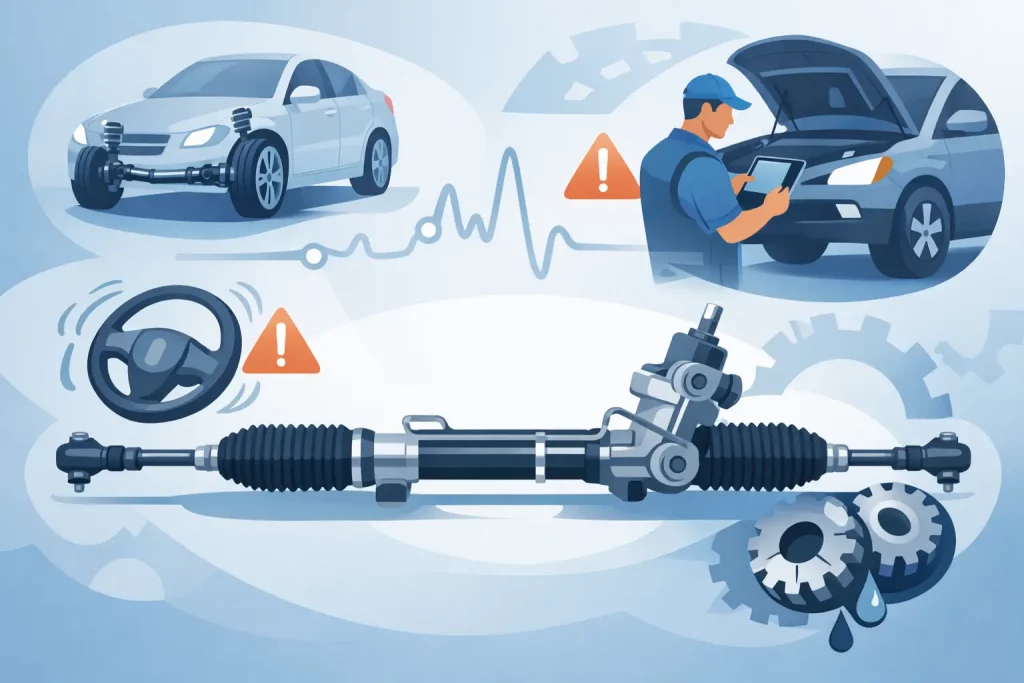
A steering rack fault rarely begins with a complete loss of control. More often, it starts with a steering wheel that feels slightly heavier than usual, a knock over rough ground, fluid beneath the front of the vehicle, or a car that no longer holds a straight, confident line. Those early signs deserve proper attention because the rack is central to safe, accurate steering.
For many vehicles, a specialist repair or reconditioned unit is a more cost-effective answer than replacing the entire assembly through a main dealer. The right route depends on the fault, the vehicle specification and whether the problem lies within the rack itself or elsewhere in the steering system.
What a steering rack does
The steering rack converts the turning movement of the steering wheel into the side-to-side movement that directs the road wheels. Its pinion gear engages with a toothed rack bar, moving it left or right. Inner joints and track rods then transfer that movement to the hubs.
Modern vehicles may use a hydraulic, electric power steering (EPS), or electro-hydraulic arrangement to reduce steering effort. Although the assistance method varies, the mechanical rack must still operate smoothly, hold its adjustment and maintain precise engagement between its internal parts.
A well-functioning rack should give consistent assistance, a positive on-centre feel and predictable response through corners. It should not bind, wander, knock or require repeated steering corrections on a level road.
Steering rack symptoms worth investigating
Some steering concerns can be caused by tyres, suspension wear or wheel alignment, so a symptom alone is not a final diagnosis. However, the following issues commonly justify a focused steering inspection.
Heavy, uneven or notchy steering
A wheel that is consistently heavy to turn, particularly at parking speeds, can point to an assistance fault or internal rack resistance. If it feels heavy in one direction but more normal in the other, or tight through a particular part of its travel, internal wear, corrosion or damage needs to be considered.
Notchy steering is particularly important. The wheel may move freely, then feel as though it catches before releasing. This can make smooth positioning difficult and should not be dismissed as a characteristic of an older vehicle.
Knocking, clunking and excess play
A dull knock through the steering wheel over potholes or broken road surfaces may indicate movement in the rack mountings, inner joints or associated steering and suspension components. Free play around the straight-ahead position can also develop when internal parts wear.
The useful distinction is whether the noise can be recreated while the vehicle is stationary, with controlled movement at the steering wheel, or only while driving. A specialist inspection can isolate the source rather than replacing parts on assumption.
Fluid loss around a hydraulic rack
On vehicles with hydraulic assistance, visible fluid around the rack gaiters or rack body should be checked promptly. Internal seals can fail and allow fluid to collect inside a gaiter before it becomes obvious externally. Low fluid levels can then worsen steering performance and risk further damage.
A leaking rack is not automatically beyond repair. In many cases, a suitable original unit can be stripped, assessed and reconditioned using the correct seals and components. The condition of the rack bar and housing determines whether this is viable.
Wandering, poor self-centring or vague response
If a vehicle needs frequent small corrections on a straight road, the cause may be alignment, tyre condition, worn suspension joints or steering rack wear. Poor self-centring after a turn can similarly have more than one cause.
That is why alignment should be checked only after any mechanical play has been identified and rectified. Adjusting wheel angles cannot compensate for worn steering components, and it may obscure the real fault for a short time.
EPS warning lights and inconsistent assistance
Electric power steering can introduce faults that are not apparent from a visual inspection. A warning light, intermittent loss of assistance, unusually light steering or a system that behaves differently after starting may be related to the electric motor, torque sensor, control module, wiring or the rack assembly.
Accurate EPS diagnostics matter. Fault codes provide useful direction, but they must be assessed alongside live data, battery condition, vehicle history and mechanical checks. Replacing an electric rack without establishing the cause can be an expensive mistake.
Why steering racks fail
Age and mileage are common contributors, but they are not the whole story. Damaged gaiters allow water and road contamination into areas intended to remain protected. Corrosion on the rack bar can damage sealing surfaces, while repeated impact from potholes and kerbs can accelerate wear or affect alignment.
Poorly maintained suspension components can also place additional loads on the steering assembly. On performance vehicles, wider tyres, altered ride height and hard road use can increase steering effort and expose existing wear more quickly. Conversely, a low-mileage classic car may develop faults through inactivity, dried seals and corrosion rather than distance covered.
For RHD vehicles, specification is critical. A rack from a left-hand-drive version may look similar while having different mounting points, travel, hydraulic or electrical connections, steering geometry or control configuration. Correct identification by vehicle registration, chassis details and part number avoids costly fitment problems.
Diagnosis before replacement
A proper diagnosis begins with the driver’s report. When does the fault occur? Is the steering heavy all the time, only when cold, or only at low speed? Does a warning light appear? Has the vehicle struck a kerb or pothole? These details help narrow the inspection.
The vehicle should then be checked for free play, joint wear, gaiter condition, rack mounting security, fluid evidence where applicable and damage to surrounding components. On EPS-equipped vehicles, electronic diagnostics should be combined with physical testing. Wheel alignment measurements are valuable once the steering and suspension are confirmed sound.
This process is more than workshop routine. It determines whether the correct repair is a rack reconditioning, an exchange unit, an electrical repair, a related component replacement or alignment work. A good diagnosis prevents the common and costly pattern of changing parts until a symptom disappears.
Reconditioning versus replacement
A new genuine steering rack can be appropriate, especially where a vehicle is very new, a specific electronic configuration cannot be repaired, or the original unit is severely damaged. It is not, however, the only reliable option.
Professional reconditioning involves more than cleaning and repainting a used part. The unit is dismantled, inspected for wear and corrosion, measured where necessary, fitted with suitable replacement components and reassembled to the required settings. The finished rack should be tested before return or installation.
The best option depends on availability, condition and vehicle use. A carefully reconditioned rack can offer strong value for daily drivers, fleets, classics and specialist vehicles, particularly where a new unit is disproportionately expensive or unavailable. What matters is traceable, vehicle-correct work supported by a meaningful warranty.
At Pro Power Steering, specialist steering diagnostics and reconditioning are focused on restoring smooth, accurate operation rather than treating every fault as a reason for wholesale replacement. Completed work is supported by a 12-month guarantee, giving owners and trade customers confidence in the repair route chosen.
Fitting and alignment are part of the repair
Even a correctly reconditioned steering rack can perform poorly if it is fitted without care. The steering wheel must be centred, the rack positioned correctly through its travel and all related components checked before the final alignment is set.
On modern EPS vehicles, calibration or steering-angle sensor procedures may also be required after installation. Skipping these steps can leave warning lights present, affect driver-assistance systems or create an off-centre steering wheel.
After fitting, a road test should confirm consistent assistance, quiet operation, self-centring and straight-line stability. If there is any remaining pull, vibration or noise, it should be investigated rather than accepted as normal after repair.
When to stop driving
Do not continue using a vehicle with sudden loss of steering assistance, severe binding, major free play, a persistent EPS warning or a substantial fluid leak. The vehicle may still be steerable, but the effort required and the risk of worsening damage can make it unsuitable for normal driving.
For less severe symptoms, arranging an inspection early is usually the sensible financial decision. A small leak, split gaiter or developing internal wear is generally easier to address before it affects multiple parts or compromises the vehicle’s handling. Precise steering is not a luxury feature – it is the feedback that tells you the vehicle is ready to respond when the road demands it.
