
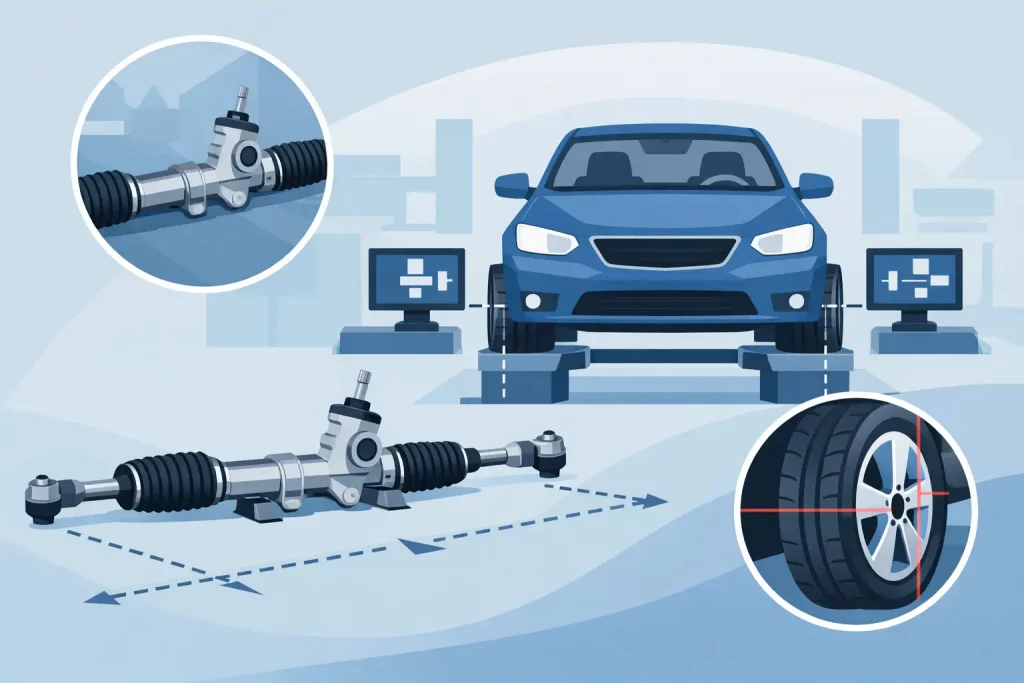
A newly fitted steering rack can remove leaks, play, stiffness and poor steering response, but the job is not complete when the rack is bolted in. Wheel alignment after rack replacement is the final mechanical check that turns a successful steering repair into a vehicle that tracks straight, turns predictably and wears its tyres evenly.
The reason is simple: the steering rack connects directly to the track rods that set the direction of the front wheels. Removing and refitting it alters that relationship, even when the replacement rack is the correct part and the track rod ends are refitted carefully. A proper four-wheel alignment is therefore not an optional extra. It is part of returning the vehicle to safe, accurate road manners.
Why wheel alignment after rack replacement is essential
The rack moves the inner track rods from side to side. Those rods, together with the track rod ends, determine front toe – the angle at which the wheels point relative to one another. A small change in thread position can put toe well outside the manufacturer’s specification.
Counting the exposed threads or marking the old track rod position is useful during installation, but it is only a starting point. It cannot account for wear in old components, differences in a reconditioned or replacement rack, changes in ride height, or previous alignment settings that may already have been incorrect.
If the toe is wrong, the effects can be immediate. The steering wheel may sit off-centre, the vehicle can drift or feel nervous on faster roads, and the tyres can scrub across the tarmac rather than roll cleanly. Excessive toe-in or toe-out can destroy the inner or outer shoulders of a tyre surprisingly quickly.
For modern vehicles with wide tyres, performance suspension or driver-assistance systems, the margin for error is particularly small. A car may appear acceptable on a short test drive yet still be wearing tyres unevenly every mile.
What should be checked during alignment?
A specialist alignment inspection begins by confirming that the steering system and suspension are sound. Alignment figures are only meaningful when there is no excessive play in the track rod ends, ball joints, control arm bushes, wheel bearings or other mounting points. Setting the geometry around worn components can give a reading that looks correct in the workshop but shifts under braking or cornering.
The steering rack must also be centred before the final toe adjustment. Most racks have equal travel either side of centre. If the track rods are adjusted with the rack off-centre, the steering wheel may look straight while the vehicle has more turning lock in one direction than the other. On some vehicles this can also affect the operation of the steering angle sensor.
A full alignment check will normally assess front toe, camber and caster, alongside rear axle thrust angle where the equipment and vehicle specification allow. Although a rack replacement mainly affects front toe, rear alignment influences whether the car travels straight and where the steering wheel sits. This is why a four-wheel geometry check is often preferable to a quick front tracking adjustment.
Toe, camber and caster in practical terms
Toe is the setting most directly altered during rack replacement. It has a major influence on tyre wear, steering response and straight-line stability. It should be adjusted to the manufacturer’s specification with the rack central and the steering wheel held in its correct straight-ahead position.
Camber is the inward or outward tilt of the wheel when viewed from the front. It is not usually changed by replacing a rack, but measuring it can reveal a bent suspension component, sagging spring, worn bush or subframe position issue that would otherwise be missed.
Caster is the fore-and-aft inclination of the steering axis. It affects self-centring and directional stability. A significant side-to-side difference can help explain why a vehicle pulls, even if toe is set correctly.
Signs the alignment has not been set correctly
An off-centre steering wheel is the most familiar warning sign, particularly after a steering repair. However, it is not the only one. A vehicle may pull to one side, feel twitchy when changing lanes, resist returning to centre after a turn, or develop a feathered pattern across the tyre tread.
Uneven tyre wear deserves prompt attention. A tyre worn heavily on one edge may point to a camber issue, while a rough, saw-tooth feel across the tread is often associated with incorrect toe. Tyre pressures, tyre condition and road camber can also influence how a vehicle feels, so the answer is diagnosis rather than guesswork.
On electric power steering systems, warning lights or unusual steering assistance after a rack repair should not be dismissed as an alignment issue alone. The system may require diagnostic checks, fault-code assessment or steering angle sensor calibration. The mechanical geometry and the electronic steering system must both be correct.
When should alignment be carried out?
Alignment should be carried out immediately after the rack replacement and before the vehicle is returned to normal use. It is not sensible to drive for several weeks and arrange it later, especially when the vehicle is covering motorway miles or carrying commercial loads.
There are a few situations where a second check is worthwhile. If new suspension components are fitted after the initial alignment, if the subframe has been moved, or if the vehicle has settled after significant suspension work, the geometry should be measured again. The same applies following a substantial pothole strike or kerb impact.
For classic, modified and performance vehicles, the target settings may not always be the standard factory figures. Lowered ride height, non-standard wheel widths and track-focused use can all change what is appropriate. Any alternative setting should be chosen with a clear understanding of the trade-off between turn-in response, straight-line stability, tyre life and road use. A setting that feels sharp on a dry circuit may be unpleasant or unpredictable on uneven UK roads.
Why a steering specialist matters
Fitting a rack is more than replacing a component. The correct rack must be matched to the vehicle, particularly on Right Hand Drive applications where part numbers, input shafts, hose connections and electronic configurations can differ. The rack then needs to be installed, centred, checked for free and equal travel, and aligned accurately.
A reconditioned rack should be assessed as part of the whole steering system rather than treated as an isolated repair. Existing wear in track rod ends, suspension joints or mounting bushes can compromise the result and leave the driver believing the replacement rack is at fault.
At Pro Power Steering, steering diagnostics, reconditioning and supply-and-fit work are approached as a complete repair process. That means identifying the original fault, fitting the correct steering component, and ensuring the vehicle leaves with smooth, precise and properly aligned steering. Completed work is supported by a 12-month guarantee.
Can you drive without alignment after a rack replacement?
Technically, a vehicle may move and steer after a rack has been changed. That does not mean it is ready for the road. The front wheels could be significantly out of toe, the steering wheel may be misaligned, and tyre damage can begin before there is an obvious handling complaint.
A short, controlled movement within a workshop may be necessary to position the vehicle for alignment. Beyond that, road use should wait until the geometry has been checked and adjusted. This is particularly relevant for vehicles with low-profile tyres, larger wheels and sensitive electric steering systems, where small errors are more noticeable.
The final road test still counts
Alignment equipment provides the figures, but the road test confirms the result. On a suitable road, the steering wheel should be centred, the vehicle should hold a straight path without constant correction, and the steering should self-centre naturally after a normal turn. There should be no new noises, binding or uneven assistance.
If something does not feel right, do not assume it will settle on its own. A prompt reinspection can identify whether the issue is geometry, tyre condition, a suspension fault or an electronic calibration requirement. Getting wheel alignment right after rack replacement protects the repair, the tyres and, most importantly, the confidence you should have in every turn of the wheel.
