
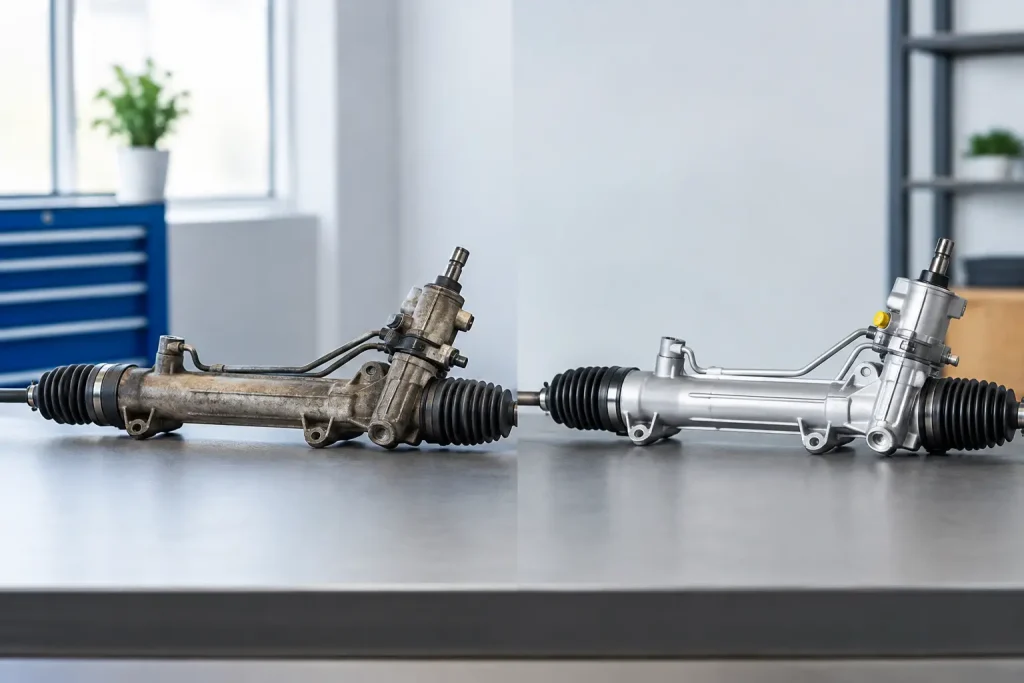
A reconditioned rack versus dealer replacement decision usually starts with an unwelcome symptom: heavy steering, a fluid leak, excessive play, an EPS warning light or a steering wheel that no longer feels precise. The obvious route is often a complete new rack from the manufacturer. Yet, where the original unit is suitable, professional component-level reconditioning can be a reliable and more proportionate repair. The right choice depends less on the vehicle badge and more on accurate diagnosis, the rack’s condition and the electronic requirements of the vehicle.
What does dealer replacement usually involve?
A dealer replacement normally means fitting a new genuine manufacturer steering rack or an approved complete replacement assembly. It may include related items such as track rods, gaiters or sensors, depending on the vehicle and the parts supplied. On modern cars, especially those with Electronic Power Steering (EPS), the process can also require software configuration, coding, calibration and a four-wheel alignment after installation.
There are clear advantages. A new dealer-supplied rack is built to the manufacturer’s current specification, supplied through its established parts chain and supported by the dealer’s own warranty arrangements. For a very new vehicle, one still covered by a manufacturer warranty, or a unit with damage that makes rebuilding unsuitable, it can be the correct route.
However, complete replacement is not always necessary. A rack may have one failed seal, worn internal bearing, damaged sensor connection or electronic issue that can be assessed and addressed without discarding every serviceable part of the original assembly. Availability can also affect the decision. Some new racks have long lead times, while others for older, specialist or right-hand-drive vehicles may be difficult to source at all.
How professional steering rack reconditioning differs
Reconditioning is not simply cleaning up a used rack and fitting it back on a vehicle. A suitable unit is stripped, inspected at component level and measured for wear or damage. The work required varies by rack design and fault, but may involve replacing worn seals, bearings, bushes, internal components or external service parts with appropriate OE or OE-quality replacements where applicable.
The housing, rack bar, pinion and related parts must be assessed carefully. Corrosion, scoring, impact damage, excessive wear or a failed electronic element can alter whether repair is viable. A responsible specialist will not treat every rack as repairable simply because a replacement is inconvenient or expensive.
Once rebuilt, the rack should be tested before leaving the workshop. This matters because steering performance is not defined by whether a unit physically fits. It must operate smoothly, respond consistently and maintain the controlled feel expected from the vehicle. For hydraulic systems, leak and pressure-related checks are relevant. For EPS units, diagnosis may extend to motors, torque sensors, control electronics and communication faults.
On applicable electronic racks, flashing or virginising may be carried out to prepare the unit for vehicle-specific coding after fitting. This does not remove the need for the vehicle to be correctly configured and calibrated by the fitting garage or dealer where required.
Reconditioned rack versus dealer replacement: the practical differences
The largest difference is the scope of repair. Dealer replacement usually substitutes the complete unit. Reconditioning aims to retain and restore a suitable original core, addressing the actual fault and any wear identified during inspection.
That can make reconditioning particularly valuable for vehicles where a new rack is costly, back-ordered or unavailable. It is also often the sensible option for classic, performance and specialist vehicles, where retaining the correct steering assembly can matter for fitment, vehicle character and parts compatibility. Right-hand-drive applications deserve particular care, as they are not always interchangeable with more widely available left-hand-drive units.
Cost is another factor, although it should not be viewed in isolation. A reconditioned rack may reduce the price of the component compared with a new dealer unit, but the full repair still needs to account for removal and refitting, alignment, coding, calibration and any related faults. A low initial price is poor value if the root cause has not been identified or the replacement cannot be commissioned correctly.
There is also a difference in lead time. A dealer may be able to source a new rack quickly for a current-volume model, making replacement a straightforward choice. On the other hand, a specialist reconditioning service can be more practical where manufacturer supply is delayed or the unit is obsolete. UK-wide collection and delivery of suitable steering components can help garages and owners avoid extended vehicle downtime.
Diagnosis should come before choosing either option
Steering faults are frequently blamed on the rack before the system has been properly tested. A heavy steering complaint may relate to an EPS fault, wiring issue, battery-voltage problem, steering angle sensor, column component or a mechanical restriction elsewhere in the steering and suspension system. Similarly, a knock or wandering sensation may originate from track rod ends, ball joints, tyres, alignment settings or suspension wear.
Replacing a rack without confirming the cause can leave the original problem unresolved. It may also create a costly argument over whether the new part is at fault when the issue was elsewhere all along.
A useful diagnosis considers fault codes, live data where relevant, steering assistance behaviour, mechanical free play, fluid condition on hydraulic systems, electrical supply and vehicle history. The vehicle’s exact specification matters. Steering systems can differ across model years, engines, trim levels and optional driving-assistance packages, even when the cars appear identical.
For trade customers, this is why clear fault information and accurate vehicle details should accompany a unit sent for inspection. Registration, VIN, part number, symptoms, warning messages and any scan results all help the specialist determine the most appropriate repair path.
When a reconditioned rack is likely to the better choice
Reconditioning is worth considering when the rack is structurally sound, the fault is identifiable and repairable, and the vehicle can be correctly set up after refitting. It is often a strong option for leaks from serviceable hydraulic racks, wear within older mechanical systems, and suitable EPS units requiring specialist diagnosis and electronic preparation.
It can also be the practical answer when originality or correct right-hand-drive fitment matters. Owners restoring classic cars and workshops maintaining specialist models may find that a known, correct core is more useful than pursuing a poorly matched replacement from an uncertain source.
Pro Power Steering assesses suitable racks on their individual condition rather than applying a one-size-fits-all answer. Completed work is tested before dispatch and supported by a 12-month warranty under the applicable terms. That combination of inspection, reconditioning and technical support is especially useful where the fitting garage needs clarity on coding, calibration or installation requirements.
When dealer replacement may be preferable
A new dealer rack may be the better route where the vehicle remains under manufacturer warranty, where a required part is only available as a complete assembly, or where the original rack has damage beyond safe economic reconditioning. Serious corrosion, distorted castings, impact damage, extensively damaged internal surfaces or certain electronic failures may rule out a rebuild.
Dealer replacement can also make sense when a new unit is readily available and the dealer has immediate access to the necessary software functions, manufacturer technical information and calibration procedures. Some advanced driver-assistance systems are tightly integrated with the steering system, and the commissioning process should not be treated as an afterthought.
This is not a case of new being automatically better or reconditioned being automatically cheaper. It is a question of selecting a repair that is technically appropriate for the specific vehicle and fault.
Do not overlook fitting, alignment and calibration
Whether a rack is reconditioned or new, installation quality has a direct effect on safety and steering feel. The steering wheel must be centred, fasteners tightened to the vehicle manufacturer’s specification, and the system checked for smooth operation through its range. Once steering components have been disturbed, wheel alignment is normally required.
EPS-equipped vehicles may need fault codes cleared, steering-angle calibration performed and vehicle-specific coding completed. If these steps are missed, the vehicle may show warning lights, provide inconsistent assistance or fail to operate its driver-assistance features as intended. A specialist can prepare or advise on the rack, but the fitting workshop must ensure the vehicle is correctly commissioned after installation.
The best next step is to establish what has actually failed before authorising a complete replacement. With the correct diagnosis, a suitable reconditioned rack can restore smooth, precise steering without replacing more of the system than necessary; where it cannot, a new dealer unit remains the right engineering decision.
