
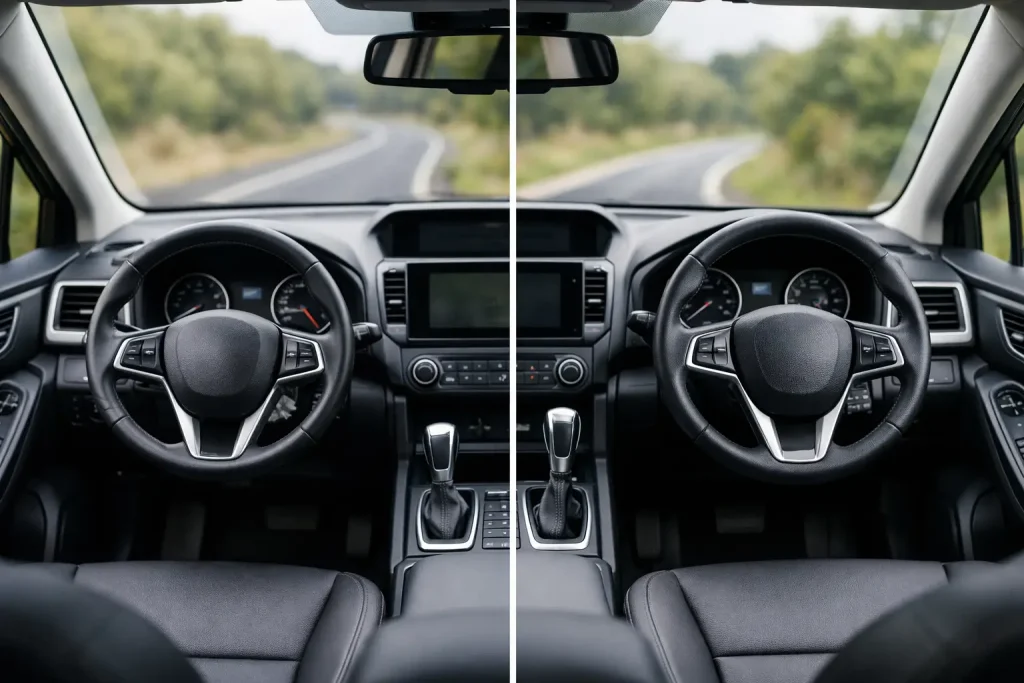
A steering rack can look identical to its left-hand-drive equivalent on a parts listing, yet be completely wrong for the vehicle once fitted. With RHD LHD steering, the rack position, pinion input, column routing, mounting points and electronic configuration can all differ. Getting one of those details wrong can leave a vehicle with poor steering geometry, warning lights, limited lock or an unsafe response at the wheel.
For UK vehicle owners, garages and restoration specialists, this matters most when sourcing a replacement rack, repairing an imported vehicle or considering a right-hand-drive conversion. Steering is not simply a case of moving the wheel from one side of the cabin. It is a connected safety system that must retain the correct mechanical operation, electronic communication and wheel alignment.
What RHD and LHD steering actually mean
RHD means right-hand drive: the driver sits on the right and the steering wheel is positioned accordingly. LHD means left-hand drive, with the driver on the left. Although the terms are straightforward, the steering components behind them are often vehicle-specific.
On many cars, the steering rack itself is mounted in a different position or uses a pinion housing on the opposite side. The steering column and intermediate shaft must reach the rack while clearing pedals, exhaust components, subframes, bulkheads and suspension parts. A manufacturer may also use different rack ratios, track rod lengths, heat shields and mounting brackets between RHD and LHD versions.
The difference becomes more significant on modern vehicles with electric power steering. An EPS rack may contain a control unit programmed for a particular vehicle specification. It can rely on the correct steering angle sensor relationship, vehicle coding and end-stop calibration before it will operate as intended.
Why a visually similar rack may not be interchangeable
A common problem is assuming that a rack with the same overall length, motor or connector will fit either driving position. Some units do share a core design, but compatibility cannot be confirmed by appearance alone.
The pinion input is the key issue. On a RHD car, the column normally approaches the rack from the right side of the vehicle. On an LHD version, it generally approaches from the left. A reversed or relocated pinion changes the path of the steering shaft and can make a direct swap impossible without major changes to the surrounding vehicle structure.
Even where a rack appears to bolt into the same subframe, internal travel can differ. This affects steering lock and, in some cases, the relationship between rack travel and wheel angle. Incorrect track rods or inner joint positions can introduce bump steer, uneven turning circles or poor centring after alignment.
For electronically assisted racks, part numbers require equally careful checking. Different software, torque sensor calibration, motor output or communication protocols may be fitted across markets and model years. A used LHD rack in an RHD vehicle may not initialise correctly, even if the mechanical installation looks plausible.
The parts that often change with driving position
The rack is only one part of the arrangement. A proper assessment may need to account for the steering column, intermediate shaft, universal joints, rack mounts, bulkhead aperture, pedal box, dashboard support, wiring loom, heat protection and, on some vehicles, the exhaust routing.
This is why a steering conversion or replacement should be assessed as a system rather than a collection of separate parts. It also explains why a correct RHD part can be more difficult to source for low-volume, classic, performance or imported models.
RHD LHD steering conversions: when they are realistic
Converting an LHD vehicle to RHD can be worthwhile for certain classics, specialist cars and commercial applications. It may improve everyday usability in the UK and suit an owner who intends to keep the vehicle long term. However, the viability depends heavily on how the manufacturer engineered the model for different markets.
A vehicle originally sold in both configurations is usually a more practical candidate because factory RHD components, layouts and documentation may exist. That does not make the work simple, but it provides a known route for the steering, dashboard, pedals, lights, wiper sweep and associated wiring.
A model never designed for RHD presents a different challenge. Fabricating mounts or modifying the bulkhead without fully understanding the steering geometry can compromise both safety and serviceability. There may also be implications for insurance, registration, future inspection and vehicle value. In these circumstances, retaining the original LHD layout can be the better decision.
Conversions involving modern EPS systems need further planning. The replacement rack may require coding to the vehicle, calibration of steering angle and torque sensors, and confirmation that driver-assistance systems recognise the new configuration. Lane support, stability control and active parking functions can all depend on accurate steering data.
Diagnosis comes before replacement
Heavy steering, inconsistent assistance, clunks or an EPS warning lamp do not automatically mean an RHD or LHD rack is at fault. A worn steering column joint, damaged intermediate shaft, incorrect alignment, electrical supply issue or calibration fault can produce similar symptoms.
Accurate steering diagnostics should establish whether the fault is mechanical, hydraulic or electronic before a replacement component is ordered. On EPS-equipped vehicles, this can include fault-code assessment, live data checks, motor and torque sensor evaluation, and confirmation of coding status. On mechanical systems, technicians should assess free play, rack movement, mount condition, column operation and the condition of connected steering joints.
This approach protects against fitting an expensive component that does not resolve the original issue. It also helps identify whether an existing RHD unit is a suitable candidate for component-level reconditioning rather than complete replacement.
Reconditioning an RHD steering rack
For suitable units, reconditioning can offer a practical route where a new RHD rack is costly, back-ordered or unavailable. The unit is assessed to establish the cause of failure, then rebuilt with appropriate OE or OE-quality components where applicable. The precise work depends on the rack design and fault present.
A quality process is more than replacing seals. It may involve inspection of the rack bar, pinion, bearings, bushes, gears, housings and electronic elements, followed by testing before the unit leaves the workshop. The objective is smooth, controlled steering with the correct feel and reliable operation, not merely a rack that no longer leaks or makes a noise.
There are limitations. Corrosion, accident damage, cracked housings, severe internal wear or unavailable electronics can mean that reconditioning is not appropriate. In those cases, a correctly identified replacement rack may be necessary. A specialist should be clear about this before committing a customer to a repair route.
Coding, flashing and calibration after EPS work
After an EPS rack has been repaired or replaced, the physical installation is only part of the job. Depending on the vehicle, it may need programming, vehicle-specific coding or commissioning. Some applicable units can be flashed or virginised in preparation for this process.
Once fitted, steering angle calibration and wheel alignment are often required. Alignment should not be treated as an optional finishing step, particularly if the rack has been removed or the track rods disturbed. A centred steering wheel, correct toe settings and validated steering-angle data help the vehicle track accurately and allow related safety systems to operate correctly.
In some cases, dealer-level access or specialist diagnostic equipment may still be required. This is not a failure of the repair process. It reflects how closely modern steering systems are integrated with the rest of the vehicle.
Questions to ask before ordering an RHD rack
Before supplying or fitting a rack, a garage or owner should confirm the full vehicle identification details, original part number where available, driving position, engine and transmission variant, steering type and any active driver-assistance equipment. Build date matters too, as manufacturers can alter rack specifications within the same model generation.
It is also sensible to establish why the old unit is being replaced. If there has been kerb impact, collision damage, water ingress or an electrical fault, related components may need attention. Ordering by registration alone can be insufficient, especially for imports, conversions and specialist vehicles.
For trade customers, clear fault information and photographs of labels, connectors and mounting arrangements can prevent delays. For vehicle owners, choosing a steering specialist who can discuss the options directly is often more useful than selecting a part solely by the lowest advertised price.
Choosing the right route for the vehicle
The correct answer may be a reconditioned RHD rack, a new replacement, repair of the original unit or further diagnosis before any parts are ordered. It depends on the vehicle, the fault, component availability and what is required to return the steering system to safe, precise operation.
Pro Power Steering supports this decision with specialist assessment, repair and reconditioning across hydraulic, manual and electric steering systems. Suitable completed work is tested before dispatch and supported by a 12-month warranty under the applicable terms, with technical support available where coding, calibration or fitting questions arise.
When RHD and LHD steering components are involved, careful identification is never a delay for its own sake. It is the step that makes sure the vehicle leaves with steering that feels predictable, centres correctly and belongs on that exact vehicle.
