
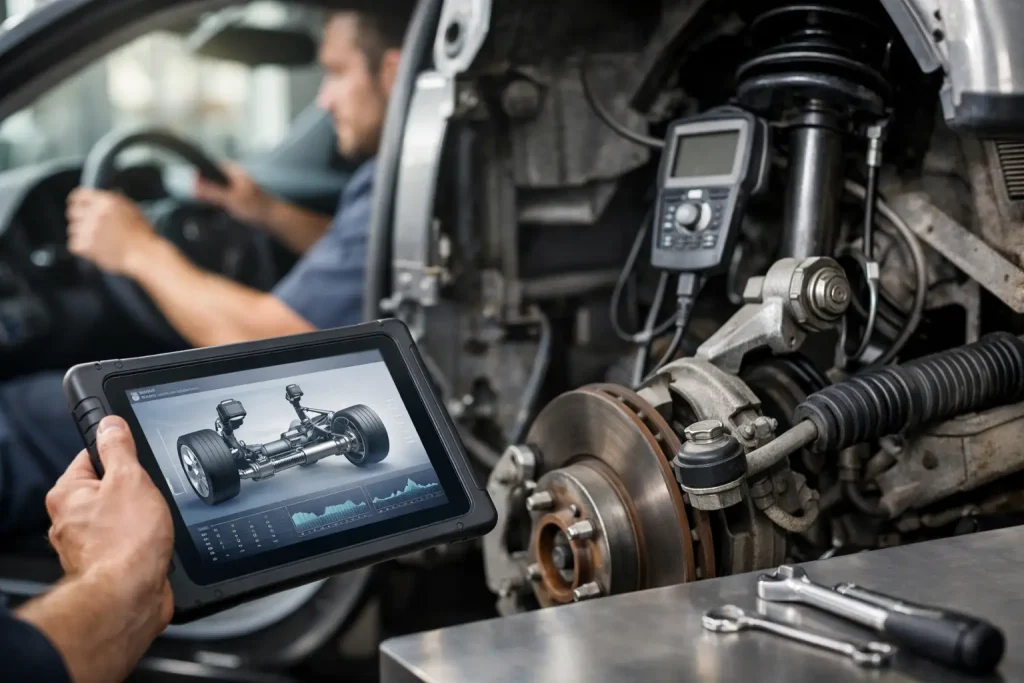
A steering fault rarely announces itself with a single, conclusive symptom. Heavy assistance, a warning light, a knock through the wheel or an off-centre steering wheel can each originate from more than one component. This steering diagnostic guide explains how a structured assessment separates the cause from the symptom, helping owners and workshops select a repair that restores safe, smooth and precise steering.
Why steering diagnosis must come before replacement
Modern steering systems combine mechanical joints, electronic control, vehicle geometry and, depending on the vehicle, hydraulic or electric assistance. Replacing the most obvious component without confirming the fault can be expensive and may leave the original problem unresolved.
For example, an EPS warning message may relate to a rack motor or internal control unit, but it can also be influenced by low system voltage, damaged wiring, communication faults, an implausible torque-sensor signal or a calibration issue. Similarly, vague steering response does not automatically mean the rack is worn. Tyres, suspension joints, steering column couplings and wheel alignment can all affect how a vehicle feels on the road.
Accurate diagnosis is particularly valuable on premium, performance and specialist vehicles, where the steering system may require vehicle-specific coding after installation. It also matters for Right Hand Drive applications, where a visually similar unit from another market may not be a suitable replacement.
Start with the driver’s description
The first useful diagnostic tool is a clear account of what has changed. A fault that appears only when parking, only at motorway speed or only after the vehicle has warmed up points the investigation in different directions. The same applies to a steering concern that follows kerb contact, accident damage, battery replacement or previous suspension work.
A specialist will establish whether the steering is consistently heavy or intermittent, whether the wheel self-centres correctly, whether assistance is unequal from lock to lock, and whether any dashboard warnings are present. Noises also need to be described accurately. A knock over bumps, a click during rotation and a groan under steering load are not interchangeable symptoms.
On vehicles with variable assistance or selectable driving modes, the assessment should confirm whether the concern occurs in every mode. A driver may reasonably notice firmer steering in a sport setting, but sudden heaviness, inconsistency or warning messages should not be treated as normal characteristics.
The steering diagnostic guide: test the whole system
A dependable diagnosis follows a sequence rather than jumping straight to the rack. The vehicle is road tested where safe and appropriate, then inspected with the wheels unloaded and under normal load. Diagnostic equipment is used alongside mechanical checks, not instead of them.
Check the mechanical path first
The steering wheel’s movement travels through the column, shafts and couplings before it reaches the rack or steering box. Wear, stiffness or play anywhere in this path can be felt at the wheel. Outer and inner track rods, ball joints, suspension bushes and mountings also require inspection because they influence steering precision and can imitate an internal rack fault.
Free play should be assessed carefully. A small movement at the steering wheel may have a different cause from play at a track rod or movement in the rack mounting. Evidence matters: a diagnosis should identify where the movement occurs, not merely report that the steering feels loose.
The condition and specification of the tyres also deserve attention. Uneven wear, damaged sidewalls, incorrect pressures or mismatched tyres across an axle can create pull, tramlining and poor straight-line behaviour. These issues do not rule out a steering fault, but they need resolving before the steering system can be judged fairly.
Confirm geometry and alignment
An off-centre wheel, pulling to one side or a vehicle that feels unsettled after steering repairs may be linked to wheel alignment. Tracking alone is not always the full answer. Camber, castor, thrust angle and rear axle geometry can affect steering feel, depending on the vehicle.
Alignment is generally a finishing operation after worn or damaged parts have been rectified. Adjusting geometry around a component with excessive play produces unreliable results. Equally, fitting a reconditioned rack without checking alignment can leave a vehicle driving poorly even when the repaired unit is functioning correctly.
Read faults in context on EPS systems
Electric power steering systems require suitable diagnostic equipment and an understanding of the manufacturer’s fault logic. Stored codes provide direction, but they are not a permission slip to replace a rack. Freeze-frame information, live data and fault status help establish whether a code is current, historic or caused by another system condition.
Technicians may compare steering angle, torque-sensor readings, motor operation, supply voltage and network communication. A voltage-related code, for instance, should prompt checks of the battery and charging system before the EPS unit is condemned. Intermittent wiring faults may require further investigation rather than a quick scan and clear.
Where a rack is removed or replaced, the vehicle may need steering angle sensor calibration, end-stop learning or manufacturer-specific coding. Certain applicable EPS racks can be flashed or virginised before installation, ready for vehicle-specific programming. However, exact requirements vary by make, model, year and software level, and some vehicles may still require dealer-level access or specialist diagnostic capability.
Recognising common fault patterns
Patterns are useful, but they are not final diagnoses. Heavy steering at all times can suggest an assistance fault, mechanical binding or an issue outside the steering unit. Steering that becomes heavy only intermittently is more likely to need a thorough electrical and live-data assessment, particularly on EPS-equipped vehicles.
A clonk or rattle may be caused by internal rack wear, but column joints, track rods, suspension components and rack mountings must be ruled out. A steering wheel that fails to return naturally after a corner can be influenced by geometry, seized joints or internal resistance. Pulling under braking may not be a steering fault at all.
Fluid loss or contamination on a hydraulic system requires careful inspection to identify its source. In some cases, a rack can be reconditioned at component level; in others, corrosion, housing damage or unavailable parts may make replacement the more sensible route. The correct decision depends on the unit’s condition, not just its vehicle application.
When reconditioning is the right option
A suitable steering rack, box or column assembly can often be assessed for component-level reconditioning rather than replaced as a complete new unit. This approach can be particularly valuable where a new original-equipment component is costly, delayed or no longer available.
The process should begin with identification and inspection of the exact unit. It may involve dismantling, cleaning, examining wear surfaces and replacing serviceable internal components with appropriate OE or OE-quality parts where applicable. A proper remanufacturing decision is based on whether the core structure and critical parts meet the standard required for a reliable repair.
Not every component is repairable. Cracked housings, severe corrosion, accident damage, obsolete electronic parts or defects that cannot be reliably corrected may require a replacement unit. Honest assessment prevents a false economy and gives the customer a clearer repair path.
At Pro Power Steering, suitable units are tested before leaving the workshop, with direct technical support available for fitting garages where required. This is useful when the repair includes installation considerations, programming requirements or questions about vehicle-specific set-up.
Protect the repair with correct installation
A reconditioned or replacement steering component is only part of the job. The steering wheel should be centred correctly, related components inspected, and wheel alignment completed once the vehicle is mechanically sound. On electronic systems, any required coding and calibration should be carried out using the proper procedure.
Care is also needed when diagnosing a fault after another workshop has already fitted a steering part. Incorrect part numbers, unsuitable software status, damaged connectors and missed calibration steps can all affect the result. The most productive next step is usually to return to the evidence: the vehicle symptoms, mechanical condition, fault codes, live data and installation history.
Choosing the next step
If the steering becomes suddenly heavy, develops excessive play, fails to self-centre, produces persistent warnings or behaves unpredictably, the vehicle should be assessed promptly. Steering faults can affect control, tyre wear and the accuracy of driver inputs, so delaying diagnosis is rarely worthwhile.
A clear diagnostic record gives owners and garages something more useful than a broad recommendation to “try a rack”. It identifies what has been tested, what has been ruled out and what work is genuinely needed. That is the foundation for a repair that feels right on the road and remains dependable long after the warning light has gone out.
