
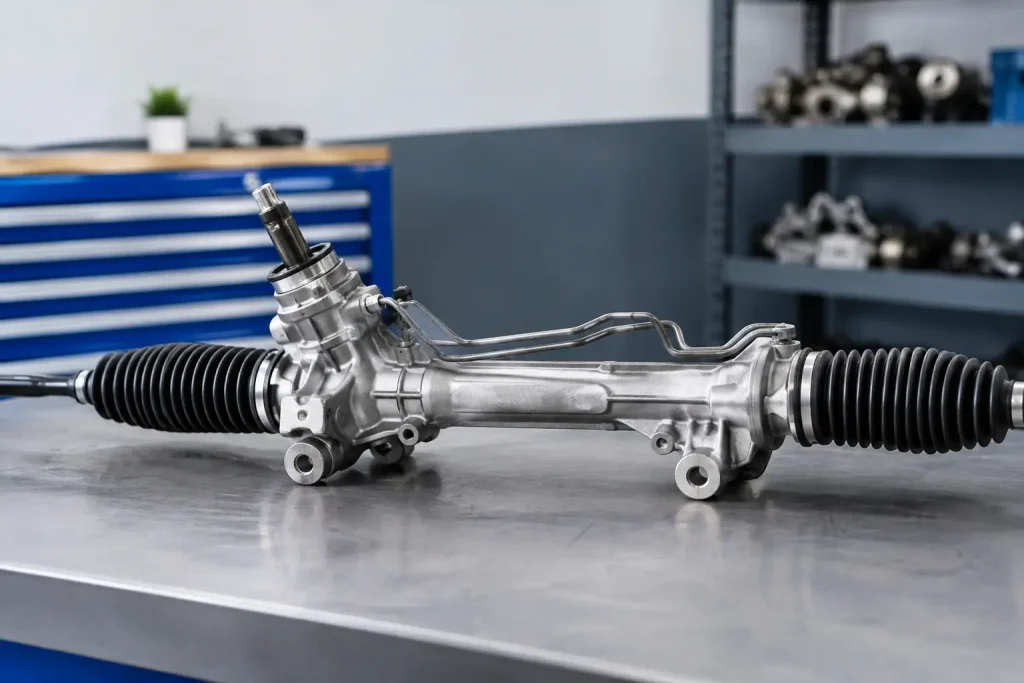
A red steering-wheel warning lamp, intermittent loss of assistance or a steering wheel that suddenly feels far heavier at parking speed can point to a serious fault within a rack-mounted electric power steering unit. EPS steering rack repair is not simply a matter of fitting another motor or clearing a fault code. The rack assembly combines precision mechanical parts with an electric motor, control electronics and vehicle-specific software, so the right repair begins with accurate diagnosis.
For owners and workshops, the central question is usually whether the existing rack can be repaired or reconditioned, or whether replacement is the sounder route. The answer depends on the fault, the vehicle application and the condition of the complete unit.
What makes an EPS steering rack different?
A rack-mounted EPS system uses an electric motor to provide steering assistance directly through the steering rack assembly. Depending on the design, the motor may sit alongside the rack housing or act through a belt, gear or ball-screw arrangement. A dedicated ECU interprets inputs from sensors and the wider vehicle network, then varies assistance according to steering demand and road speed.
This matters because an EPS fault is not always an electronic fault. A warning message may be caused by an internal motor or ECU issue, but it can also be triggered by excessive mechanical resistance, water ingress, damaged wiring, poor power supply or a communication fault elsewhere on the vehicle. Conversely, a noisy or stiff rack may have a mechanical cause even when no dashboard warning is present.
It is also worth distinguishing rack-mounted EPS from column-mounted electric assistance. Both are commonly described as EPS, yet their repair paths are entirely different. This article concerns the steering rack assembly itself, which is the principal area of specialist repair and reconditioning.
Common faults requiring EPS steering rack repair
The symptoms provide useful direction, but they do not confirm the failed component on their own. Steering faults must be investigated with the vehicle specification, diagnostic information and physical condition of the rack in mind.
Intermittent heavy steering is a frequent complaint. Assistance may disappear during low-speed manoeuvres, then return after an ignition cycle or once the vehicle has been driven. Possible causes include internal ECU failure, motor wear, overheating protection, voltage-related faults or network communication errors. The way the fault occurs matters: a fault that appears only under load may need a different investigation from one that is permanently present.
A steering warning lamp with stored diagnostic trouble codes can indicate motor circuit faults, torque-sensor plausibility errors, internal control-module faults or missing calibration data. Reading codes is valuable, but replacing a rack solely because a code names the steering system can be expensive and premature. Codes need to be assessed alongside live data, supply and earth checks, wiring condition and the manufacturer’s test procedure.
Mechanical wear remains relevant on electric racks. Internal rack-bar wear, guide adjustment problems, damaged gearing or corrosion can lead to play, knocking, tight spots or inconsistent steering feel. Split gaiters can allow water and road contamination into the rack, causing corrosion that may damage seals, bearings and internal components. In some cases, the motor is operating correctly but is being asked to overcome a mechanically compromised rack.
Water ingress deserves particular attention. Modern racks are fitted low in the vehicle, where they are exposed to spray and road salt. Moisture entering electrical connectors, the motor housing or ECU area can cause corrosion and intermittent electronic faults. The original cause must be identified before refitting any repaired or replacement unit. Otherwise, the same environmental or wiring issue may affect the replacement.
A proper diagnosis protects the repair decision
The objective of steering diagnostics is to identify whether the fault lies within the rack, its electrical connections, the vehicle’s power supply or another related system. That is especially valuable for garages faced with a vehicle that reports an EPS malfunction but still drives normally on some journeys.
A specialist assessment normally starts with confirmation of the complaint and a scan of relevant control modules. Fault codes, freeze-frame data and live readings can reveal whether the rack is receiving the expected voltage, communicating with the vehicle and responding plausibly to steering inputs. The rack is then assessed for external damage, corrosion, fluid contamination where applicable, excessive play and signs of mechanical binding.
For a removed unit, component-level testing can be more revealing than vehicle diagnostics alone. The motor, electronic control section and mechanical rack operation can be examined separately. This approach helps establish whether a repair is technically viable and prevents the common mistake of treating every EPS failure as a complete-rack replacement.
However, diagnosis must stay realistic. Some faults are only reproducible when the unit is installed and communicating with the vehicle, while severe crash damage, extensive corrosion or unavailable internal parts can rule out reconditioning. A reliable repair decision is evidence-led, not based on symptoms alone.
What EPS rack reconditioning can involve
When a rack is suitable for repair, reconditioning addresses the specific failure and the overall condition of the assembly rather than merely masking a warning light. The scope varies considerably between vehicle types and fault types.
Mechanical work may include dismantling the rack, inspecting the rack bar and pinion, replacing worn bearings, bushes, seals or guides, and correcting internal wear where viable. Electronic work can involve investigation and repair of motor, sensor or ECU-related defects, subject to the design of the unit and availability of suitable components.
Once rebuilt, the rack should be tested for smooth, consistent movement, correct mechanical operation and the relevant electronic functions. Proper testing is particularly important because a steering rack is a safety-critical assembly. A rack that appears acceptable on the bench but has not been assessed thoroughly may still produce inconsistent assistance or fault recurrence once installed.
The exact procedure is vehicle-specific. Premium marques such as BMW, Mercedes-Benz, Audi, Jaguar, Land Rover, Range Rover, Porsche and Volvo may use rack designs with different ECU configurations, communication requirements and mechanical layouts. Right Hand Drive units can also differ materially from equivalent Left Hand Drive versions, affecting both availability and suitability.
Coding, programming and calibration after fitting
A repaired or replacement EPS rack may require more than physical installation. Many vehicles need coding, programming, parameterisation or steering-angle calibration before the system will operate correctly. In some applications, an ECU must be virginised or prepared for its next vehicle before installation.
Requirements vary by manufacturer and model year. A rack may need to be matched to the vehicle configuration, coded for optional equipment or calibrated with the wheels held straight. If this stage is missed or performed incorrectly, warning lamps, reduced assistance, fault codes or abnormal steering behaviour can remain even when the rack itself is sound.
This is why workshops should establish the post-installation requirements before ordering a unit. Knowing whether the original rack needs to be supplied, whether coding equipment is available and whether the vehicle requires an alignment check after refitting avoids unnecessary delays. Wheel alignment is not a cure for an EPS fault, but it is relevant after rack removal or replacement to ensure the vehicle is set up correctly and the steering-angle reference can be calibrated where required.
When replacement is the better option
Repair is often a sensible route, but not every rack is recoverable. A replacement steering rack may be the appropriate choice where the housing is badly damaged, internal corrosion is extensive, vital electronic components are beyond repair, or the unit has suffered accident damage. Availability of parts and the practical cost of specialist work also influence the decision.
An exchange reconditioned rack can be a strong option where a vehicle needs to return to service promptly and a suitable unit is available. For fleet operators and busy workshops, this can reduce vehicle downtime. The critical point is that the replacement must match the vehicle precisely, including part number, steering configuration, software requirements and Right Hand Drive specification where applicable.
Used racks can appear attractive, but their history, internal condition and coding status may be unknown. A low purchase price can become poor value if the unit carries the same age-related weaknesses, cannot be programmed correctly or fails shortly after fitting. A professionally assessed repair or reconditioned replacement provides a clearer route to dependable steering performance, with appropriate warranty cover.
Choosing a specialist for the job
EPS racks sit at the intersection of electronics, mechanical engineering and vehicle software. The best repair path is therefore one that considers the complete rack rather than treating it as a disposable electrical module. Pro Power Steering assesses steering rack faults at component level where appropriate, supports suitable UK-wide collection and delivery, and provides a 12-month guarantee on completed work.
For vehicle owners, the useful information to provide is the registration, exact symptoms, warning messages, diagnostic codes, whether the fault is constant or intermittent, and any history of impact or water ingress. For trade customers, confirming the original rack number and the vehicle’s programming capability can speed up the process considerably.
If the steering is heavy, inconsistent or accompanied by an EPS warning, do not leave the decision to guesswork. Establish whether the fault is electronic, mechanical or installation-related, then choose a repair or replacement route that restores smooth, precise and predictable steering.
