
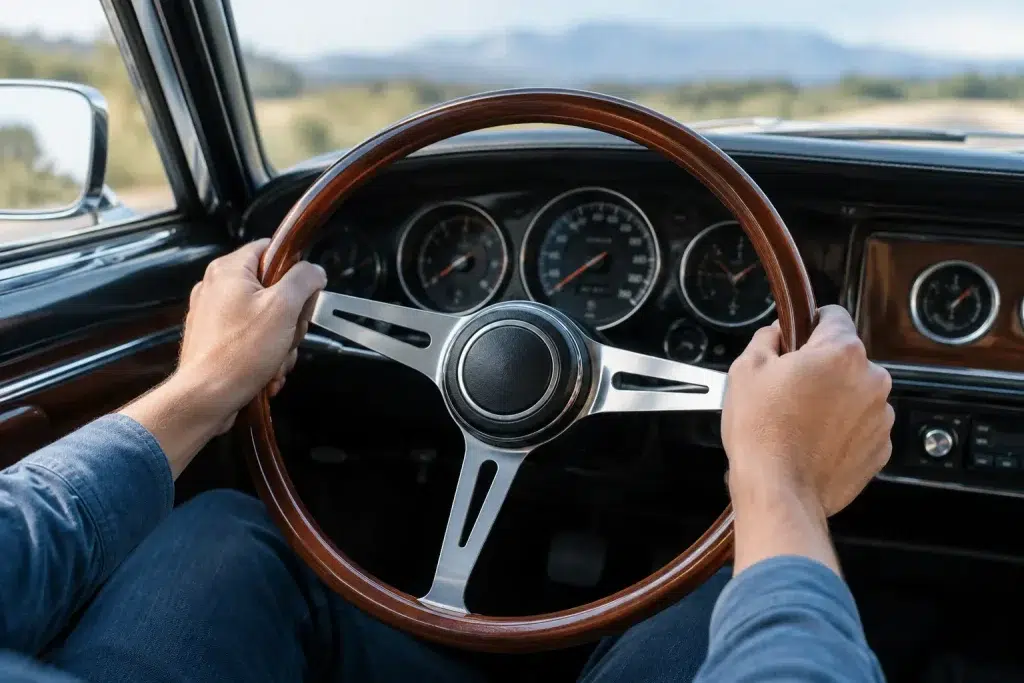
A classic car that needs both hands braced on the wheel at parking speed can soon become a car that is driven less often. Reducing classic steering effort can make town driving, manoeuvring and longer trips far more enjoyable, but the correct solution is not simply the one that makes the wheel feel lightest. The aim is controlled assistance that retains a natural response, adequate self-centring and confidence at road speed.
For restorers, enthusiasts and specialists, the starting point is always the vehicle itself. A light steering conversion cannot compensate properly for a worn steering box, incorrect geometry or unsuitable tyres. Equally, a well-designed modification can transform the usability of a sound classic without losing the character that made it worth preserving.
Why classic steering can feel so heavy
Many older vehicles were designed around manual steering systems. At speed, these systems can feel accurate and communicative. At low speed, particularly with wider tyres or more modern wheel and tyre combinations, they can demand considerable effort.
Weight over the front axle is part of the equation, but it is rarely the whole story. Steering effort is also shaped by steering-box or rack ratio, kingpin inclination, caster angle, scrub radius, tyre width, tyre construction and wheel offset. A vehicle modified with wider wheels, lowered suspension or an engine conversion may steer much more heavily than it did in original specification.
Condition matters just as much. Stiff universal joints in the steering column, seized suspension pivots, a dry or overtight steering box, internal rack wear and poor wheel alignment can all add resistance. These faults may be gradual enough that an owner assumes the weight is normal for the vehicle. Before considering an assistance conversion, they should be identified and addressed.
Reducing classic steering effort starts with diagnosis
A proper assessment separates normal manual-steering weight from a mechanical problem. This avoids spending money on an upgrade only to retain an underlying fault that affects safety, feel or component life.
The inspection should consider the steering mechanism, column and shafts, front suspension movement, wheel alignment and tyre specification. It should also examine whether modifications have altered the original geometry. A classic with excessive positive caster or unsuitable wheel offset may be difficult to steer even when every steering component is in good condition.
Tyre pressures deserve checking, but they are not a cure for a badly set-up vehicle. Increasing pressure solely to make the steering lighter can compromise grip, ride quality and wear pattern. The right answer is normally a combination of correct tyres, sound mechanical components and geometry appropriate to the car’s intended use.
For a steering box, specialist inspection is especially valuable. Excessive adjustment to remove free play can create tightness around the straight-ahead position. A box may then feel vague in one part of its travel and unduly heavy in another. Reconditioning at component level can restore smooth operation where the unit is suitable, but not every worn or damaged assembly is a sensible repair candidate.
Choosing the right assistance system
Electric power steering is often the most practical route for a classic, particularly where there was no factory hydraulic system. A carefully selected electric column assistance unit can be packaged discreetly and, with the right control strategy, can provide more help while parking than when travelling at speed.
That distinction is crucial. Constant high assistance may feel pleasant on a driveway but can make a light, short-wheelbase car feel nervous or remote on an A-road. The best installations are matched to the steering ratio, vehicle weight, tyre choice and intended use rather than treated as a universal conversion.
Some vehicles are better suited to a rack-based solution, while others retain their original layout with an assisted column or modified steering box arrangement. Space, dashboard structure, steering-column design, crash protection, electrical capacity and the availability of correctly engineered mounting points all influence the choice.
A hydraulic conversion can be appropriate on certain larger, heavier or period-correct projects, but it requires suitable component packaging and careful integration. It is not automatically preferable to electric assistance simply because it has an older design. The correct route depends on the car, not on a preference for one technology.
Preserving steering feel, not just reducing weight
A successful conversion should still tell the driver what the front tyres are doing. It should not mask poor geometry, pull against the driver, introduce notchiness or create an artificial centre feel.
Progressive assistance is particularly valuable. More support at low speed reduces the physical effort of parking, while reduced assistance as speed rises helps the vehicle remain stable and predictable. The steering should self-centre appropriately after a corner, although the precise behaviour will depend on the vehicle’s suspension design and alignment settings.
For performance classics, the target may be modest assistance rather than fingertip-light steering. For a touring car, an owner with reduced upper-body strength, or a vehicle used regularly in urban traffic, greater low-speed support may be entirely reasonable. Neither choice is inherently better. The question is whether the system suits how the car is actually used.
Engineering and safety considerations
Steering is a safety-critical system. Any modification must preserve secure column location, correct joint articulation and reliable clearance throughout suspension and steering travel. Poorly placed components, incorrect shaft angles or improvised mounts can create binding, excess play or weakness where it cannot be tolerated.
Electrical installations also need more than a live feed and an earth. Electric assistance can place significant demand on the vehicle’s charging system, particularly during repeated low-speed manoeuvres. Cable sizing, fuse protection, battery condition, alternator output and secure wiring routes all require consideration. A conversion may need charging-system improvements before it can operate reliably.
Where electronic assistance includes a control module, its set-up must be appropriate to the vehicle. Some systems need vehicle-specific inputs or calibration; others are configured around an adjustable assistance controller. In either case, the response should be tested on the road rather than judged solely with the vehicle stationary.
Wheel alignment should be checked after relevant steering or suspension work. A steering wheel that is off-centre, a car that pulls, or poor return-to-centre behaviour may point to alignment or installation issues. Alignment figures should be selected with an understanding of the classic’s suspension design, not copied blindly from a modern vehicle.
When restoration is the better answer
Not every heavy-steering complaint requires a conversion. An original car with seized pivots, worn rack mounts or a tired steering box may become markedly easier to use once those faults are rectified. This route keeps the vehicle closer to factory specification and may be preferable for historically important cars, concours restorations or owners who value the original driving experience.
There is also a middle ground. Correcting unsuitable wheel and tyre choices, returning excessive suspension modifications to sensible settings, and reconditioning the existing steering components can reduce effort without adding assistance. The result may still be heavier than a modern car, but it can be smooth, consistent and entirely manageable.
Conversely, an owner should not feel obliged to retain heavy manual steering simply for originality. A sympathetic, well-engineered system can allow a classic to be used more often and by more people. The quality of the design and installation matters more than whether assistance is present.
A specialist approach to classic steering modifications
The strongest outcomes come from treating the steering system as a complete assembly. Pro Power Steering assesses the existing rack, box, column, shafts and associated geometry before recommending whether reconditioning, correction of a fault or an assistance solution is appropriate.
Suitable components can be rebuilt and tested before leaving the workshop, while vehicle-specific support helps garages and owners make informed fitting decisions. Some projects will require fabrication, electrical work, wheel alignment or further vehicle set-up beyond the steering unit itself. Being clear about those dependencies prevents a promising modification from becoming an unpredictable one.
A classic should remain involving to drive, even if it no longer demands a wrestling match outside the supermarket. Start with an accurate diagnosis, choose assistance that matches the car and its use, and judge success by safe, smooth and precise steering rather than by lightness alone.
