
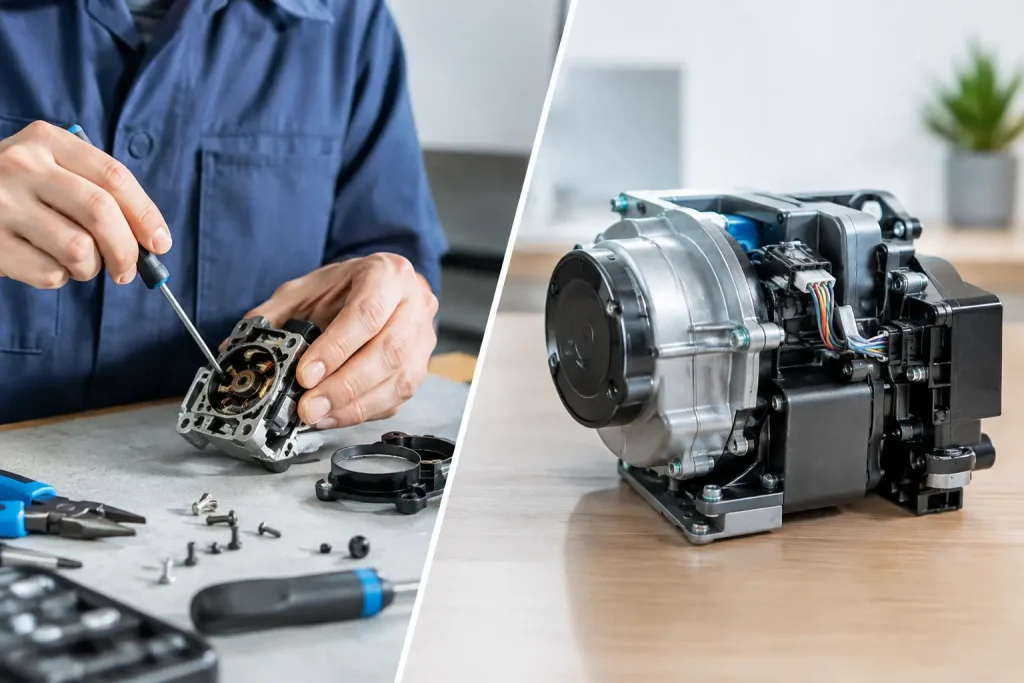
A warning light, a heavy steering wheel or a visible fluid leak can quickly lead to the same question: is component repair versus complete assembly the better answer? It is not a decision that should be made from a fault code alone, or simply because a complete new unit is readily available. The correct route depends on what has failed, the condition of the wider steering system and what is required to return the vehicle to safe, smooth and precise operation.
For many vehicles, particularly those with expensive, hard-to-source or right-hand-drive-specific steering parts, a targeted repair or professional reconditioning can be the sensible option. In other cases, a complete assembly is the only responsible choice. Accurate steering diagnosis is what separates those two outcomes.
What component-level steering repair means
Component repair identifies and rectifies the specific part or parts responsible for the fault while retaining serviceable sections of the original assembly. On a steering rack, this could involve replacing worn seals causing hydraulic fluid loss, renewing bearings or bushes, addressing internal wear, or repairing an electrical issue within an applicable EPS system.
This is not a short-cut patch repair. A suitable unit is stripped, assessed and measured before the repair path is agreed. Serviceable mechanical parts are retained only where they meet the required condition. Worn items are replaced with appropriate OE or OE-quality components where applicable, and the completed rack is tested before it leaves the workshop.
The principle also applies to steering boxes, columns, shafts and related steering components. A fault in one area does not automatically mean that every part of the assembly has reached the end of its service life.
Why the original unit can matter
Keeping the original assembly can be particularly valuable on older, classic, performance and specialist vehicles. The correct steering unit may be difficult to obtain, no longer available new, or available only in a configuration that is unsuitable for a UK right-hand-drive vehicle.
Original housings and vehicle-specific fitment details may also be preferable where a car has unusual mounting points, a specialist steering ratio or limited parts availability. A properly reconditioned original unit can preserve correct fitment while dealing directly with the defect.
That said, retaining an original assembly only makes sense if its main structure is sound. A severely corroded housing, damaged rack bar, cracked mounting point or extensive internal damage can make repair unsuitable.
When a complete steering assembly is the better option
A complete assembly replacement involves fitting a new, remanufactured or suitable replacement rack, steering box or column rather than repairing the customer’s original unit. This can be the right choice where the unit is beyond an economical or reliable repair, where damage affects safety-critical structure, or where a suitable replacement is available without compromising the vehicle’s specification.
Complete replacement can also be appropriate when several faults exist within the same assembly. For example, a rack with major internal corrosion, damage to the shaft and a failed electronic module may not offer a sensible component-level repair route. Replacing the full unit removes uncertainty around multiple worn or damaged sections.
Availability and vehicle downtime matter too. Fleet operators, busy workshops and drivers who depend on a vehicle every day may need the quickest reliable route, provided the replacement part is correctly specified. The important word is correctly. Steering assemblies can differ by engine, drivetrain, suspension specification, wheelbase, steering ratio and electronic configuration, even within the same model range.
A replacement assembly is not always plug-and-play
Modern electric power steering systems add another layer to the decision. An EPS rack may contain control electronics that need vehicle-specific coding, programming or calibration after installation. In certain applicable cases, a rack can be flashed or virginised in preparation for coding to the vehicle.
A replacement unit can still require steering-angle sensor checks, end-stop learning and a full wheel alignment. If these steps are missed, the steering may feel incorrect, warning messages may remain, or driver-assistance functions may not operate as intended. A complete assembly solves a mechanical problem only when installation and commissioning are completed properly.
Component repair versus complete assembly: the real decision factors
Cost is naturally part of the conversation, but it should not be the sole deciding factor. The cheapest initial option can become expensive if it does not address the true fault, is incorrectly matched to the vehicle, or leaves associated problems unresolved.
The first consideration is diagnosis. Heavy steering could be caused by an internal rack fault, but it may also relate to an EPS issue, a damaged steering column joint, incorrect alignment, seized suspension components or a fault elsewhere in the system. Likewise, a leak around a rack gaiter does not automatically identify the precise source or confirm the condition of the rack internals.
The second consideration is repairability. A professional inspection establishes whether the housing, rack bar, pinion, seals, bearings, electrical elements and other relevant areas are within a condition suitable for reconditioning. Some units respond very well to component-level work. Others do not.
Third is specification. Correct right-hand-drive fitment is especially important on vehicles with limited UK parts supply. A superficially similar left-hand-drive rack may not be a safe or practical substitute. Connections, mounting positions, input arrangement, travel and electronics may differ.
Finally, consider the vehicle’s intended use. A cherished classic, a performance vehicle and a commercial vehicle can each justify a different repair choice. The appropriate answer balances reliability, parts availability, lead time, vehicle value and the need to retain original characteristics.
What a proper assessment should establish
Before authorising either route, the workshop should establish the reported symptoms, inspect the unit and identify whether the fault is mechanical, hydraulic or electronic. Where applicable, diagnostic information should be considered alongside physical testing rather than treated as a verdict in isolation.
For a steering rack, the assessment may include checking for leakage, free play, damaged gaiters, corrosion, roughness through the steering travel, mounting condition and signs of internal wear. EPS systems may require examination of fault codes, power supply, communication issues and calibration status. The surrounding steering and suspension components must also be considered, because they affect both diagnosis and the finished driving result.
At Pro Power Steering, suitable units are assessed at component level, reconditioned where appropriate and workshop tested before dispatch or fitting. This approach gives vehicle owners and trade customers a clear basis for choosing repair or replacement, rather than assuming that one answer fits every fault.
Installation work still matters after the decision
Whether the vehicle receives a repaired original unit or a complete assembly, fitting quality is central to the result. Steering joints and fixings must be installed correctly, fluid systems must be dealt with according to the vehicle’s requirements, and electrical connections must be secure and protected.
The vehicle should then receive wheel alignment where required. A steering wheel that sits off-centre, uneven tyre wear or a vehicle that pulls after rack work can point to alignment issues that need correcting. On electronically controlled systems, coding and calibration should be completed using the correct process for that model.
These final steps protect the work completed on the steering component and help restore the calm, accurate response the driver expects. They are also why steering repair is best handled as a system repair, not merely a parts-changing exercise.
Choosing the route with confidence
Component repair is often an excellent solution when the original assembly is structurally sound and the fault can be rectified to the required standard. Complete assembly replacement is the better route when damage, wear, availability or electronic complexity makes reconditioning unsuitable. Neither option is automatically superior.
The most useful starting point is a clear diagnosis followed by an honest assessment of the unit in front of you. That gives you, your garage or your fleet workshop the information needed to make a decision based on safety, fitment and long-term reliability – not just the first price attached to a part.
