
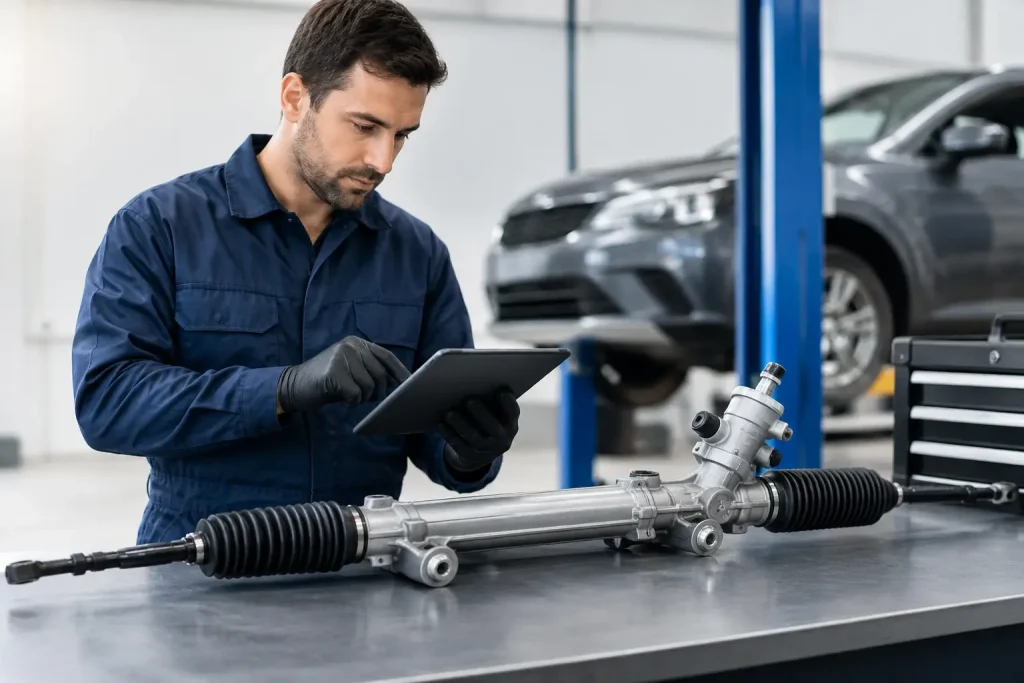
A replacement or reconditioned steering rack may be mechanically sound and still not work correctly when fitted. So, is coding necessary after a steering repair? On many modern vehicles with electric power steering, the answer is yes – but coding is only one part of returning the system to safe, smooth and precise operation.
The requirement depends on the vehicle, the type of steering system, the work carried out and whether the electronic control unit recognises the fitted component. Hydraulic and manual systems generally do not require electronic coding, although wheel alignment and careful inspection remain essential. Electric power steering (EPS) systems are different: the rack, column, control unit and vehicle network may need to communicate correctly before assistance and safety functions operate as intended.
Is Coding Necessary for an EPS Steering Rack?
An EPS rack uses an electric motor and electronic control unit to provide steering assistance. Depending on the design, the control unit may be built into the rack or communicate with separate modules elsewhere on the vehicle. It can store vehicle-specific information, configuration data and fault records.
When an EPS rack is replaced, the vehicle may need to accept or configure the new unit. This is often described simply as coding, but that word can cover several separate operations. The required procedure may include entering vehicle-specific configuration, matching the rack to the vehicle network, clearing transport or component-protection states, or programming software at dealer level.
Some vehicles will start and steer with an uncoded rack but display warning messages, provide reduced assistance or store faults. Others will not permit normal assistance at all until the correct procedure has been completed. A warning lamp should never be treated as a minor inconvenience where the steering system is concerned. It is evidence that the vehicle requires proper diagnosis.
A reconditioned unit is not automatically exempt from this process. Even where the original casing and electronics are retained, the vehicle may require settings to be checked or reset after repair and refitting. Conversely, some models do not require conventional coding when the original control unit is refitted, but will still need calibration and alignment.
Coding, Calibration and Alignment Are Not the Same Job
These terms are often used interchangeably, which can lead to incorrect repair plans. Each has a distinct purpose.
Coding or programming configures the electronic unit for the vehicle. It may identify the correct vehicle specification, options, steering characteristics or security status. The exact process is manufacturer and model dependent.
Calibration teaches the control unit known reference positions and sensor values. A steering angle sensor, torque sensor or rack end-stop position may need to be relearned following steering work. Without valid reference data, an EPS system may interpret straight-ahead incorrectly or log plausibility faults.
Wheel alignment is a mechanical adjustment of the wheel geometry. Removing or replacing a rack, disconnecting track rods or altering steering components can affect toe settings. Alignment does not code the rack, and coding does not correct poor alignment. Both may be needed to ensure the vehicle tracks accurately, the steering wheel is centred and tyres do not wear prematurely.
This distinction matters to owners and fitting garages. Completing one task does not confirm the others have been done. The right sequence is determined by the vehicle manufacturer’s procedure and the nature of the repair.
When Coding May Be Required
Coding is most likely to be required when a complete EPS rack or electric steering column has been replaced, particularly on modern premium vehicles and models with advanced driver-assistance systems. Systems that support lane-keeping functions, parking assistance, variable steering assistance or active safety features can have additional configuration and calibration requirements.
It may also be necessary if a control unit has been changed, if the replacement rack is supplied in a blank or virginised state, or if diagnostic checks identify stored configuration faults. Certain vehicle platforms use security measures that prevent a second-hand or replacement module from operating correctly until it has been authorised or programmed.
Where suitable, an EPS rack can be flashed or virginised before installation so it is prepared for the vehicle-specific coding stage. This can be a practical route where a replacement unit is available but must be configured by the receiving vehicle. It does not remove the need for the correct equipment, software access or post-installation checks.
In some cases, manufacturer-level programming is required. An independent steering specialist can assess the rack itself, advise the fitting garage on the preparation required and identify where dealer or manufacturer-authorised programming remains the correct route. That is a sensible part of the repair process, not a shortcoming of a reconditioned component.
When Coding May Not Be Needed
A conventional hydraulic steering rack has no electronic control unit to program. After replacement or repair, the key requirements are correct installation, secure steering connections, fluid-system checks where applicable and accurate wheel alignment. The same broad principle applies to manual steering racks and steering boxes.
On certain EPS vehicles, refitting the original rack after component-level repair may avoid a full coding process because the original electronic identity remains with the vehicle. However, fault memory should still be checked, relevant sensors may need calibration and the wheel alignment must be set correctly.
There is no safe rule that a rack will “plug and play” because it looks identical or has the same part number. Vehicle build date, steering variant, software level, trim specification and Right Hand Drive configuration can all affect compatibility. A part that physically fits is not necessarily electronically correct.
Why Accurate Diagnosis Comes First
A steering warning lamp does not prove that the rack has failed. Faults can originate from the rack motor, internal sensors, wiring, connectors, power supply, battery voltage, a steering column module or communication on the vehicle network. Replacing a complete rack without confirming the cause risks unnecessary cost and may leave the original problem unresolved.
The same applies to heavy or intermittent steering. Reduced assistance can be caused by an EPS fault, but the symptoms need to be assessed alongside diagnostic fault codes, live data and the vehicle’s mechanical condition. A specialist diagnosis separates a repairable rack fault from an external electrical issue or a component that is beyond economical repair.
For suitable units, component-level reconditioning can address specific internal faults rather than assuming that a complete new assembly is the only option. The rebuilt rack should then be tested before it leaves the workshop. This provides a sound basis for fitting, while recognising that vehicle-side programming, calibration and alignment are completed after installation.
A Practical Plan for Garages and Vehicle Owners
Before ordering a steering rack, establish the exact vehicle details, original part number and fault findings. This is especially valuable on vehicles with several steering variants or model-year changes. If a garage is fitting the part, agree in advance who will carry out coding, calibration and wheel alignment, and ensure they have access to the appropriate diagnostic equipment.
After fitting, the vehicle should be scanned for faults and any required procedures completed in the specified order. The steering wheel should be centred during alignment, and a road test should confirm consistent assistance, accurate self-centring and the absence of warning messages. Driver-assistance systems may require further calibration where steering geometry or steering-angle references have changed.
Pro Power Steering supports suitable EPS racks with specialist diagnosis, reconditioning, testing and technical advice for fitting garages. Where a unit can be prepared for vehicle-specific programming, this should be considered as part of the complete repair route rather than an afterthought.
The useful question is not simply whether coding is necessary. It is whether the repaired steering system has been correctly identified, configured where required, calibrated and aligned for that particular vehicle. That is what gives the driver confidence that the steering will remain safe, predictable and precise.
