
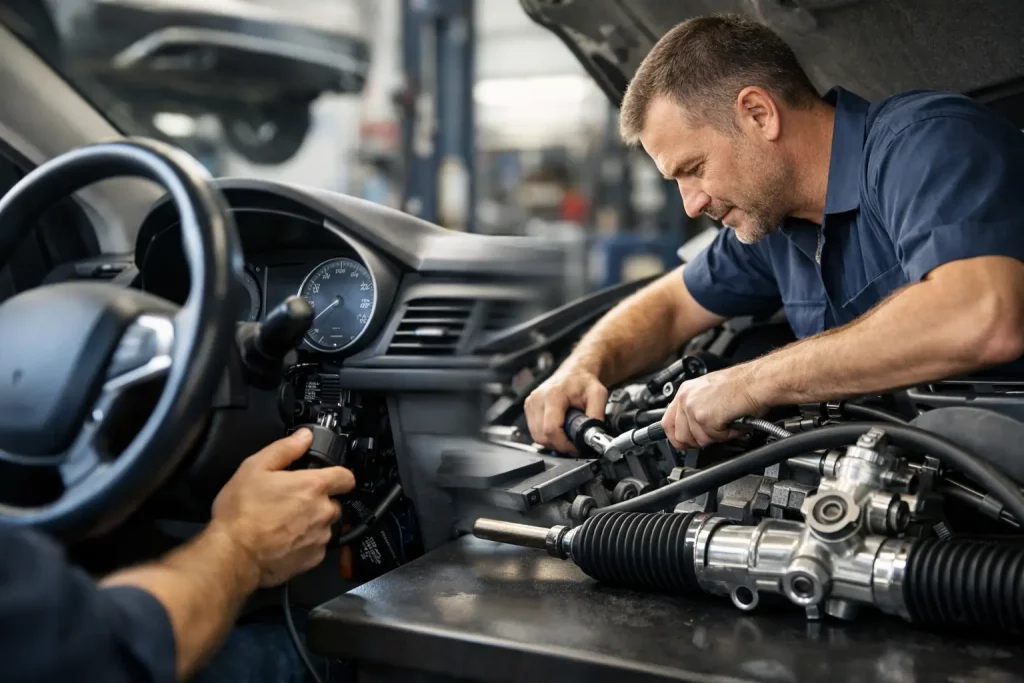
A steering fault is rarely just an inconvenience. A heavy steering wheel, a pull under braking, a vague centre position or an EPS warning can affect confidence in the vehicle and, in some cases, its safe operation. Steering specialists look beyond the obvious symptom to establish whether the cause sits in the rack, column, pump, steering box, electronic controls, suspension geometry or the vehicle’s calibration.
That distinction matters. Modern steering systems are closely integrated with vehicle electronics, while older and specialist vehicles may have components that are difficult to source or no longer available new. Accurate diagnosis can prevent a serviceable unit being replaced unnecessarily, while also identifying the occasions where replacement is the only sensible route.
What steering specialists assess
A focused steering inspection starts with how the vehicle behaves, but it should not stop there. The technician needs to consider the steering system as a whole: the driver’s reported symptoms, fault codes where applicable, physical wear, fluid condition on hydraulic systems, steering effort, wheel position and the vehicle’s response on the road.
For electric power steering, diagnostic information can be particularly valuable. A warning light may be linked to an internal rack fault, but it can also result from a power supply issue, damaged wiring, a torque sensor concern, communication fault or an unsuccessful previous repair. Reading codes is a starting point, not a diagnosis by itself.
On hydraulic systems, leaks, inconsistent assistance and noise can point towards several possible causes. On manual steering racks and boxes, free play, stiffness and poor self-centring are more likely to be the key concerns. The right repair depends on confirming the actual failed component rather than fitting parts around an assumption.
Symptoms that deserve proper investigation
Not every steering concern means the rack has failed. Tyre condition, tyre pressures, worn suspension joints and incorrect wheel alignment can all make a vehicle feel unstable or imprecise. Equally, a vehicle can have correct alignment figures yet still suffer from an internal steering fault.
A specialist assessment is particularly worthwhile when there is excessive play at the wheel, uneven assistance from lock to lock, a notchy feeling through the steering wheel, fluid leakage from a rack, repeated EPS warnings or a wheel that does not return naturally after a turn. These symptoms may develop gradually, which can make them easy to normalise until the steering becomes noticeably difficult to control.
For garages, the benefit is being able to separate steering-component faults from related chassis or electrical issues before committing the customer to a major repair. For owners, it means receiving an explanation of what has been found and why the recommended work is appropriate.
Repair, reconditioning or replacement?
There is no universal answer. A new complete assembly may be the right choice where a unit is unavailable for repair, damaged beyond economic reconditioning or subject to a manufacturer-specific requirement. In other cases, a component-level rebuild can offer a dependable and cost-effective alternative, particularly where a suitable original unit is available.
Reconditioning is not simply cleaning an old part and sending it back out. A suitable steering rack, box or related component is stripped, assessed and rebuilt with appropriate OE or OE-quality parts where required. Worn internal parts, seals, bearings and other service items are addressed according to the unit’s condition. The completed unit should then be tested before it leaves the workshop.
The condition of the core unit matters. Heavy corrosion, accident damage, cracked casings, severe internal damage or previous unsuitable modifications can limit what can safely be rebuilt. An experienced steering repair business should be clear about these limitations rather than assuming every unit can be saved.
Why original units can be worth retaining
For many vehicles, the original Right Hand Drive rack or steering box is an important starting point. This is especially true for premium, performance, classic and specialist vehicles where the correct unit may differ from the more commonly available Left Hand Drive version. Mountings, shaft arrangements, pipe routing, gearing, sensors and electronic specification can all vary.
Retaining and reconditioning a suitable original component can preserve the correct fitment and vehicle-specific characteristics. It may also reduce delays caused by incorrect catalogue matching. That does not mean every original unit is repairable, but it explains why careful identification and inspection are central to the process.
The additional demands of electric steering
Electric power steering has made vehicles more efficient and allowed manufacturers to integrate assistance with driver-assistance systems. It has also made steering repairs more technically involved. Many EPS racks contain motors, control modules and sensors that must communicate correctly with the rest of the vehicle.
After repair or replacement, some vehicles need coding, programming, calibration or a steering-angle sensor reset. Where applicable, an EPS rack may be flashed or virginised in preparation for vehicle-specific coding. However, the exact procedure depends on the vehicle, its control modules and the equipment available to the fitting workshop.
A correctly rebuilt rack can still require further vehicle-side work before it operates as intended. This may include fault clearing, coding, calibration and wheel alignment. In some cases, main-dealer access or manufacturer-level software may be needed. Being upfront about these requirements helps avoid the frustration of fitting a component and expecting the job to be finished immediately.
Fitting and alignment are part of a successful outcome
The quality of the repair is only one part of steering performance. Installation must be carried out with the rack centred correctly, steering wheel position checked and all relevant fixings tightened to the vehicle manufacturer’s specification. Incorrect installation can create a crooked steering wheel, restricted travel, damaged components or new fault codes.
Wheel alignment should be checked after steering rack removal and refitting, and whenever steering geometry may have been disturbed. Alignment does more than keep the steering wheel straight. It affects tyre wear, straight-line stability and the vehicle’s response to driver inputs. Where advanced driver-assistance systems are fitted, further calibration may also be necessary after alignment or suspension work.
For trade customers, direct technical support can be valuable at this stage. A fitting garage may need help confirming the correct rack variant, understanding coding requirements or checking whether an exchanged unit needs the customer’s original module retained. Clear communication before installation saves time once the vehicle is on the ramp.
Choosing a specialist for unusual and older vehicles
The need for specialist knowledge becomes more apparent when a vehicle falls outside a straightforward modern-car repair. Classic steering boxes may require refurbishment rather than replacement. Sports and performance cars can have vehicle-specific rack ratios and intricate installation requirements. Commercial vehicles and fleet cars place different demands on durability, downtime and parts availability.
Owners of classic and specialist cars may also be considering a steering conversion or modification intended to reduce steering effort. This needs a measured approach. Lighter steering can make a vehicle more usable, but the system must retain predictable response, adequate clearance and safe component integration. The best option depends on the vehicle’s design, intended use and the condition of its existing steering system.
Pro Power Steering works as a dedicated steering engineering and remanufacturing partner across electric, hydraulic and manual systems. Suitable components can be assessed for repair or reconditioning, with workshop testing and a 12-month warranty on completed work under the applicable terms. For customers outside the immediate area, UK-wide collection and delivery can also make specialist assessment practical for suitable components.
Ask the questions that lead to the right repair
Before authorising work, it is reasonable to ask what has actually failed, whether the original unit is suitable for reconditioning and what further work will be needed after fitting. You should also establish whether the quoted solution includes coding, calibration, alignment or only the supply of the steering component.
These questions are not about complicating the repair. They help define the complete job and make the cost, timescale and responsibility for each stage clear. A steering repair should leave the vehicle feeling smooth, precise and predictable, not merely remove a warning light or stop a leak.
If the steering no longer feels as it should, treat that change as useful diagnostic information. The sooner the symptom is assessed by people who work with steering systems every day, the better the chance of choosing a repair path that suits both the vehicle and the way it is used.
