
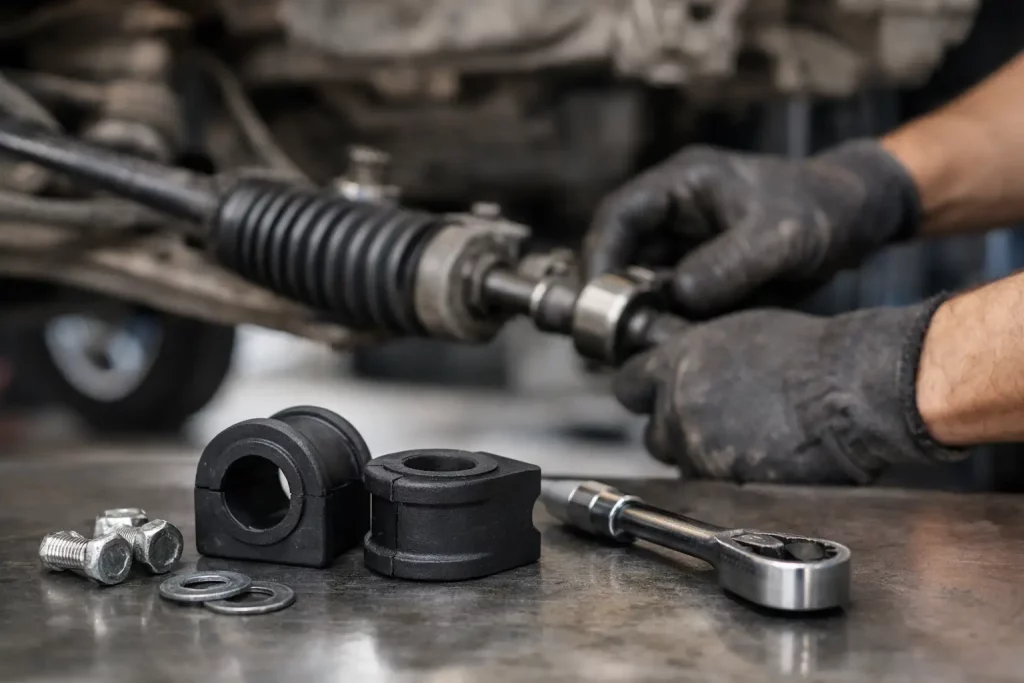
A steering knock over broken tarmac, a vague feeling around the straight-ahead position or a steering rack that appears to move as the wheel is turned can all lead to the same question: are steering bushes replaceable? Often, yes. But the useful answer depends on which bush is worn, how the steering assembly is constructed and whether the apparent bush fault is actually coming from another component.
On many vehicles, the term ‘steering bushes’ means the rubber or polyurethane mounting bushes that secure the steering rack to the subframe or crossmember. These are commonly replaceable separately. However, internal rack guide bushes, column bushes and bushes incorporated into a larger mounting arrangement require a different assessment. Accurate diagnosis matters because steering is a safety-critical system, and fitting a bush will not cure wear inside the rack, a loose ball joint or a damaged subframe mounting.
Are steering bushes replaceable on every vehicle?
No. Separate rack mounting bushes are fitted to many cars, vans and 4x4s, particularly where the rack is held by clamps or brackets. Once worn, split, compressed or oil-contaminated, they can usually be renewed without replacing the complete steering rack. The rack may need to be lowered or removed from its mountings to do the job correctly, but the replacement itself is a component-level repair.
Some vehicles use an integrated mounting arrangement, a rack carrier or bushes that are not supplied separately by the vehicle manufacturer. In these cases, availability of quality replacement parts and the condition of the surrounding mountings determine the sensible repair route. Classic, performance and specialist vehicles can be particularly varied, with previous repairs or modifications adding another layer to the inspection.
There is also an important distinction between external mounting bushes and bushes inside a steering rack. An internal guide bush supports the rack bar and helps maintain controlled movement within the housing. If it is worn, the repair may involve specialist rack reconditioning rather than an external bush replacement. The rack must be stripped, measured, rebuilt with suitable parts and tested. It is not the same job as renewing a rack mounting bush.
What worn steering rack bushes feel like
A worn rack bush does not always create an obvious fault at the steering wheel. Its symptoms can overlap with worn suspension or steering-linkage components, which is why a visual and physical inspection is needed before parts are ordered.
Common signs include a dull knock or thud over uneven road surfaces, a delayed response as the steering direction is changed, or a feeling that the car is less settled when cornering. In some cases, an observer can see the rack housing shift relative to the subframe while the steering is gently moved. Excessive movement is not normal, but it must be judged against the design of that particular vehicle.
Drivers may also describe wandering, tramlining or a steering wheel that needs frequent small corrections. These symptoms can be caused by rack bushes, but they can equally be linked to tyre condition, wheel alignment, lower-arm bushes, top mounts, track rod ends or play within the rack itself. Heavy steering is less characteristic of a mounting-bush issue and may point towards a hydraulic, electric power steering or mechanical concern instead.
A noise that appears only while turning at a standstill should not automatically be blamed on the rack bushes either. The source could be in the steering column, top bearing, suspension joint or internal rack mechanism. Replacing parts by assumption can leave the original fault untouched.
Why diagnosis must separate mounting wear from rack wear
The steering rack is designed to remain firmly located while its internal rack bar moves precisely from side to side. If the outer mountings are soft or damaged, the whole rack can move before the road wheels respond. If the internal guide components are worn, there may be play or a knock within the rack even when its external mountings are sound.
These faults can feel similar from the driver’s seat, yet they need different repairs. A competent steering inspection checks the rack mountings, clamps, subframe condition, inner joints, outer track rod ends and steering-column connections. The wheels are assessed for free play in the correct positions, rather than relying solely on a general road test.
For vehicles with electric power steering, diagnostic checks may be relevant as well. An EPS warning light, inconsistent assistance or stored fault codes are separate concerns from a perished mounting bush, although a vehicle can have both mechanical wear and an electronic fault at the same time. Treating the steering system as one connected assembly avoids incomplete repairs.
When replacement bushes are the right repair
Renewing the mounting bushes is normally appropriate when the rack housing is sound, the mounting points are undamaged and inspection confirms that the excess movement comes from the bushes. It can restore a more direct, controlled steering response and stop the rack moving against its brackets.
The material choice deserves consideration. Standard rubber bushes generally preserve the isolation and refinement intended for a road car. Polyurethane alternatives can offer firmer location and may suit certain performance, commercial or enthusiast applications, but they can transmit more vibration and road feel into the cabin. Harder is not automatically better, especially on a daily-driven vehicle.
The fitting process also matters. A bush installed in the wrong orientation, a distorted clamp or incorrect tightening procedure can affect durability and rack location. Where the rack has been moved, the vehicle should be checked for wheel alignment afterwards. If track rod ends have been disturbed or the steering wheel is no longer centred, alignment is essential rather than optional.
When a bush replacement is not enough
A complete rack replacement is not the automatic answer to every steering concern, but there are situations where bushes alone will not provide a reliable repair. Internal play, corrosion of the rack bar, damage to the housing, fluid contamination, failed electronic components or severe wear at the inner joints may require specialist reconditioning or replacement of the complete unit.
A damaged subframe, elongated mounting hole or broken rack bracket also changes the repair scope. Fitting new bushes into a compromised mounting location can allow movement to return quickly and may create a safety risk. The supporting structure must be repaired correctly before the steering rack is secured.
On some modern electric racks, replacement or reconditioning may be followed by coding, calibration or steering-angle sensor procedures. This varies by make and model. A mechanically sound unit can still produce warning lights or incorrect assistance if the vehicle-specific electronic set-up has not been completed. In certain cases, dealer-level functions or manufacturer procedures may be required.
For suitable units, Pro Power Steering assesses steering faults at component level and can advise whether a mounting repair, rack reconditioning or replacement unit is the appropriate route. Reconditioned steering units are rebuilt with applicable OE or OE-quality components, workshop tested and supported by a 12-month warranty under the relevant terms. Not every rack is economically or technically suitable for repair, but a proper assessment gives owners and workshops a clear basis for deciding.
Questions to ask before authorising work
Before agreeing to a steering-bush replacement, ask which bushes have been identified, how movement was confirmed and whether the rack itself has been checked for internal play. It is also sensible to establish whether the bushes are available separately for the exact vehicle, including its Right Hand Drive configuration where relevant.
Ask whether alignment will be checked after the repair and whether any coding or calibration is required. For trade customers fitting a supplied rack, clarify the return condition of the old unit, the steering wheel centring procedure and any technical information needed before the vehicle leaves the ramp. These details prevent a straightforward mechanical repair from becoming an avoidable follow-up visit.
Steering bushes are small components, but their job is to keep a major safety system accurately located. If the steering no longer feels calm, precise and predictable, the best next step is not to guess at the part – it is to establish exactly where the movement begins.
