
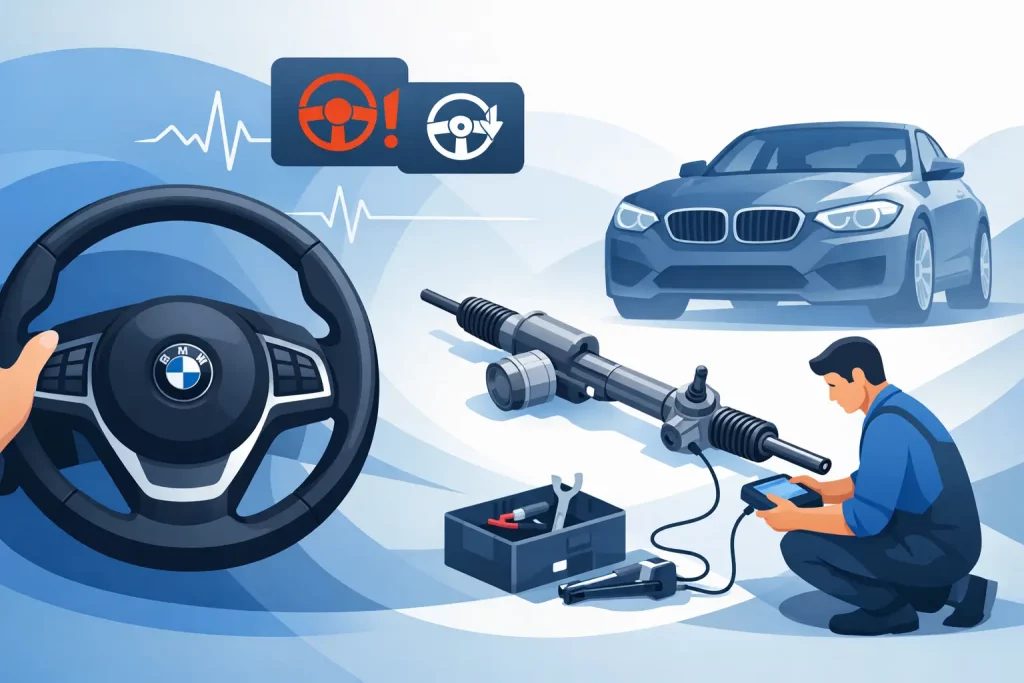
A BMW that suddenly feels heavy at the wheel, gives uneven assistance or displays a steering warning should not be treated as a minor inconvenience. The electric power steering system is central to low-speed manoeuvring, straight-line stability and accurate response through bends. Proper BMW EPS repair starts with identifying the fault at component level, rather than assuming the complete steering assembly must be replaced.
On many BMW models, dealer-led repair can mean fitting an expensive new steering rack or column assembly. That is sometimes the correct route, particularly where there is major physical damage, but it is not the only option. Specialist diagnostics and reconditioning can often establish whether the underlying issue is electronic, mechanical or related to the vehicle’s electrical system.
How BMW electric power steering works
BMW electric power steering, commonly known as EPS or electric power-assisted steering, uses an electric motor and control electronics to provide steering assistance when required. The amount of assistance changes according to vehicle speed, steering input and information received from other vehicle systems. Light assistance is expected during parking; at higher speeds, the system reduces assistance to retain a more settled, connected steering feel.
Depending on the BMW model and generation, the motor and electronics may be integrated into the steering column or steering rack. Many modern BMWs use rack-mounted EPS, where the motor, torque sensor, reduction gear and electronic control unit work closely together. This provides precise control, but it also means a fault in one area can affect the operation of the complete system.
For right-hand-drive BMWs, correct unit identification matters. A rack from a left-hand-drive vehicle is not a like-for-like substitute, even where the model designation appears similar. Mounting positions, internal configuration, wiring orientation and calibration requirements can differ. This is one reason vehicle-specific assessment is essential before ordering a replacement or proceeding with repair.
Signs that BMW EPS repair may be needed
A red or amber steering warning light is the clearest indication that the system has recorded a fault. However, drivers often notice a change in steering behaviour before a warning appears. Heavy steering at parking speeds, intermittent loss of assistance, a steering wheel that feels notchy or self-centres poorly, and assistance that changes unexpectedly are all reasons to arrange a diagnostic inspection.
Some faults occur only after the car has been driven for a period of time. Heat can expose weaknesses in electronic circuits, motor components or internal connections. Others appear after a flat battery, jump start, battery replacement, wheel alignment work or an impact with a kerb or pothole. The timing is useful diagnostic information, but it is not proof of the cause.
Mechanical symptoms also need separating from EPS faults. Knocking, free play, stiffness in one part of the steering travel or an off-centre steering wheel may point to wear, impact damage or incorrect geometry. An EPS warning light does not automatically mean the rack electronics have failed, just as a heavy steering complaint does not automatically mean the motor is at fault.
Common causes of EPS faults in BMW vehicles
Low system voltage is a frequent contributor to steering faults on modern BMWs. The EPS system requires a stable electrical supply, so a weak battery, charging issue, poor earth connection or voltage drop under load can trigger warnings and reduced assistance. Clearing a stored code without checking the power supply can lead to the fault returning quickly.
Within the steering assembly, potential causes include motor wear, torque sensor errors, damaged internal wiring, water ingress, connector issues and faults within the EPS control module. Internal mechanical wear can also affect steering feel even where the electronics remain operational. The correct repair depends on which part has failed and whether the unit is suitable for reconditioning.
Accident damage deserves particular attention. A forceful wheel strike can damage the rack housing, mountings or internal components, while also disturbing suspension geometry. In these cases, a repairer should assess the steering system as a whole rather than focusing solely on the warning message displayed on the dashboard.
BMW EPS diagnostics should come before replacement
A meaningful diagnosis goes beyond reading a generic fault code. BMW-specific diagnostic equipment can identify stored and current faults in the EPS control unit, monitor relevant live data and establish whether communication, voltage supply or sensor readings are plausible. This information must then be compared with the physical condition and operation of the steering system.
The process should include checking battery condition and charging voltage, examining electrical connectors and wiring, inspecting for external impact or water damage, and assessing steering movement with the vehicle safely raised where appropriate. A road test may also help confirm whether the concern is constant, temperature-related or linked to a particular driving condition.
Calibration is another consideration. After certain repairs, replacement units or alignment work, the vehicle may require steering angle sensor calibration, end-stop learning or coding procedures. Skipping these steps can leave warning lights present or produce steering behaviour that does not feel correct, even if the replacement component is sound.
A specialist will also distinguish between faults that are repairable within the rack or column and faults caused elsewhere on the vehicle. This avoids the expensive mistake of fitting a replacement EPS assembly only for the original warning to remain.
BMW EPS repair, reconditioning or replacement?
The right solution depends on the fault, the condition of the unit and the availability of vehicle-specific parts. A component-level BMW EPS repair can be a practical option where the rack or column is structurally sound but has an identifiable electrical or internal fault. Reconditioning typically involves stripping the assembly, inspecting critical components, replacing worn or failed parts where suitable, rebuilding it to specification and testing operation before return.
Reconditioning is not simply a cosmetic clean-up. The purpose is to restore dependable steering performance while retaining the correct specification for the vehicle. It can offer a cost-effective alternative to a new dealer unit, particularly for owners of older premium BMWs and independent garages managing customer repair costs.
There are limits. A badly cracked housing, severe corrosion, extensive collision damage or a unit with unavailable core components may make replacement the safer and more economical decision. Equally, a used unit can appear attractive on price but may carry the same age-related weaknesses, uncertain history and coding complications as the original part. It should only be considered when its exact compatibility and condition can be established.
For many vehicles, the decision comes down to evidence rather than a fixed rule. A thorough diagnosis provides that evidence and gives the owner a clearer choice between repair, reconditioned exchange or replacement.
Why fitting and set-up matter
An EPS rack is not a simple bolt-on item. It must be fitted without damaging connectors or wiring, secured correctly, aligned accurately and programmed or calibrated where the vehicle requires it. The steering wheel must be centred and the geometry checked, because incorrect alignment can affect tyre wear, steering response and the driver-assistance systems that rely on steering-angle information.
For trade customers, supplying the correct RHD unit first time is equally important. BMW part numbers, production dates, steering configurations and electronic variants need checking carefully. A visually similar rack may not communicate correctly with the vehicle or may not have the required mounting and connection arrangement.
At Pro Power Steering, the focus is on steering diagnostics, vehicle-specific reconditioning and practical repair options supported by a 12-month guarantee on completed work. That specialist approach is particularly valuable where a BMW has been diagnosed broadly as needing a complete unit but the precise cause has not yet been confirmed.
Protecting the repair after the fault is resolved
Once the steering has been repaired, do not ignore a returning warning light, new noise or change in assistance. Early investigation can prevent a small electrical or alignment issue from becoming a repeat failure. Keeping the battery and charging system in good condition, addressing kerb-impact damage promptly and avoiding unnecessary force against full steering lock all help reduce strain on the system.
Most importantly, judge the repair by how the BMW drives as well as what the diagnostic tool reports. The wheel should turn smoothly, assistance should be consistent and the car should track accurately. When those fundamentals are restored through proper diagnosis and correctly specified repair work, the result is the safe, precise steering feel BMW drivers expect.
