
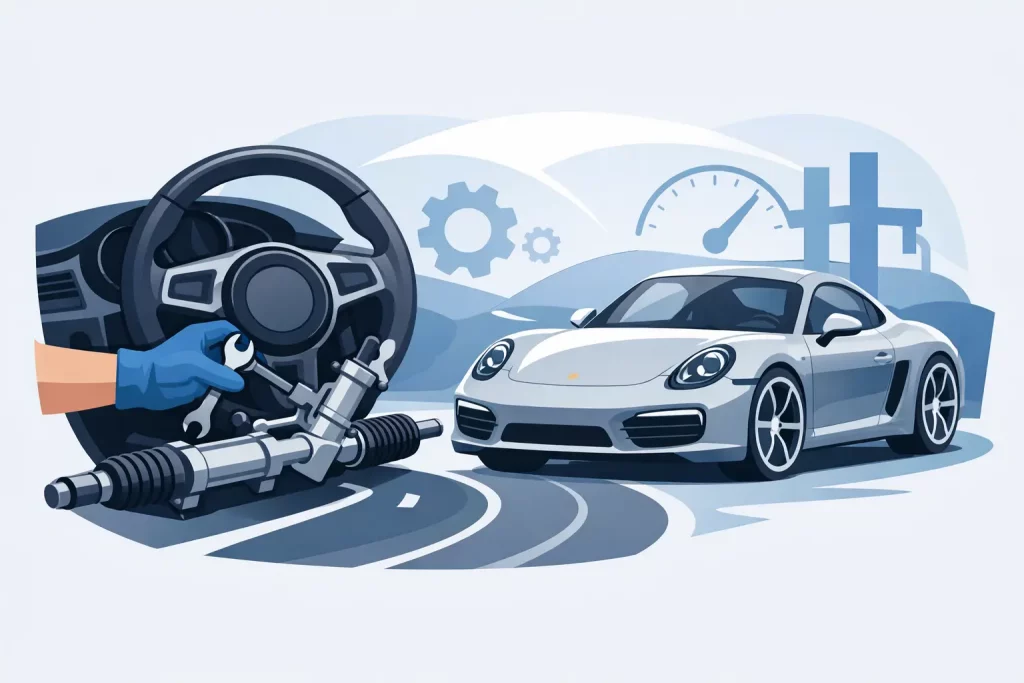
A Porsche that needs constant small corrections is not delivering the precise, confidence-inspiring handling it was designed to provide. Porsche steering repair is not simply a matter of fitting a replacement part when the steering feels heavy, vague or noisy. The correct repair begins by identifying whether the fault lies in the rack, electric assistance, steering column, shaft joints, mountings or the vehicle’s alignment.
For owners, garages and restoration specialists, that distinction matters. Replacing major components without confirming the cause can be expensive and may leave the original problem unresolved. A specialist diagnosis protects the vehicle’s driving character as well as its safety.
Why Porsche steering faults need a proper diagnosis
Porsche has used different steering designs across its range, from older hydraulic systems to modern electric power steering (EPS) arrangements. The layout, control strategy and common failure points vary by model and generation. A fault on an early 911, for example, requires a different assessment from an EPS warning on a Cayenne, Macan, Panamera or later 718 and 911.
The steering rack is only one part of the system. Excessive free play can originate within the rack, but it can also be caused by worn inner joints, track rod ends, a loose coupling, deterioration in the steering column shaft or suspension wear. Similarly, a steering warning light may indicate an EPS motor, torque sensor, wiring, control module or low-voltage issue rather than a failed rack assembly.
A workshop should establish the fault before recommending repair, reconditioning or replacement. This normally includes a road test where appropriate, physical inspection with the vehicle safely raised, checks for movement through the steering linkage and a review of diagnostic fault codes on EPS-equipped vehicles. The aim is to find the failed component, not to guess at the most costly one.
Symptoms that point to Porsche steering repair
Steering concerns often develop gradually, especially on vehicles used regularly on poor road surfaces. Others appear suddenly after impact damage, water ingress or an electrical fault. The following symptoms justify a professional inspection:
- Heavy steering, either consistently or only during low-speed manoeuvres
- A steering wheel that does not return smoothly towards centre after a turn
- Knocking, clicking or a clunk felt through the wheel over uneven surfaces
- Noticeable play around the straight-ahead position or a need for repeated correction
- An EPS or steering-system warning message on the instrument display
- Uneven tyre wear, a crooked steering wheel or the vehicle pulling under normal driving
These signs can overlap. A vehicle with poor self-centring may have an internal rack issue, incorrect wheel alignment, binding joints or damage following a kerb strike. An EPS warning may come with normal steering assistance at first, then become intermittent or disappear entirely. Treating the symptom alone can lead to unnecessary parts costs.
Porsche steering repair starts with system checks
A thorough inspection begins with the basics. Tyre condition, tyre pressures and wheel alignment affect steering feel far more than many drivers expect. A performance Porsche can feel unsettled or resistant to turn-in when alignment angles are outside specification, even if the rack itself is mechanically sound.
Mechanical inspection of the rack and linkage
With the front wheels unloaded, a technician can assess rack mountings, track rods, joints, gaiters and the steering shaft connection. Any play must be traced accurately. A worn outer joint and internal rack wear can both produce movement at the wheel, but their repair routes are very different.
The condition of the rack housing and gaiters is also significant. Damaged gaiters allow dirt and moisture towards precision internal components. On hydraulic steering systems, signs of fluid contamination or leakage around the rack require investigation before the unit is condemned. The quality of the fluid and evidence of corrosion can help determine whether reconditioning is viable.
EPS diagnostics for modern Porsche models
Electric power steering systems need both mechanical and electronic testing. Reading fault codes is an essential starting point, but it is not a complete diagnosis. Live data can help assess steering angle, torque-sensor readings, supply voltage and communication between relevant control modules.
Intermittent faults deserve particular care. A warning that appears only after a cold start, during parking or on a long journey may be related to voltage stability, wiring condition, connector corrosion or an internal EPS component. Clearing a code without finding its cause is not a repair.
Where calibration is required after steering work, it must be completed correctly. Steering-angle settings and vehicle alignment are linked to safety systems on many modern Porsche models. A car may drive acceptably after a mechanical repair but still display warning messages or have compromised assistance if set-up procedures are missed.
When reconditioning is the right answer
A new Porsche steering assembly can be costly, particularly when supplied through a main dealer. In many cases, a professionally reconditioned original unit offers a more proportionate solution, provided the rack or steering box is suitable for repair.
Reconditioning is not a cosmetic clean-up. A proper process involves stripping the unit, inspecting the shaft, pinion, rack bar, bearings, seals, bushes and internal surfaces, then replacing worn or damaged serviceable components. The unit is rebuilt to the required specification and tested before it is returned for fitting. The exact work depends on the steering design and the condition of the original component.
The trade-off is straightforward: reconditioning can offer substantial value and preserve the correct vehicle-specific unit, but not every assembly is economically or technically repairable. Severe impact damage, extensive corrosion, damaged housings or certain electronic failures may make replacement the better route. An honest assessment should explain why.
For classic and older Porsche applications, reconditioning can be especially valuable where new original equipment is unavailable, prohibitively expensive or no longer the preferred option. Retaining the correct steering component can also matter to owners preserving originality.
Common Porsche steering repair routes
The repair needed depends on the confirmed fault. Internal rack wear, leakage or rough operation may call for rack reconditioning. A failed EPS motor, sensor or electronic fault requires model-specific diagnostics and, where possible, component-level repair rather than automatic replacement of the complete assembly.
Wear in a steering column, intermediate shaft or universal joint can create stiffness, free play or a notchy sensation that is easily mistaken for a rack problem. These components should be inspected before approving a rack replacement. The same applies to suspension joints and wheel bearings, which can affect steering precision and tyre wear.
Once the mechanical repair is complete, wheel alignment is a critical final stage. It is not an optional extra after replacing steering components. Correct geometry helps the vehicle track straight, turn predictably and return towards centre as intended. It also protects expensive tyres from premature wear.
What to expect from a steering specialist
A credible Porsche steering repair service should be able to explain the diagnosis in clear terms: what has failed, how it was confirmed, what repair options exist and what related work is necessary. For trade customers, this means reliable identification of the correct RHD unit and a clear process for supplying or returning the original component. For private owners, it means no vague recommendation to replace parts until the fault is understood.
At Pro Power Steering, work is focused on steering diagnostics, repair and reconditioning across electric, hydraulic and manual systems. This specialist approach is particularly useful where a vehicle needs more than a standard parts-change solution. Completed work is supported by a 12-month warranty, providing reassurance that the repair has been carried out with long-term steering performance in mind.
Ask whether the quoted work includes testing, replacement seals or internal components where required, and whether calibration and alignment will be needed after installation. If a reconditioned rack is supplied, confirm the unit matches the vehicle’s exact specification. Porsche model badges alone are not enough: year, steering configuration, drivetrain and electronic compatibility can all matter.
Protecting steering performance after repair
Avoid holding the steering on full lock for prolonged periods, and investigate kerb impacts promptly. A minor strike can alter alignment or damage a joint without producing an immediate warning light. During routine servicing, ask for gaiters, steering joints and tyre wear to be checked rather than waiting for a noticeable handling problem.
Most importantly, do not accept vague steering as normal for a performance vehicle. Prompt, accurate diagnosis gives you the best chance of restoring the smooth, direct response that makes a Porsche rewarding to drive.
